




















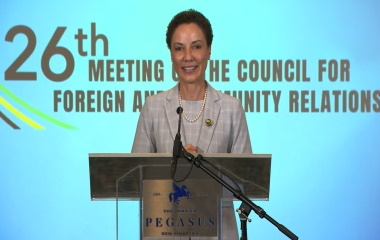
KINGSTON, Jamaica, CMC – Jamaica’s Foreign Affairs and Foreign Trade Minister, Kamina Johnson Smith, Tuesday urged Caribbean Community (CARICOM) countries to work as a unit to continue to promote the value of multilateralism and expand and elevate the influence and contributions of the regional integration grouping and Small States generally.
“We must continue to strengthen our relationships, both with our traditional partners and those with whom we can advance, South-South cooperation,” Johnson Smith told the two-day 26th Council on Foreign and Community Relations (COFCOR).
“We must also create an environment that enables collaboration, cooperation, and strategic partnerships with all sectors across civil society and national, regional, and international partners.”
She told the opening ceremony that the mission of the COFCOR is clear, and she hopes the deliberations will allow for the region to “strategically” position itself to face the challenges and grasp the opportunities that lie ahead.
The meeting here marks the first in-person regular meeting of COFCOR since 2019, and Johnson Smith said that it takes on added significance as the region celebrates the 50th anniversary of CARICOM, to be formally observed on July 4 this year.
“Our Caribbean Community enjoys the distinction of being the longest surviving regional integration movement in the developing world. Our CARICOM half-century demonstrates our resilience and is a milestone we can be proud of.”
She told her colleague foreign ministers that over the next two days, they must “deliberate and strategize on the issues…with the ultimate goal of achieving the best possible opportunities and outcomes for our Community, in our engagements with hemispheric and global partners.
“We are meeting when our Community is at a pivotal inflection point. Our decisions will lay the foundation for the region’s future, and we must determine our ability to thrive despite myriad and constantly evolving global dynamics.
“While we welcome the recent WHO (World Health Organization) announcement that COVID-19 no longer represents a global health emergency, the war in Ukraine has now passed the one-year mark, and we continue to feel the effects of geo-political tension, including food and energy insecurity. “
Johnson Smith said the destructive impacts of climate change and other issues, such as transnational crime, continue to threaten communities and daily lives.
“Together with the developmental losses incurred by the pandemic, these interlocking crises underscore the vulnerability of developing countries, especially Small Island Developing States (SIDS).
“It, therefore, falls to the COFCOR to work with our development partners, like-minded states, Third States, and regional groupings, including the African Union (AU), the European Union (EU), and the membership of ASEAN, to achieve equitable, meaningful solutions from which the benefits can redound to our people throughout the region.
“Our strength in working with extra-regional partners lies in our cohesion. The region must work collectively and effectively in a highly coordinated manner to strengthen Community relations and institutions and pursue regional foreign policy objectives.
“We are reminded of the driving force behind our Community and this Council, which is that “the interests of the entire region can best be served by the maximization of cooperation by all Governments concerned.”
The Jamaican foreign minister said COFCOR is meeting at a time when “the imperative of 50 years ago has not changed.
“The COFCOR’s role in defining the region’s place in the world through the strategic engagement of bilateral partners and hemispheric and multilateral institutions is crucial to elevating the Caribbean voice and world view on the international stage.
“And with that voice, we will continue to offer the world Caribbean-grown solutions while championing the interests of the sixteen million citizens who make up our Community across the 15 member states and five Associate Member states.”
Like other regional groupings, Johnson Smith said that CARICOM must continually provide opportunities for thorough and productive introspection.
“We, therefore, look forward to this meeting, particularly to our retreat, for the opportunities to be open about our collective growth opportunities and to actively delineate specific, measurable, and achievable methods to strengthen its systems and processes.
“We do this even as we seek renewed commitment from member states towards concerted Community action and to consider how best to have robust, efficient Community institutions adequately resourced to execute their mandates. “
She said this would require agile, adaptive, and strategic policy decisions and mechanisms to predict, respond, and leverage changes in the international landscape.
“Our decisions will also need to benefit from active Community engagement, as with full participation and active engagement in the COFCOR decision-making, we can better equip ourselves to realize the vision enunciated in Article 16 of the Revised Treaty of Chaguaramas.”
He Guyana-based CARICOM Secretariat said that the 26th meeting of the COFCOR will tackle a packed agenda including relations with India, Europe, Canada, Mexico, and Cuba, and bilateral relations engagements with CARICOM and the USA, Africa, Dominica Republic, and the Central America Integration System (SICA).
It said the ministers would also discuss the situation in Haiti and matters about the United Nations (UN), including UN Security Council Reform and CARICOM’s engagement in the Permanent Forum of People of African Descent.
“There are several upcoming high-level meetings on the international agenda in which CARICOM will be involved, such as the High-Level Dialogue on Financing for Development and the SDGs Summit.”
Johnson Smith said that the region’s relations with the United Kingdom would also merit attention as the foreign ministers prepare to convene the 11th UK-Caribbean Forum on Thursday.
She said Thursday’s meeting provides a significant opportunity to collectively engage James Cleverly, the UK Foreign Secretary, with the Dominican Republic and Cuba.








 and then