





































BRIDGETOWN, Barbados, CMC – The Barbados-based Caribbean Climate Outlook Forum (CariCOF) on Monday said that Caribbean weather conditions will most likely be affected over the next three months, as ENSO conditions in the Pacific are forecast to transition to neutral or El Niño by June.
ENSO-El Niño-Southern Oscillation- conditions refer to the natural, recurring, three to seven-year cycle of sea surface temperature fluctuations in the central and eastern tropical Pacific and the corresponding atmospheric pressure changes.
CariCOF said this, combined with unusually warm waters around and north of the Caribbean, but seasonably warm waters in the southern reaches imply a Caribbean heat season with heatwaves occurring as early as April and gradually ramping up.
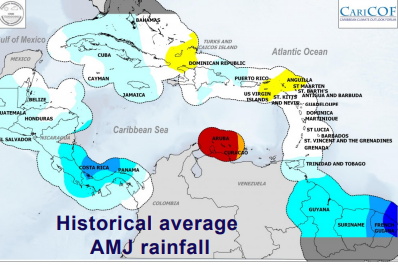
It said this will also result in high evaporation rates, frequent short dry spells and buildup of any ongoing drought, thus increasing wildfire potential through May or longer and that except for Aruba, Bonaire and Curacao (ABC Islands), rainfall intensity should rise towards June, resulting in high to extremely high potential for flooding, flash floods, cascading hazards and associated impacts.
“Episodes of Saharan dust intrusion will likely be frequent; if combined with El Niño, this means more buildup of dryness and heat, as well as more erratic occurrence of severe weather,” CariCOF said in its latest bulletin for the period April 20 June this year.
It said that a moderate short-term drought has developed in Antigua, the northwest and northern Bahamas, French Guiana, St. Kitts, St. Lucia, St. Vincent, and Suriname. In contrast, long-term drought is imminent in Grenada, St. Kitts, and St. Lucia, and is evolving in the ABC islands, southwest Belize, Dominica, and Martinique, and might develop or continue in southeast Belize, St. Martin, and St. Vincent.
According to CariCOF, during the period July to September this year, which marks the buildup into the annual peak of the Caribbean Wet Season and Heat Season, as well as the Atlantic Hurricane Season, ocean temperatures are forecast to remain unseasonably warm around the Caribbean, especially in the far north, where record levels as experienced in 2023 and 2024 are possible.
Meanwhile, increasingly confident forecasts suggest a likely transition into possibly strong El Niño conditions in the Pacific.
“Unusually high air temperatures will most likely prevail with recurrent, significant heat stress. The risk of severe weather impacts, including flooding, flash flooding, and cascading impacts, is expected to be high. Hurricane season activity should peak in September.
“However, should a strong El Niño manifest and, especially if compounded by very frequent intrusions of dusty Saharan air, more intense drought and heat, but reduced severe weather and tropical cyclone activity may ensue,” CariCOF said in its brief climate outlook.










 and then
  on Monday said that Caribbean weather conditions will most likely)