








































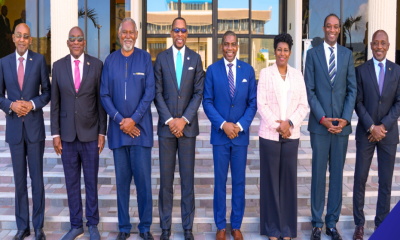
BASSETERRE, St. Kitts, CMC -The Monetary Council of the Eastern Caribbean Central Bank (ECCB) says some of its member countries were not on track to secure the debt-gross domestic product (GDP) ratio of 60 per cent by 2035, even as it emphasised the need for policy agility and strategic partnerships to mitigate external vulnerabilities.
The Council held a one-day meeting here on Friday against a backdrop of evolving global dynamics, shifting geopolitical conditions, and persistent structural challenges within the Eastern Caribbean Currency Union (ECCU).
It said that the deliberations focused on safeguarding monetary and financial stability while accelerating structural transformation under the region’s Big Push for Shared Prosperity and Resilience.
The ECCB regards “The Big Push Initiative” as a call for a decade of transformative actions to double the GDP of the ECCU’s economies and elevate the quality of life of its people.
The ECCU groups the islands of Antigua and Barbuda, Anguilla, Dominica, Grenada, St. Kitts and Nevis, St. Lucia, St. Vincent and the Grenadines, and Montserrat.
According to a statement issued following the meeting that was chaired by Antigua and Barbuda Prime Minister, Gaston Browne, the Council affirmed its commitment to advancing the Big Push, “a coordinated regional strategy to raise productivity; diversify economic activity; strengthen food and energy security; deepen financial markets; enhance competitiveness and build climate resilience”.
The Council stressed that the region’s challenges are structural rather than cyclical and that sustained acceleration will require “deliberate reform, targeted investment, and stronger regional coordination”.
In addition, the Council agreed on four strategic “Theatres of Transformation” as central to the Big Push agenda, namely food security, energy security, reducing import dependence, scaling renewable energy, and strengthening climate-smart agriculture to improve resilience and ease cost-of-living pressures.
There was also agreement to modernise ports, shipping, and inter-island transport to reduce transaction costs and improve regional integration, as well as to expand access to credit, capital markets, and digital payments to support entrepreneurship and private-sector growth.
But the Council noted that some member countries were not on track to secure the Debt-GDP ratio of 60 per cent by 2035.
The goal was originally set for 2030 but was extended to 2035 in February 2021 by the Council, comprising mainly ECCU finance ministers, to accommodate the severe economic impact of the COVID-19 pandemic, which saw regional debt-to-GDP spike to 87.8 per cent in 2020.
While falling, public debt in the ECCU remains high, with the debt-to-GDP ratio estimated at 76.1 per cent at the end of December 2024, down from 77.4 per cent the previous year.
In its statement, the Council “acknowledged ongoing efforts by member governments to strengthen fiscal and debt sustainability and the necessity for fiscal resilience frameworks in a climate of constant shocks”.
It said sustainable fiscal policy “remains essential to preserving macroeconomic stability and supporting long-term growth”.
The initiative is also part of a strategy to improve fiscal resilience and sustainability, supported by increased economic activity and, in some cases, Citizenship by Investment (CBI) revenues.
In the statement on Friday, the Council said it welcomed the enactment of the ECCIRA Agreement into national law by the participating ECCU member countries, paving the way for the operationalisation of the Eastern Caribbean Citizenship by Investment Regulatory Authority (ECCIRA) in 2026.
“Together with the launch of a Regional Biometrics Programme, these reforms are expected to strengthen governance and due diligence; enhance transparency and credibility; and support sustained investor confidence.”
The Council reaffirmed its commitment to high standards of integrity and regulatory oversight of the CBI through which foreign investors are granted citizenship of the participating countries in return for making a substantial investment in their socio-economic development.
The Council meeting also reviewed the Governor’s Report on monetary, credit, and financial conditions in the ECCU that was titled “ECCU 2026 and Beyond: Bold Policies for Bigger and More Resilient Economies.”
The Council reaffirmed that monetary and financial stability remain the bedrock of the ECCU’s development strategy and that the Eastern Caribbean (EC) dollar “remains strong and credible”.
The Council noted that the Backing Ratio stands at 99.5 per cent, “well above the statutory minimum of 60 per cent,” and that foreign reserves total EC$5.83 billion (One EC dollar = 0.37 cents).
The Council said that July this year will mark the 50th anniversary of the EC dollar being pegged at EC$2.70 to US$1.00 and that the statement said that “in light of stable domestic conditions and moderating global inflation, the Council agreed to maintain the minimum savings rate at two per cent and maintain the discount rate at three per cent (short-term) and 4.5 per cent (long-term).
The Monetary Council said that the stability of the currency union remains “non-negotiable and central to investor confidence and regional prosperity”.
It said that the ECCU banking sector remains stable and highly liquid, supported by strong capital buffers, a rising capital adequacy ratio, and a declining non-performing loans (NPL) ratio. Excess liquidity was estimated at EC$1.41 billion as at the end of January 2026.
The ECCU Credit Bureau continues to expand its reach, with five member countries, Antigua and Barbuda, Grenada, St. Kitts and Nevis, St. Lucia, and St. Vincent and the Grenadines, now live on the credit bureau system.
“While ECCU growth is projected to improve modestly to 3.3 per cent in 2026, the Council acknowledged that this remains significantly below the approximately seven per cent annual growth required to double regional output over the next decade.











 and then
  says some of its member countries were not on track to secure)