








































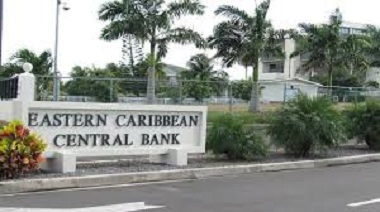
BASSETERRE, St. Kitts, CMC – The St. Kitts-based Eastern Caribbean Central Bank (ECCB) says it has partnered with the United Nations Capital Development Fund to prepare the draft ECCU Financial Inclusion and Literacy Strategy that is intended to address gaps in how citizens and businesses access and use financial services across the Eastern Caribbean Currency Union (ECCU).
The ECCU groups the islands of Anguilla, Antigua and Barbuda, Dominica, Grenada, Montserrat, St. Kitts and Nevis, St. Lucia, and St. Vincent and the Grenadines, and the strategy focuses on building awareness and removing access barriers, particularly for underserved groups such as micro-entrepreneurs.
“At its core, the strategy is really about making everyday financial life easier for individuals and businesses. So, individuals would see benefits such as improved access to credit, savings, and even investment opportunities, and digital financial payment tools,” said Shanette Shaw-Archibald, the project and technical assistance in the ECCB Governor’s Office.
“Businesses, on the other hand, would see benefits such as better support to go digital, better support or even access to financing, and to grow their business with confidence,” she said, adding “so, overall, the strategy is really about helping people to feel more confident and comfortable while using financial services and understanding and building trust with the financial system.”
The ECCB has been working with key groups across the ECCU to ensure the strategy meets the needs of the currency union’s population, and Shaw-Archibald said the strategy was shaped by considering all stakeholders, from consumers to fintech companies and financial institutions, to build it.
“From the beginning, the strategy was shaped around listening to the people that it’s about to serve. And so we’ve partnered with the United Nations Capital Development Fund, which has supported us in drafting the strategy. We’ve also met with national representatives, who have provided us with information at the national level.
“We’ve also met with fintech companies, such as JAD in St. Kitts. We’ve also met with PennyPinch in St. Lucia and Serra in Montserrat. We’ve also met with all the financial institutions, the credit unions, and, of course, other important stakeholders.
“So, overall, we wanted to make sure that their feedback and their real-life experiences really shape and guide how we would fill the gaps to really resolve the problems for the people of our currency union,” Shaw-Archibald said.
The ECCB said that the strategy will work alongside other of its banking efforts, including the establishment of the Office of Financial Conduct and Inclusion, which is expected to be fully operational by the end of 2026, and the introduction of basic bank accounts with no maintenance fees to improve accessibility.








 and then
  says it has partnered with the United Nations Capital Development Fund to prepare)