

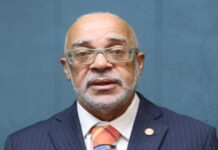


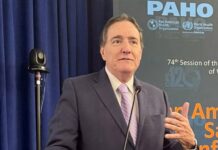













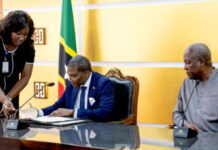



GEORGETOWN, Guyana, CMC – The chief executive officer of the Trinidad-based Caribbean Private Sector Organization (CPSO), Dr. Patrick Antoine, says discussions have already started regarding the challenge thrown out by Guyana’s President, Irfaan Ali, for the regional private sector to help find a solution to the problems facing transportation in the region.
Addressing the two-day second AfriCaribbean Trade and Investment Forum (ACTIF23) that ended here on Tuesday, Ali told delegates that he would consider it a severely missed opportunity by the regional private sector if they cannot form a consortium “and use this opportunity that Africa Ex-Im Bank is offering to end our regional transport system failure.”
“We can plant and grow as much as we want. We can do our processing, manufacturing, industrial development, we can re-engineer the supply chain, but we have to move things, we have to move things throughout the region. We must find the solution,” Ali said.
Antoine, in an interview with the Caribbean Media Corporation (CMC), said that the working group comprising officials and colleagues from the Africa ExIm Bank, the Africa Business Council, and several players in the logistics, shipping, and transportation space from both the Caribbean and from the continent, has already met “to map out what we’re going to be the next steps to getting this work done.”
Antoine said the work is “understanding the nature of the challenge in its various constituent parts, and how we would, in fact, approach getting resolutions that could then form themselves into business cases.
“So the idea would be, for instance, they may be an issue with operators, there may be an issue with ports, there may be an issue with vessels, there may be an issue with price and cost incentives, freight rates, for instance, based on you know, international norms, regulations and the need to harmonize that.
“So there are various elements of this that we discussed, and we discuss how we are going to approach breaking this, what sounds like a simple task, down into elements that would allow us to, perhaps, approach this in a way that would give the results that both the private sector, Caribbean society, and of course, the heads and the governments have articulated as being a key priority for agri-food development in our region and also between the continent and our region.”
Antoine, who is also the CPSO technical director, said that the meeting did settle on a phased approach with urgent concrete results that could be delivered in meeting this objective of addressing the constraint faced in the context of the Caribbean Community (CARICOM” as well as “in developing intra CARICOM trade and trade between the continent and the Caribbean in areas where we know there are significant opportunities, but where the logistics and transports continue to be a bottleneck.”
He said that while a timeline has not been outlined to meet the objectives, “what we’re going to do in the first instance, is to do an urgent concept note essentially and happily, the CPSO and other players that were in the meeting… have advanced to work on certain elements of this.”
He said in the case of CPSO, which became an Associate Institution of CARICOM in October 2020, “our executive committee gave us marching orders that all of our work and our interventions must be data and information-led.
“So we’ve been working already on identifying what the existing opportunities are and linking those opportunities using what we call trade corridors,” Antoine said, reiterating that the demand may be one place and the supply another.
“How do we follow what’s there now regarding trade, but also existing trade routes? Also, how do we look at the potential demand, not just what we’re supplying, but what we need to give and where it’s coming from?
“And how do we essentially repurpose both the trade routes and the logistics that would essentially now link that excess demand with the supply that we have, so that we essentially have the makings and enlargement of the market is really what we’ve been focused on in the case of the CPSO.”
Asked whether he felt it fair to ask the private sector to lead the initiative on transportation when, to some observers, the governments have failed in this regard, Antoine told CMC he believes that transport needs to be looked at in two ways.
“It has to be private sector-led. There is a public goods element. And we need to be cautious about approaching the public goods element. But there is a place for the public goods element in seeing that there is a place for governments to play a role, not just in creating the framework suitable, but perhaps in instances where there may be justifications, for instance, to intervene on the pricey side.
“But clearly, our view is that we understand the importance of the private sector leading, but we also understand that governments need to be prepared to put the framework in place policy-wise and incentive-wise and regulation-wise,” he told CMC.
Antoine said that the matter of maritime transportation is also a significant issue for the region “because we believe that that is, in fact, a big part of where we need to solve the problem.
“It’s not the only part. It’s a good place to start,” he said, adding that “if we’re able to solve the maritime transportation challenges for cooling, for logistics, for port operations, for freight rates, for port charges, for the regulations that exist, simplify for instance, processing, advance clearance certificates that it would make a tremendous difference.
“We think it’s an excellent place to start. Given the food crisis that we face, 57 percent of Caribbean populations continue to be food insecure. It’s a perfect place to start. And then we can go on to other aspects of this.
“Air transport is an issue, but we think, you know, step by step, let’s start here and solve this before we move on to another challenge. and let me see that there well may be another stream that we may be running on on the issue of air transport.
“But right now for agri-food systems, most of our products are moved by sea and hence the importance of the maritime transportation and the importance of us addressing that while recognizing that there are other problems that also need to be addressed,” Antoine told CMC.









 and then
 , Dr. Patrick Antoine, says discussions have already started regarding the challenge thrown out by Guyana's President, Irfaan Ali)