


































BRIDGETOWN, Barbados –Caribbean Forum (CARIFORUM) countries are now better equipped to collect, store, and analyze hydro-meteorological data that will form much evidence base to support building resilience to weather and climate hazards in the region as well as global monitoring of climate change.
Representatives of national hydro-meteorological services (NHMSs) from 16 Caribbean countries have now completed a training workshop under the European Union Intra African, the Caribbean, and Pacific Group of States (ACP) Global Climate Change Alliance Plus (EU Intra-ACP GCCA+) Project.
The project is being managed by the Belize-based Caribbean Community Climate Change Centre (CCCCC). It addresses meteorological and hydrological needs across the region through technical assistance that will further enhance climate observation in CARIFORUM states to support the development and use of climate products and services that lead to improved sectoral planning and decision-making planning.
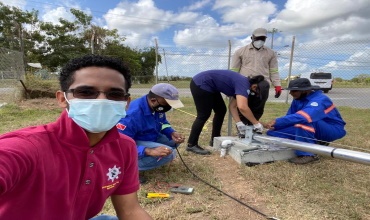
Trinidad and Tobago meteorological service technicians install automatic weather stations in Port of Spain (CIMH Photo)
The training program was led by the Barbados-based Caribbean Institute for Meteorology and Hydrology (CIMH), in its role as one of the project’s implementing agencies that provide technical and instructional support.
“Hydro-meteorological services play a critical role in ensuring Caribbean small island developing states are informed of weather and climate hazards ahead of time to prepare and protect our societies and economies from adverse impacts.
“CIMH is pleased to partner with the CCCCC under the EU Intra-ACP GCCA+ Project to increase the capacity of these national-level weather and climate authorities so that they can deliver and analyze more accurate and timely information that their governments and sectors can use to reduce vulnerabilities and bring better outcomes in disaster risk reduction,” said Dr. David Farrell, Principal of CIMH.
During the training, participants learned how to use and maintain the new automatic weather stations (AWS) that continuously record weather and climate-related variables, including temperature, rainfall, relative humidity, wind speed, and wind direction, with some stations having additional sensors to collect soil moisture and soil temperature.
“The training focused on best practices for installation maintenance, monitoring, and collecting the weather data that the stations will provide. While some information served as timely reminders, there was a lot to be learned, especially in this age of developing technology, said Janelle Garraway McPherson, a meteorological technician at the Dominica Meteorological Service.
The senior meteorological technician at the St. Lucia Meteorological Service, Govinda Augustin, said she came out of this training much “more confident in my task to install the automatic weather station provided to my country.
“I also have a better understanding of how to interpret the data collected.”
The organizers said that the boost to the participants’ capacity would enhance the quality of our region’s ability to use climate data to respond to climate variability and change.
“The Caribbean is at the frontline of the climate emergency and one of the most vulnerable regions in the world to hydro-meteorological events such as floods, droughts, tropical storms, and hurricanes that are increasing in frequency and intensity of climate change.
“As such, access, availability, and use of climate-related data are indispensable to evidence-based decision-making and resilience building in our member states. We are most pleased to have partnered with the CIMH to deliver this needed and timely training,” expressed Dr. Colin Young, CCCCC executive director.








 and then