







































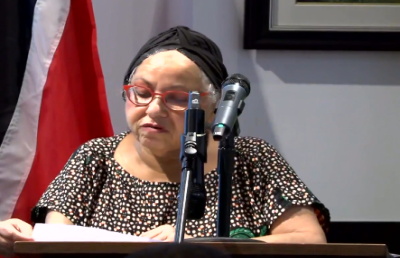
PORT OF SPAIN, Trinidad, CMC – The Assistant Secretary-General, Human and Social Development at the Guyana-based Caribbean Community (CARICOM) Secretariat, Alison Drayton, said Monday that micro-credentials are assuming strategic importance in the CARICOM region.
Addressing the Commonwealth of Learning CARICOM Micro-Credentials Sub-Framework Development and Planning for Caribbean Registry Roadmap opening ceremony here, Drayton expressed her appreciation to the Technical Working Group for the “diligence, expertise, and collaborative spirit” that have gone into preparing the Draft Framework for the delegates.
She said the document reflects careful thought, technical rigour, and a deep understanding of the region’s evolving education and training landscape, and it provides a strong foundation for the discussions we will have in this session.
Drayton said that the consultation sits at the intersection of two urgent realities.
“First, the Caribbean is undergoing profound economic and social transformation – driven by digitalisation, climate vulnerability, shifting labour markets, and evolving global value chains.
“Second, our education and training systems must respond with greater agility, inclusivity, and relevance if we are to equip our people – not only for jobs, but for life, resilience, and regional progress.”
She said it is within this context that micro-credentials assume strategic importance in the CARICOM region, adding that it offers the region a pathway to rethink how learning is designed, delivered, recognized, and valued.
“For a region such as ours – with diverse education systems, varying access challenges, and significant informal and non-traditional learning – this is not simply an innovation. It is a necessity.
“They are also highly relevant to one of the most pressing challenges facing our region – climate change.”
Drayton said that, as Small Island Developing States (SIDS) countries are on the frontlines of the climate crisis, “our ability to respond effectively, to build resilience, to adapt our infrastructure and systems, and to transition towards greener economies, depends fundamentally on the skills of our people.”
She told delegates that micro-credentials can play a transformative role in rapidly equipping citizens with targeted, practical competencies in areas such as climate-smart agriculture, renewable energy, disaster risk management, coastal zone protection, and sustainable tourism.
“But let us be clear: micro-credentials are not an end in themselves. Their value lies in their strong embedding within coherent national and regional systems. This is why the development of a CARICOM Micro-Credentials Framework must be approached with careful deliberation and strategic intent.”
She told the two-day conference that there are four critical matters for consideration, including coherence and quality assurance.
”We must ensure that micro-credentials are credible, transparent, and trusted – by learners, employers, and institutions alike. This requires alignment with existing qualifications frameworks, robust quality assurance mechanisms, and clear standards for design, assessment, and certification,” she said, adding that “without this, we risk fragmentation and diminished value”.
Drayton said it was also important to ensure portability and regional recognition, adding that a central promise of CARICOM integration is the free movement of skills.
“Our framework must therefore enable micro-credentials to be recognized and valued across member states, “ she said, adding that a certificate earned in one country must carry meaning and currency in another.
“This is essential for labour mobility, regional competitiveness, and equity of opportunity,” Drayton said, noting also the relevance to labour market needs.
She said micro-credentials must be demand-driven, adding “they must respond to real and emerging skills gaps – whether in digital competencies, green skills, entrepreneurship, technical trades, or care economies.
“This underscores the importance of sustained engagement with employers, industry bodies, and sectoral stakeholders,” she said, referring also to inclusion and access.
“Perhaps most importantly, micro-credentials must expand opportunity – not reinforce existing inequities. They should serve out-of-school youth, working adults, women re-entering the workforce, persons with disabilities, and those in rural and hinterland communities.
“This requires intentional design, flexible delivery models, and the strategic use of digital technologies – while remaining mindful of the digital divide that persists across our region.”
Drayton said that as the meeting considers this framework, “we must also guard against a potential risk – one that has confronted us in other domains. That is, the risk of uneven and fragmented adoption across the region.
“This consultation, therefore, is not merely technical. It is foundational. It is about shaping a shared regional approach – one that balances national priorities with collective goals, and innovation with integrity.
It is also about building a new social compact around learning,” she added.











 and then
  Secretariat, Alison Drayton, said Monday that micro-credentials are assuming strategic importance)