


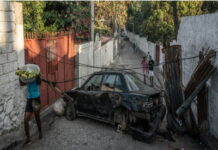



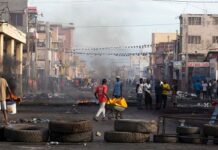
















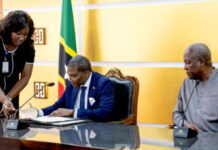


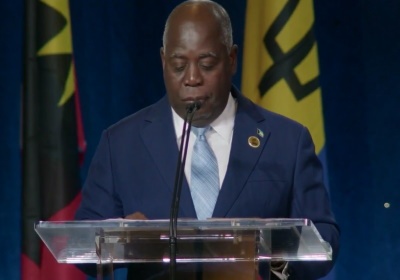
NASSAU, Bahamas, CMC – Caribbean Community (CARICOM) leaders began their 44th regular summit here on Wednesday night, overshadowed by the continued deterioration of the situation in the French-speaking member country of Haiti, also pledging to find a solution to the political and socio-economic problem there.
“The situation in Haiti requires our urgent attention. The turmoil and suffering there continue to worsen. As a near neighbor, the Bahamas is under great strain, and many other countries in our region are already heavily impacted,” Bahamas Prime Minister Phillip Davis told the opening ceremony of the summit.
Davis, the chairman of the 15-member regional integration grouping, said the region would benefit “if Haiti is again fully functioning as a state.
“We should learn from the failures of past efforts to help rather than use these disappointments as an excuse for inaction. I pray that we can agree on a series of concrete steps to help move towards a solution for the Haitian people and the region as a whole,” Davis told the audience, which included Haitian Prime Minister Dr. Ariel Henry and Canada’s Prime Minister Justin Trudeau, who has pledged his country’s support in finding a solution to the situation.
“We have learned that inaction has its costs and consequences,” Davis added.
Earlier, outgoing CARICOM chairman and Suriname’s President, Chandrikapersad Santokhi, said Haiti “needs our concrete and feasible assistance.
“We must support the Haitian people. Building on our discussions in the past year, I look forward to how and in what way this assistance can be provided. Democracy, free and fair elections, the rule of law, and the protection of fundamental human rights are indeed at the core of the Caribbean civilization,” Santokhi said, adding, “we must foster and protect these also in the sister nation in need.”
CARICOM Secretary General Dr. Carla Barnett told the ceremony that even as progress is being made on some fronts, CARICOM and the wider international community continue to struggle to help Haiti resolve its multifaceted crises.
“We will continue our efforts to assist all stakeholders in Haiti to ensure a Haitian-owned resolution to the crises,” she said, adding, “we will have to show the resilience and fortitude of the Haitian people as we strive to overcome challenges and advance the initiatives to improve the lives of all citizens of our Caribbean Community.
“That goal – to create a safe, sustainable, prosperous, and viable Community for all – has been the guiding principle of our efforts over the last 50 years and will continue to guide us over the next 50 and beyond,” she added.
Haiti has called on the international community, “especially those countries that can help,” to support efforts to deal with the ongoing socio-economic and political situation in his country.
Prime Minister Henry, who succeeded the assassinated President Jovenel Moise as head of the government in July 2020, has said to deal with this situation, his administration is urging the international community to participate in a specialized multinational force to help the Haitian security forces to fight against the proliferation of organized crime, the illicit trafficking of arms and ammunition, and eradicate the gangs that have held the country, hostage.
United Nations Secretary-General Antonio Guterres reiterated his urgent appeal to member states to understand the urgency of acting quickly to support the solutions chosen by Haitian actors.
So far, Jamaica is the only CARICOM country that has publicly said it is “willing to participate in a multinational security assistance deployment to Haiti,” which is going through a period of political turbulence and economic and social difficulty, aggravated by a climate of insecurity fuelled by armed criminal groups.
Over the two days, the Caribbean leaders will discuss a wide range of issues, ranging from climate change to food security and the impact of the ongoing coronavirus (COVID-19) pandemic.
Prime Minister Davis said the pandemic had taught the region a valuable lesson “about what’s important and what we need to do to save lives and livelihood.”
He said, as an example, the Bahamas has spoken about food security in the past, “but since the advent of the pandemic, we recognize that the need to be able to feed ourselves was just not an economic nicety, but a matter of survival.
“Some of the other priority issues are more protective. We should seek to strengthen our collective response to end the smuggling of drugs and guns, and we must do all we can to wipe out the misery of human trafficking”.
Davis said that the 50th anniversary of the regional integration movement should provide an opportunity for reflection and feeling a sense of pride in all that has been gained and the value added to the region.
“But it also presents an occasion to look forward to seizing the opportunity to collaborate, to cooperate and through our collective effort build a stronger, more resilient and more prosperous region,” he said, noting that the University of the West Indies (UWI) should be seen as a “shining testament to the difference CARICOM has made to the lives of the people of the region.”
Barnett told the ceremony that the focus of attention of the summit would be “on the pressing issues of the day.
“our member states and the global community of nations continue to face many challenges. Many of our economies began to rebound from COVID-induced contractions, only to be affected by sharp inflation and shipping bottlenecks.
“COVID-19 continued to hover, and the conflict in Ukraine carried on. Our member states again faced the continuing onslaught of climate change with the destruction caused by storms, rain events, and drought. Our hard-won development gains continue to be threatened by these challenges,” she told the ceremony.




 and then
  leaders began their 44th regular summit here on Wednesday night, overshadowed by the continued deterioration)