




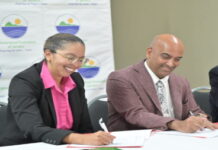















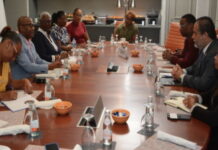
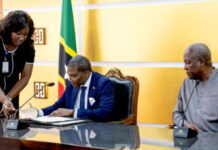
On Monday, GEORGETOWN, Guyana, CMC – The Caribbean Community (CARICOM) launched a CARICOM Skilled Workers Programme coinciding with the region’s component for secondary school teachers.
Under the initiative, 19 CARICOM teachers are being placed on two-week attachments to secondary schools in Barbados, Belize, Guyana, St. Kitts, Nevis, and Trinidad and Tobago from March 6- 17.
Other components of the Skilled Workers Programme, which will be rolled out later this year, involve attachments to the CARICOM Secretariat for CARICOM Youth Ambassadors, extensions to other CARICOM Member States for Border Control Officers, and National CSME Focal Points.
CARICOM Secretary General Dr. Carla Barnett said that the initiative provides opportunities for learning best practices to administer the CARICOM Single Market and Economy (CSME) regimes that allow for the free movement of goods, skills, labor, and services across the 15-member grouping.
“The intention is to also develop practical skills through work-related attachments, which will assist member states in implementing the CSME and decisions of the organs and bodies of the Community,” she said.
She told the ceremony that another part of the plan is to have effective advocates for CARICOM integration through the exposure given to participants.
“Thus, the targeted groups have been selected for their critical role in implementing and sustaining training at the national level and in advocacy regarding the CSME, particularly the free movement of CARICOM skilled nationals.
“Our research and observations over the years indicate the need for an improved understanding of procedures and adherence to guidelines for the operation of the CSME. Insufficient knowledge of issuing the relevant certificates to facilitate access to the various regimes are also noted.”
Barnett said the absence of such basic knowledge could adversely impact the ability or willingness of Caribbean nationals to capitalize on the free movement regimes.
“Against this background, an assessment of the impact of our CSME public education recommended ongoing training for immigration personnel, as they are the primary facilitators and gatekeepers of free movement. Interactive programs for the youth and entrenchment of the CSME in the school curriculum are among other recommended measures.”
She said in continuing to engage member states. The Guyana-based CARICOM Secretariat developed the program, which involves one-week work attachments of border officials in different member states to allow for sharing of best practices in administrating the Free Movement Regime for Skilled Nationals.
The program will also allow for the placement of CSME focal points in the private and public sectors and regional institutions for one week, with the focal points benefitting from observing and sharing best practices in the operations of the CSME in critical areas.
There will also be a two-week work attachment for secondary school teachers to be exposed to teaching CSME and broader CARICOM integration in the classrooms in other member states and how best practices can be replicated in their schools.
“The attachments will also better inform participants about the qualification framework for the free movement of skills, such as the levels of technical qualifications and skills.
National certification and categories of skills approved for unrestricted movement,” Barnett said.
The CARICOM Secretary-General said there would also be a one-week internship for the new cohort of CARICOM Youth Ambassadors (CYAs) at the CARICOM Secretariat to expose them to regional integration processes so that they can become better advocates for regional integration.
“While the focus is on teachers for the next two weeks, we expect to roll out the other attachments at the earliest opportunity, even with the realities of air transportation in our region,” she said, adding, “I understand, only too well, the challenges you teachers from St. Kitts and Nevis, Montserrat, and Antigua and Barbuda experienced to arrive in Guyana for your attachments.
“The story is the same for the other participants simultaneously placed at schools in St. Kitts. and Nevis, Trinidad and Tobago, Belize, and Barbados.”
Barnett said it could be considered lucky that the Secondary School Teacher Attachment is the first program segment to be activated, noting that the “capacity building for the teachers will benefit youths in their classrooms.
“Involvement of youth in regional integration must be seen in tangible terms and, over the years, the Secretariat has managed with limited resources to engage this key stakeholder group meaningfully.”
In her address to the opening ceremony, the head of Delegation to the European Union to Barbados, the Eastern Caribbean States, the OECS, and CARICOM/CARIFORUM, Malgorzata Wasilewska, said it was not difficult for the European Union to collaborate with CARICOM to support this initiative as part of “our broader support to the CSME.
“For those who doubt the potential of the CARICOM Single Market and Economy, I can categorically say that the European Single Market is one of the European Union’s greatest achievements, which seeks to guarantee the free movement of goods, capital, services, and people, known collectively as the ‘four freedoms.’
“The European Single Market, the world’s largest single market area, has fuelled economic growth and made everyday life easier for consumers and businesses. The CSME, once fully realized, can do the same for this Caribbean region.”
The EU diplomat said that as she travels through the Caribbean, listening to the voices of citizens, especially the youth, “I recognize that you too would undeniably like to have more unrestrained movement of goods, people, services, and capital.
“We believe that this CSME Skilled Workers Programme, through its sensitization of youth, teachers, and a targeted group of workers, can catalyze supporting this process.
“We, therefore, encourage you to measure the success of this program, not merely through the number of persons mobilized but the knock-on benefits of that mobility. Indeed, we hope that such exposure by participants translates into easier implementation by CARICOM member states at the national level of CSME decisions required to advance the regional integration process.”
She said that the program also comes at a pivotal time when the European Union, in the coming months, will roll out a new agreement that will define its relationship with Latin America and the Caribbean over the next few years.
The new EU Regional Programme for the Americas and the Caribbean – the ‘Global Gateway’ – is part of the EU’s global efforts to advance a green, digital, and sustainable global economic recovery.
It will seek to fight inequalities, build more prosperous, inclusive, and sustainable societies –particularly for women and young people – and promote human rights, democracy, peace, and security. It will enhance multilateralism by promoting reform and addressing global challenges such as health, biodiversity loss, and climate change.
Wasilewska said for the Caribbean region. The agreement will support jobs and growth, promote trade and investment, and build inclusive, secure societies and accountable institutions which leave no one behind.
“A critical part of this new Caribbean-EU Partnership strategy is the strengthening of CARICOM integration, including support for CSME consolidation,” she said, adding that more information will be available to the region in the months ahead.
“Colleagues, I wish to underscore the European Union’s continued commitment to its partnership with the region, especially in supporting CARICOM integration through initiatives such as this one.
“We agree that such initiatives are proving to be vital in boosting regional economic growth as CARICOM countries come to terms with the impact of the COVID-19 pandemic,” she added.










 and then
  launched a CARICOM Skilled Workers Programme coinciding with the region's)