







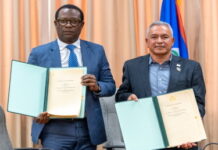























ST. JOHN’S, Antigua, CMC – Antigua and Barbuda’s Trade Minister, E.P Chet Greene, says 16 years after the Caribbean signed an Economic Partnership Agreement (EPA) with Europe, “the promise of that partnership remains largely unfulfilled for many of us”.
The 15 member states of the Caribbean Forum (CARIFORUM) and the EU signed the EPA on October 15, 2008. As the first, full regional EPA for the EU, it grants Caribbean states duty-free, quota-free access to EU markets while facilitating trade in services, investment, and development.
But speaking at the inaugural three-day EU-Caribbean Parliamentary Assembly taking place here, Greene said that for a small economy like Antigua and Barbuda, the EPA provides 100 percent duty-free access to the EU market.
“Yet, in 2023, our total exports to the European Union were a mere US$60,000. In 2024, that figure crept up to just US$124,000,” he said as he spoke on the topic “The Future of EU-Caribbean Trade: A Critical Assessment and Call to Action”.
“This is not a partnership; it is an underperformance. The celebrated benefits of market access remain theoretical for our micro, small, and medium-sized enterprises. We see no real collaboration between EU firms and our producers to get our rum, our fresh fish, or our fruits onto your supermarket shelves.
The Agreement has facilitated EU exports to our region far more effectively than it has helped us diversify our own trade portfolios,” Greene told the Assembly, which is being co-chaired by Malik Azmani of the Renew Group and Jamaica’s Deputy Speaker of Parliament, Heroy Anthony Clarke, both of whom serve as the Co-Presidents of the EU-Caribbean Parliamentary Assembly.
Greene said this is because the EPA’s implementation has focused on liberalisation, neglecting “the very foundation on which we signed it”, specifically Development Cooperation. He said that Articles 7 and 8 of the Agreement, on development assistance and cooperation priorities, are not optional extras; they are the engine that was supposed to make this trade work.
“Our firms are small, operate in fragmented markets, and face prohibitive costs in energy and logistics. They lack the capacity to meet EU technical standards or navigate non-tariff barriers. Without targeted, tangible assistance, we are asking our businesses to compete in a Formula One race on a bicycle.”
Greene said that as the region prepares for the second five-year review of the EPA, there is a need for a reset.
“We must pivot from simply trading goods to building genuine sectoral partnerships. Our future is not just in bananas and rum; it’s in the 70 per cent of our economy that is services—in sustainable tourism, in digital animation and design, in health and wellness, and in maritime services.”
Greene, who is also the Foreign Affairs Minister, said that his recommendations to the Assembly are “clear”.
He noted that from market access to market presence, “we need joint ventures. We need EU investment in our creative and digital industries, not just our traditional sectors. Let us create the financial instruments and matchmaking platforms that connect Caribbean micro, small, and medium enterprises (MSMEs) with European investors to build export capacity.”
In addition, Greene said there is a need to unlock the development mandate, telling the delegates the EU must deliver on the development cooperation provisions of the EPA.
“This means tangible technical assistance to help our firms meet EU standards, and direct support for technology transfer, as outlined in Article 142, to build our innovative capacity in agriculture and the green economy.”
He said there is also a need to “modernise” the EPA, saying it must reflect the 21st-century economy.
“We need a specific focus on digital transformation, e-commerce, and the green transition. We need an online portal for real-time export opportunities and programs that help our businesses sell online to the European consumer.”
Greene said that the EU “is our most important partner, but a true partnership requires balance.
‘Let us use the 2026 Review not just to tick boxes, but to build the bridges, provide the resources, and create the opportunities that will finally make the EPA work for all our people,” he added.
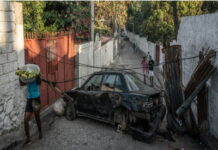
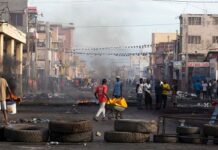
According to the agenda for the Assembly that ends on Wednesday, parliamentarians from Europe and the Caribbean will debate five key themes, namely climate resilience, the sargassum phenomenon and the energy transition, trade and investment, transnational organised crime, territorial integrity and multilateralism, and the situation in Haiti
The parliamentarians will conclude their work by adopting concrete recommendations to be addressed to the EU-Caribbean Council of Ministers.







 and then
 )