































HAMILTON, Bermuda, CMC – Premier David Burt Friday said revenue estimates for the upcoming fiscal year are US$2.03 billion, representing a landmark achievement as it is the first time in Bermuda’s history that the government’s revenue is projected to exceed the two-billion mark.
Burt, who is delivering his final budget address to Parliament, after earlier announcing that he would be stepping down in October this year, told legislators that the revenue anticipated represents a substantial increase of US$596.3 million, or 41.7 per cent over the original estimate for the 2025-26 financial year of US$1.43 billion.
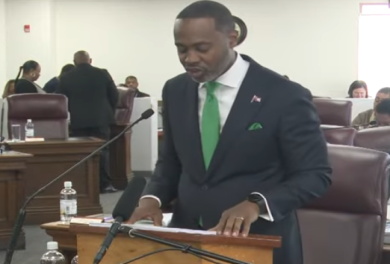
Premier David Burt presenting the 2026 budget to Parliament (CMC Photo)
“The primary driver of this increase is the provision for Corporate Income Tax receipts, which are estimated at US$753.2 million for the coming year, Burt said, adding that this performance is the result of years of meticulous work by the Ministry of Finance, the Corporate Income Tax Agency, and the International Tax Working Group to ensure that Bermuda remains a premier jurisdiction while meeting its international obligations.
“This government has remained committed to the principle of fairness. We promised to reduce the burden on Bermuda’s workers. Through these changes, the government will ensure that no worker in this country will pay more in payroll tax. This is a deliberate policy to increase the take-home pay of Bermudians and to stimulate activity in our local economy.”
He said that it is a simple fact that no business in Bermuda will pay more in employer payroll taxes under this budget, and no worker in Bermuda will pay more in employee payroll taxes. “Every employer rate will either remain at its current level or will decrease. Similarly, the total tax bill for every worker on this island will go down,” he said, adding that the government is providing relief to the employers, ensuring a reduction in the cost of doing business.
He said that as of April 1 this year, employer payroll tax rates will decrease, with the rate for International Business decreasing from 10.25 per cent to 9.75 per cent, and large local employers with remuneration greater than one million dollars will see their rate reduced from 10 to 9.5 per cent.
He said the rates will be reduced for all medium-sized businesses (with remuneration between $200,000 and one million) by 0.5 per cent, and for hospitality – hotels, guest houses, and restaurants, the rate will be reduced from five to four per cent to support the tourism sector.
He said that for the Special Retail Group, the rate will be lowered from 6 to 5 per cent, and for the Bermuda Hospitals Board & Corporations of Hamilton & St. George, the rate will move from 3.50 per cent to 3 per cent. At the same time, nursing and rest homes will be added to this category to reduce their costs as they care for an aging population.
Burt said that in line with the government’s platform commitments, employer payroll taxes for self-employed caregivers will be eliminated. And about seniors, the employer portion of payroll tax is exempt on the first US$96,000 of remuneration for Bermudian employees aged 65 and over, an initiative to support seniors who want to remain in the workforce.
Burt said that the local dividend exemption is being raised from US$10,000 to US$20,000, and that the government is also maintaining the zero or 1% rates for small businesses, charities, and Economic Empowerment Zones.
“ No entity will pay more in taxes under this budget,” Burt said. He said about employee payroll tax, the government is delivering a comprehensive reduction in the tax burden for all people working in Bermuda.
“This will be achieved through a targeted adjustment of our marginal tax bands, ensuring that all workers have a tax reduction,” he said, noting that as of April 1, adjustments will be made to the marginal tax rates.
For example, persons earning up to US$48,000 will benefit from a reduction from 0.50 per cent to 0.25 per cent, with the reduction decreasing in each band, except bands 4 & 5, which will remain the same.
“Mr Speaker, it is essential to spell this out in full, so there is no confusion, because our system is marginal; every worker, regardless of their total salary, benefits from the lower rates in the first two bands. These savings more than offset the adjustment in the third band, resulting in a net tax cut for everyone.”
Burt said that when the government came to office in 2017, the tax burden on workers was the highest ever, but now all working-class Bermudians are paying far less in taxes than they were nine years ago.
“In 2017, a worker earning $48,000 paid $2,280 in annual payroll tax. Under this budget, they will pay just $120. That is a 95 per cent reduction in their tax burden,” he said, noting that in 2017, a worker earning $96,000 paid $5,820. “Today, they pay $3,840, a nearly $2,000 annual saving for that worker or $4,000 more per year for a family,” Burt said, telling legislators, “relief in this budget does not end with payroll tax reductions and that the Government has reduced the tax burden for working families time and again, and this budget continues that work’
He said there will also be a reduction in electricity rates, as well as essential goods, including everyday household hygiene and cleaning products, infant nutrition and care items, core dairy products, bakery goods and grains, pantry staples, selected meats, and fresh produce. These are the basics that families purchase week after week.
He said the government will keep its commitment to reduce private car licensing fees by a further 10 per cent, effective April 1.
“ For Bermudian families, vehicle licensing is a fixed annual cost, and this reduction provides direct and predictable relief. It is another practical step to lower recurring household expenses, ensuring that Bermudians benefit from the country’s stronger financial position.”
Burt said that the current expenditure for the 2026-27 financial year, excluding debt service, is estimated at US$1.25 billion, an increase of US$137.7 million, or 12.4 per cent over the 2025/26 original estimate of US$1.11 billion. T
He said that this figure includes a baseline expenditure of US$1.12 billion and a provision of US$124 million for strategic investments.
He said that capital expenditure is estimated at US$182 million, an increase of US32.2 million, or 21 per cent, over the original 2025/26 estimate of US$149.8 million.
“This is the largest planned capital programme since 2008/09, and it is another step toward increasing capital spending to the goal of two per cent of gross domestic product,” Burt told legislators.
He said for too long, the government has been forced to extend the life of critical assets because its finances did not allow it to do what was needed.
“That approach comes with a cost, and eventually that cost shows up in breakdowns, delays, and risks to public safety. With our stronger fiscal position, we are now better placed to invest for the future while being more proactive on maintaining existing assets,” he said.
The budget debate will begin next Friday.










 and then