




























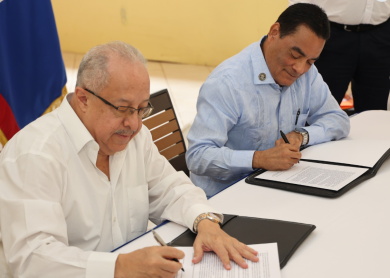
BELMOPAN, Belize, CMC – Belize and Guatemala have signed a declaration reaffirming the role of the Organization of American States (OAS) in dialogue, mediation, and confidence-building in the Adjacency Zone as it relates to the border dispute between the two countries.
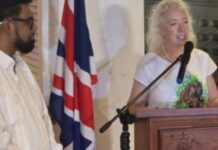
Foreign Affairs Minister Francis Fonseca and his Guatemalan counterpart, Carlos Ramiro Martínez, signed the joint declaration that also reaffirms the support of both nations toward the ongoing process at the International Court of Justice (ICJ) to resolve the territorial dispute, as well as their shared commitment to peace, cooperation, and continued OAS engagement before and after the ICJ ruling.
Fonseca, speaking to reporters following the meeting held at the OAS Office here, said both Belize and Guatemala have worked through this office to advance discussions on the confidence-building measures and to advance the work as the parties move towards the final, definitive determination of the claim against Belize.
“So, the OAS Office has played a critical role throughout this process for the last 20 years, and today we met to get a review and report of the ongoing work, the ongoing activities to look at what has taken place in 2025, and also to discuss the future role of the OAS Office as we move towards a judgment from the ICJ.
“So what will be the role, the post-ICJ role of the OAS office. So that was the main purpose of the meeting,” Fonseca said, adding that he was able to talk with his Guatemalan counterpart “about issues of mutual concerns to both Belize and Guatemala and to discuss meaningful ways in which the OAS office can continue to support our efforts to advance peace and stability between our two countries.”
For his part, Martínez Alvarado reiterated his country’s commitment to the ICJ process as the long-standing territorial dispute with Belize edges closer to a final ruling.
Martínez Alvarado said Guatemala will respect whatever decision the ICJ hands down, win, lose, or draw, describing the case as a model of how countries can resolve disputes peacefully and through international law.
“We have an agreement with Belize, and we have gone through the processes at the ICJ. We continue to monitor the development of the process across all phases presented. I have been vocal in previous forums about our country’s commitment to honor the judgment and remain compliant. And the OAS plays a crucial role in this process.
“In the same manner that Minister Fonseca has handled the case, as we reflected on the case for the past twenty years, we will continue to collaborate with them. This was our first engagement with the new representative of the Secretary-General. She had already met with other countries, but this was our first official meeting with her.
“We consider her role an essential part of the collaboration between our two countries. As we have said before, this process stands as an example of an amicable resolution to a long-standing, controversial issue involving both nations,” Martinez Alvardo said.
Explicitly asked whether Guatemala remains committed to respecting the ICJ’s final ruling regardless of the outcome, Martinez Alvarado replied, “Yes, and like I’ve said before in many other forums that I’ve been part of, our position is with the basic principles according to international law.”
The ICJ is actively managing the territorial, insular, and maritime claim brought by Guatemala against Belize, which was formally submitted to the Court on June 7, 2019. The case has moved through written pleadings, ending in June 2023, and is currently in the pre-hearing phase.
Guatemala claims a massive portion of Belize’s territory, arguing it inherited the land from the Spanish Empire and that the 1859 treaty boundary is invalid. But following a 2008 agreement, both countries held referendums – Guatemala in 2018, Belize in 2019 – where voters authorised the ICJ to make a final, binding decision on the dispute.
Meanwhile, amid repeated reports of Guatemalan Armed Forces crossing into Belizean territory, the issue of border incursions was brought up during the talks between the two foreign ministers.
“As you know, we have an ongoing dialogue at the political level between Belize and Guatemala. So, it is an ongoing discussion and in every meeting we have at the bilateral level and …we discussed these issues with a view to finding some mechanism, putting in place some mechanism, some structure to allow us to ensure that tensions are reduced between our two countries,” said Fonseca.
He said one of the issues discussed during the meeting, “under the auspices of the OAS is how we can improve military-to-military engagement and communication and cooperation between the militaries, because that is where, on the ground, we have to ensure there are no mistakes made and that tensions are reduced on the ground.
“So, those are the things we have always discussed between ourselves, and we will continue to dialogue and discuss because we both agree that it is important to reduce tensions and ensure there is always peace and stability between our two countries.”
For his part, Martinez Alvarado confirmed that there have been discussions between the two countries aimed at reducing tensions that have led to incidents, which the OAS office has also been closely monitoring.
“And yes, there are several measures that we have had to follow and implement internally, in coordination with our armed forces, in addition to the arrangements in place between both countries. I reiterate that the objective is to reduce tensions across the entire zone, including the Sarstoon River. There have been incidents that, unfortunately, were inevitable. However, Guatemala remains committed to reducing the tensions that lead to those incidents,” Martinez Alvarado said.






 and then
  in dialogue, mediation)