

































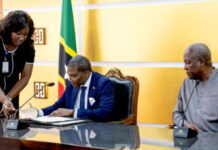



BELMOPAN, Belize, CMC -Prime Minister John Briceño, Tuesday, presented BDZ$1.79 billion (One Belize dollar=US$0.49 cents) to Parliament, promising a “balanced and targeted” framework for the new fiscal year, which will start on 1st April 2026
He told legislators that the fiscal package is an increase of BDZ$139 million compared to the last period, or an estimated 8.5 per cent growth, to be achieved by continued economic growth and collection efficiencies.
He said that of the BDZ$139 million, the largest increase, BD$116 million, will come from higher recurrent revenue. In contrast, BD$9 million will come from increased grants, and BDZ$2.3 million from capital revenue.
On the expenditure side, the government said it proposes BDZ$1.902 billion in total spending, of which BDZ$1.296 billion is recurrent, and BDZ$606.8 million is capital investment.
Briceño said that for this fiscal year, BDZ$780 million is allotted to salaries and pensions, representing 60 per cent of total recurrent spending. He said this total represents a net increase year-on-year of BDZ$82 million, or about 11.7 percent.
Briceño said that the amount allocated to wages and pensions accounts for almost 11 per cent of gross domestic product (GDP), “one of the highest in the region and therefore something that we have to keep under tight control.
“Reflecting our determination to direct the maximum possible resources to public sector capital investments, and specifically to funding the Medium-Term Economic Strategy, this year’s capital spending is the highest amount ever, at BDZ$606.8 million, and the highest percentage ever of total spending, at 32 per cent.”
Briceño said that debt servicing costs for the year remain just below 9 cents of every one dollar of spending and that during this fiscal year, Belize’s GDP is forecast to exceed 7.4 billion dollars of annual output.
“With this growth and the prudent levels of spending we propose, the primary surplus is expected at 1.1 per cent of GDP or BDZ$79.4 million. The overall budget deficit is projected at negative 1.49 per cent, in dollar terms, some BDZ$110 million dollars, which, when added to BDZ$140 million for amortization payments, means that the total financing required by the government for the fiscal year is BDZ$251 million or just over 3.3 per cent of 2026 GDP.”
Briceño said that in this budget year, the difference between total revenue and total expenditure, including amortization, which amounts to BDZ$250 million, will be partially financed by BDZ$117 million in external loan disbursements. In contrast, a further BDZ$133 million will be financed from domestic sources.
“The government of Belize continues to advance a broad-based tax reform agenda aimed at improving equity, efficiency, and sustainability within the national tax system. High on the agenda for Fiscal Year 2026/2027 is the transformation of the Belize Tax Service Department into a Semi- Autonomous Revenue Authority (SARA).”
Briceño said that this structural shift will provide the operational autonomy, governance flexibility, and enhanced accountability needed to deliver on Belize’s tax modernization agenda.
He said as part of its modernization strategy, the Belize Tax Service will oversee the full implementation of Electronic Invoicing supported by the Inter-American Development Bank (IDB) and the Inter-American Center of Tax Administrations (CIAT).
“We expect that this will significantly reduce opportunities for tax evasion, improve compliance, and simplify reporting obligations for businesses within the general sales tax (GST) regime.
He said reform efforts will also focus on a comprehensive review of the GST structure, including, in the course of this upcoming year, a review and amendments, where found necessary, of the classification of standard-rated and zero-rated items.
Briceño said that another significant shift will be the transfer of responsibility for land tax collection from the Lands Department to the Belize Tax Service. He said under this proposal, tax assessments themselves will remain in the purview of the Land Department, but the collection would then fall to the Belize Tax Service Department.
“This transition, supported by the IRIS Belize platform and enforced through the provisions of the Tax Administration and Procedure Act (TAPA), will strengthen the administration, registration, and enforcement framework for land taxation.”
Briceño told legislators that together, these reforms signal a decisive step in achieving the government’s commitment toward building a modern, transparent, and service-oriented tax system, one that supports national development and long-term fiscal sustainability.
He said on the expenditure side, the government will continue to exercise tight control on its recurrent expenditure while making sufficient provisions for key needs in education, health, and national security, to name a few.
Briceño said the particular focus will be on containing any additional wage growth and wage-related increases now that we have reached an agreed three-year compensation package with the joint unions.
He said the government will continue working on pension reform to place pension expenditure on a long-term, sustainable footing.
He said a working sub-committee has been established, comprised of management and staff with representation from unions, to look at key elements of the pension system, such as the retirement age, employer/employee contributions, and the level of benefit entitlements upon retirement, and then to make recommendations to the government on achieving long-term sustainability of the government’s pension scheme.
Briceño said that the government, with technical assistance support and potential funding from the IDB, is also embarking on a programme of Civil Service modernization.
“The general objective of the programme is to improve public sector efficiency to enhance the business environment. The specific objectives of the program are to enhance efficiency in public-sector human resource management and strengthen institutional capacity for human resource management in the public sector.
Briceño said a key element of the program will be the modernisation and consolidation of the now-outdated pay and grading system in the public service.
Prime Minister Briceño, who is also the Finance Minister, said that within the Medium-Term Fiscal Framework, fiscal policy is anchored on maintaining a prudent overall budget position and a sustainable public debt path.
He said that the government’s primary fiscal objective is to sustain a consistent primary budget surplus in the range of 1.5 to two per cent of GDP over the medium term, which will support fiscal credibility, strengthen buffers, and ensure that the overall budget balance remains consistent with macroeconomic stability objectives, both in nominal terms and as a share of GDP.
“On the debt side, although public debt has declined earlier than projected and is currently in the 65 per cent GDP range, further consolidation is expected to be more gradual due to structural constraints on economic growth and limited control over global interest rate conditions.
“Accordingly, fiscal policy will remain focused on disciplined expenditure management, efficient revenue mobilization, and cautious borrowing, to place public debt on a firmly downward trajectory toward 50 per cent of GDP by 2030, in both nominal terms and relative to GDP,” he added.








 and then
  to Parliament, promising a "balanced and targeted" framework)