




























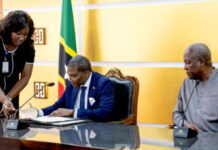


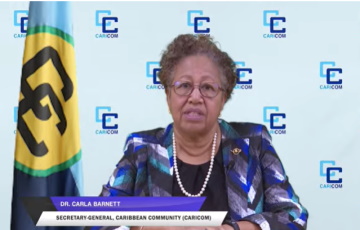
BELMOPAN, Belize, CMC – Caribbean Community (CARICOM) Secretary General, Dr. Carla Barnett, Monday said that the pursuit of strong public financial management is critical to the sustainable development of small developing states, like Belize, which face a unique set of challenges.
“Vulnerability to external shocks – such as the global economic and trade instability that we are all now experiencing – is compounded by increased risks of weather events associated with climate change,” Barnett said, as she addressed the certification ceremony to recognise the achievements of the first cohort of public officers who have participated in the Strengthening Public Expenditure Management (SPEM) project.
“As economies with narrow economic bases, dependence on global markets where we are price takers, and limited fiscal space, there is intense pressure on public resources, and therefore, every public dollar matters.
‘How we plan, allocate, spend, monitor, and account for public funds is not merely a technical exercise, it is a decisive factor in our ability to deliver development outcomes, maintain public trust, and cooperate effectively across borders,” she told the attendees of the SPEM project, an initiative of the Belize government, the University of Belize and the Inter-American Development Bank (IDB).
An eight-million-dollar loan from the IDB finances the project. It is implemented by the Ministry of Economic Transformation and the Ministry of Finance, with the primary goal of enhancing the systems and practices used to manage public funds, including accounting, budgeting, procurement, and internal audit processes.
Barnett said that strong public financial management is a foundation pillar of good governance, ensuring that public resources are aligned with priorities, used efficiently and effectively, and safeguarded against waste and misuse.
“Without sound public financial management systems, even the most ambitious and well-prepared development strategies are at risk of unfulfilled aspirations. A sound public financial management system is critical to ensuring that limited financial resources can be transformed into lasting investments in people, in social and economic infrastructure, and resilient, long-term, sustainable development.”
The Belize-born CARICOM Secretary General said that for small developing states, sustainability and resilience are two sides of the same coin.
“Extreme weather events, global economic downturns, and sudden disruptions can quickly overwhelm our fragile economic systems. Effective financial management allows governments to build fiscal buffers, mobilise domestic financing more effectively, and channel emergency funding where it is needed most, and to do so quickly and with transparency and accountability.”
She said the ceremony is, therefore, more than just a formal recognition of hard work, adding that it underscores a strong commitment to prudent public financial management.
“Investment in the skills and capabilities of public officers is an affirmation that prudent fiscal discipline and effective public financial management are not simply about balancing budgets.
“It is about ensuring that every dollar spent translates into robust health and education systems, improved infrastructure, vibrant communities, strong families, safe societies, and meaningful opportunities for everyone.”
Barnett said that, in today’s interconnected world, the vision for development, by definition, extends beyond national borders.
“As members of a wider community – within CARICOM, the Americas, and other regional and international frameworks – we recognise that a nation’s prosperity is linked to the prosperity of its neighbours.”
She said that Belize is a strong partner in the CARICOM Single Market and Economy (CSME), which supports the harmonisation of standards, the sharing of best practices, and the pooling of resources for greater impact.
She said that strong public financial management, enabled by transparent reporting systems, empowers Belize to participate more effectively in regional trade, to attract investment, and collaborate on cross-border projects.
Barnett said that this, in turn, drives collective growth and resilience, and allows citizens to engage confidently with partners across the region.
She said strengthening public financial management is also not a one-time or sporadic activity. It is a continuous process that requires policy direction, institutional capacity, and committed public service workers.
“This means embracing innovation in use and improvement of digital financial systems, strengthened data analytics, and modern auditing techniques, while remaining grounded in core principles of continuous learning, accountability, and inclusiveness.”
Barnett said that this effort to strengthen economic governance aligns with the United Nations Financing for Development (FfD) agenda, particularly the goal of domestic resource mobilisation.
“The Financing for Development framework reminds us that sustainable development cannot rely solely on external aid or borrowing. It requires countries to strengthen their own capacity to generate, manage, and channel domestic resources toward national priorities.
“Embedding fiscal discipline and building human capacity directly contributes to this global goal, ensuring that Belize can increasingly finance its own development, reduce vulnerability, and chart a path of resilience and self-reliance.”
She told those graduating from the SPEM project that they carry the responsibility of using the skills they have learned to contribute practically to strengthened fiscal management, to improve service delivery, and thereby secure long-term development outcomes.
“These are not abstract ideals; they are the very pillars on which trust in government is built, and the mechanisms through which citizens experience the tangible benefits of development.”








 and then
  Secretary General, Dr. Carla Barnett, Monday said that the pursuit of strong public financial management is critical)