











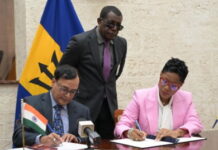













BRIDGETOWN, Barbados, CMC—A two-day international conference on energy began here on Wednesday amid concerns that the world has run out of time for hesitation and that immediate, tangible action is needed to accelerate the energy transition.
The 2025 Sustainable Energy for All (SEforAll) Global Forum, which has brought together more than 1,000 delegates from around the world, including the executive secretary of United Nations Climate Change, Simon Stiell, Sierra Leone, Liberia, and the Gambia, is being co-hosted by SEforAll and the Barbados government under theme “Sustainable Energy for Equity, Security and Prosperity,” with a focus on catalyzing the actions and investment needed for countries to achieve their energy access, climate and development goals.
“The time to change must begin with us, right here, right now, at this moment, not a moment later,” said Barbados Minister of Energy and Business Lisa Cummins.
“We have seen far more watershed moments in history than we can count. There is always a battle of some kind. There will always be a battle of some kind. But how do we progress out of this present moment?”
“This is not just another conference. This is a call to action. And we cannot afford to leave here with only words. The people who depend on us deserve more. The time for change is now—not a moment later,” she added.
The United Nations Deputy Secretary-General Amina Mohammed reinforced the urgency, telling the delegates that “we just have five years to close the energy gap” and that the “urgency of action cannot be exaggerated.”
She outlined three critical pillars for the transition–collaboration, creativity to address complexity and coherence–warning that the “window for action is closing.”
Mukhtar Babyev, the president of the 29th United Nations Climate Change Conference, which took place in Baku, Azerbaijan, also echoed the call for immediacy, further stressing that the stakes have never been higher and that delay is no longer an option.
The chief executive officer of SEforAll, Damilola Ogunbiyi, reinforced the urgency, stating that energy access must be seen as a fundamental right rather than a privilege.
“We must seek to solve the energy access challenge with a commitment to giving people power for a dignified and productive life,” she said, adding, “We simply cannot be satisfied with providing poor solutions for poor people.”
She said clean energy must do more than provide essential lighting and charging, noting that it must fuel industries, create jobs, and drive economic growth.
“Two sides are competing right now. How we collectively decide to act at this moment will determine whether we progress on our shared goals or undo decades of action,” she said, highlighting Barbados, as one of the few countries aiming for net-zero emissions within the next decade, as a beacon for what is possible, particularly for small island states.
“Being here in the Caribbean, we can see first-hand that climate change is no longer a distant threat. It is affecting communities, economies, and ecosystems, from flooding in coastal areas to heat distress in agricultural regions,” Ogunbiyi said.
She said the Barbados Energy Transition and Investment Plan presents a unique opportunity to showcase how a developing nation can drive the shift toward sustainability while reaping economic benefits.
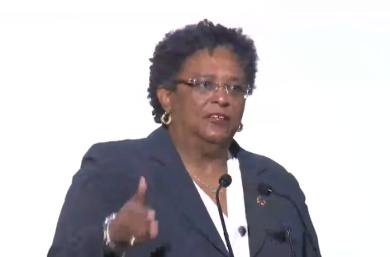
In her address to the conference, Barbados Prime Minister Mia Mottley spoke of the importance of pooling resources and activities within the Caribbean Community (CARICOM) to enhance energy capacity and meet global demand.
“In our region…we have started the preliminary work of seeing what it can look like if instead of each country trying to go off on their own for off-take agreements or to compensate for the fact that we are one of the most underpopulated regions in the world, except Haiti…to compensate for the lack of demand.”
“Our energy capacity, our renewable energy capacity in this region, is significantly higher than our ability to use the off-take therefrom. Therefore, rather than seeking to move, we must come together to determine how we can leverage Guyana and Suriname’s hydroelectric potential and its vast solar because of the land the geothermal of Dominique. Jamaica, St. Kitts, Grenada, St. Vincent and the Grenadines, and St. Lucia, the offshore and onshore wind potential and solar potential of Jamaica, Belize, the various associate territories, Antigua and Barbuda, Barbados, Trinidad and Tobago.”
Mottley said that in order to meet global demand, whether in Europe, Japan, or elsewhere, the president of the European Commission, Ursula von der Leyen, recently visited the Caribbean and “made us aware of the fact that they in Europe have determined that they will produce 10 million tons of green hydrogen by 2030.”
But she said they would need to import and that while there has been much commercial activity between Europe and Africa, the reality is that within CARICOM, Trinidad and Tobago has stood as a credible and large supplier of ammonia, not just in this region, but to Europe already.
“But the conversion into ammonia creates a different business case. And I stand here today to tell you that if we tried to walk this journey alone, we would have many polite conversations in the margins and on verandas about what could be and what might be.
“But if we summon the… energy and the political will…we can achieve so much. Europe has made its claim very clear. President von der Leyen called for reliable partners to attain this objective. You have heard that capacity and financing continue to bedevil us. And Europe has perfected the art of using guarantees to unlock additional capital,” Mottley added.
She said that in the Caribbean, there are at least six billion US dollars, which “ may sound small to those of you who are accustomed to large countries,” in domestic excess liquidity, attracting interest rates from 0.01 percent to below five percent in most instances, except one country.
“And we know from our debt-for-climate swap, supported ably by the Inter-American Development Bank, and by the European Investment Bank, … the Green Climate Fund that has remained the only primary credible source for investment. “
She urged delegates not to spend time or energy crying over what could have been but to deal with the world as it is on March 12, 2025. She urged the need for partnerships going forward while perfecting the network.
“That will help us unlock the critical financing. I also ask us to recognize that mimicry does not get us as far as small or developing states.
“If we try to establish regulatory structures that are known to the North Atlantic world, whose systems of development and whose institutions are completely different, we find ourselves, as my own country has done, regrettably, in the last three and a half years, caught up in regulatory arbitrage that has done nothing other than to lock off and block off over half a billion dollars of investment in renewable energy that is weak. And exploding to be put into action,” Mottley told the conference.






 and then