




























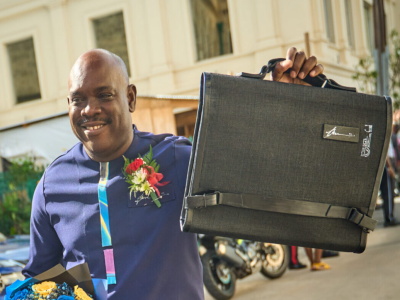
BRIDGETOWN, Barbados, CMC – Finance Minister Ryan Straughn presented Barbados’ first budget on Monday. At the same time, the country is not in an International Monetary Fund (IMF) programme. Still, it is overshadowed by global issues, such as rising oil prices, which could affect the overall cost of living on the Caribbean island.
“This budget is a product of discipline, of careful thought, and a response to global shock,” Straughn said in a nearly three-hour presentation.
Straughn told legislators that Barbados is on a stronger economic footing and that while it is not in an IMF programme, it nonetheless remains in a stand-by arrangement with the Washington-based financial institution.
Straughn said that the Barbados debt-to-Gross Domestic Product (GDP) ratio stood at 99.8 per cent in October 2025, but had improved to 93.3 per cent as of January this year. He said he expects the Central Bank of Barbados (CBB) to report next month that the country had recorded 19 consecutive quarters of growth, telling legislators Barbados is “financially stable enough to meet our obligations without constantly borrowing more”.
In addition, the finance minister said that Barbados is no longer on any list compiled by regional or international organisations and that the country meets international standards for transparency and financial regulation.
The government had last month tabled figures showing total revenue on a cash basis of BDS$3.856 billion (One BDS$=US$0.50 cents), comprising BDS$3.663 billion in tax revenue and BDS$192.6 million in non-tax revenue and grants.
Total expenditure, exclusive of amortisation, is projected at BDS$3.939 billion, including BDS$3.419 billion in current spending and BDS$520.8 million in capital outlays.
“We took cognisance of the fact that since we made those estimates, the world has changed fundamentally, and so we are here this evening to outline to the country what we will do to respond to the current challenges, even though we have always been flexible with respect to these measures,” Straughn said, warning of a possible impending fuel and energy crisis.
In his budget statement on Monday, Straughn said that the Mia Mottley administration, which won all 30 seats in the Parliament at the last general election in February this year, would implement measures to protect Barbadians from rising energy costs.
In the past two weeks, Brent crude has risen from US$64 per barrel to just under US$106. Straughn said that the Barbados National Energy Company Limited (BNECL) has locked in the price of heavy fuel oil, which powers electricity generators, at US$92 per barrel for the next three months, and that the move is intended to shield the public from international fuel price spikes and will be reviewed after three months.
Straughn said the government would also subsidise electricity prices.
“With effect from April 1, the government will absorb 50 per cent of any increase in the fuel clause adjustment on electricity bills above the March 2026 rate for the next three months,” he said, adding that the measure will cost the government BDS$7.9 million.
In addition, fuel prices at the pump will be capped. The government said value-added tax (VAT) collected on gasoline will be limited to BDS$0.47 per litre, and on diesel to BDS$0.37 per litre, until March 31 next year.
He said excise taxes on gasoline will be reduced from BDS$99.39 cents to BDS$89.30 cents per litre, and diesel from BDS$44.03 cents to BDS$34.03 cents per litre for three months.
Straughn said the measures were designed to ease the impact of international fuel volatility while maintaining a stable electricity supply for Barbadians.
He said the adjustment will require government, households, and all businesses to rethink their strategies.
“We can only urge the private sector to revisit this, along with their sourcing and pricing strategies, as any attempt to price gouge in this environment will be self-defeating,” he said, referencing how the private sector partnered with the government to introduce a Social Compact in 2022.
Straughn said adjustments have been made to the fiscal package to address current global challenges, noting, for example, that corporation tax assumptions have been reduced by BDS$200 million.
He said that during the COVID-19 pandemic in 2020, Barbados imported BDS$519 million in fuel, and that figure increased to BDS$728.5 million last year.
The government has also announced that, from April 1 to March 31 next year, it intends to extend the Excise and CAT holiday on electric vehicles, and that the cost of replacement batteries for electric and hybrid vehicles will be eligible for the five-year personal income tax deduction.
Straughn said that shipping bunker surcharges will also be adjusted, noting that for 20-foot containers, it will increase from US$200 per container to US$700, for 40-foot containers from US$400 per container to US$1400
He said that, from April 1, the Customs and Excise Department will cap the value of a 20-foot container at US$ 3,000 and a 40-foot container at US$6,000.
In his presentation, the finance minister announced that, for the 2026 income year, personal income tax rates will be cut by 1 per cent to 11.5 per cent for individuals earning between BDS$25 000 and BDS$75 000, and to 27.5 per cent for those earning above BDS$75 000.
“Combined, these two measures return $26.1m annually to working Barbadians, placing more disposable income in the hands of the middle class while preserving the integrity of the progressive tax structure.
“We would have gone further, and we intend to do so, but the current global environment, marked by geopolitical conflict, supply chain disruption, and rising inflation, demands that we proceed with discipline. Fiscal caution today is what protects our ability to deliver more for Barbadians tomorrow.”
Straughn said that for the 2025 income year, the reverse tax credit will increase from BDS$1,300 to BDS$1,700 for those earning up to BDS$25,000, and that the income eligibility for the credit will be expanded from BDS$25,000 to BDS$35,000 per annum.
These persons will receive a reverse tax credit of BDS$750. This will benefit another 17, 221 persons for BDS$12.9 million,” he said.
In addition, with effect from the income year 2025, the income limit for the compensatory income credit will increase from $35 000 to $50 000, benefiting 18,415 taxpayers.
“The compensatory income credit helps ensure that lower- and middle-income earners retain more of their income to reduce tax liability. That means more money stays in the pockets of ordinary Barbadians. These enhanced credits will be available to taxpayers as they file during the next filing season in April 2026, in two weeks.”
Pensioners will also benefit from the government’s new policy, with Straughn announcing a one-year cost-of-living cash credit of BDS$100 per month for those earning less than $50,000 per annum, starting April 1.
“This will be paid through the National Insurance and Social Security Service, which will liaise with the Barbados Revenue Authority to confirm income levels. This monthly payment provides direct assistance to pensioners whose fixed incomes have been strained by rising prices. Persons may opt to receive the cash credit quarterly, semi-annually, or annually.”
He said those eligible are pensioners who, as of April 1, are receiving contributory and non-contributory pension, survivors’ benefits, and retired public officers receiving pension payments from the Treasury.
Straughn said that the taxable allowance for pensioners will also increase from $50,000 to $75,000, with effect from the 2025 income year.
Barbados has had to deal with an increase in violence, and more so gun-related crimes, and Straughn announced that two dedicated gun courts will be established, one dealing with offences committed in the last year and the other with the backlog of cases.
“The Barbados Police Service has done a wonderful job apprehending offenders, and with further digitalisation and training, we expect to see these and other cases being managed through the court system more efficiently,” he said.
Straughn said Customs duties and VAT will be removed for one year regarding the importation of home CCTV/security systems.
The Barbados government is also promising Barbadians that goods imported for personal use through registered couriers will benefit from a tax-free amount that has increased from BDS$60 to BDS$150, and from BDS$150.01 to BDS$199.99, duty-free, with only VAT payable. The government said that anything over BDS$200 in value, Customs duty, and VAT apply, and that items such as alcohol, cannabis products, cigars, and cigarettes have been excluded.
The government is also warning of a BDS$$500 fine for false declarations or under-invoicing.
Straughn also announced the launch of the Green Industrial Gateway Advantage (GIGA) to create thousands of new, high-value jobs, telling legislators that this is projected to raise the country’s foreign earnings from US$700 million to between US$4-6 billion annually within a decade.






 and then
 )