





























BRIDGETOWN, Barbados, CMC – Public sector unions have given a guarded response to plans by the Barbados government to provide permanent appointments to more than 2,000 public officers.
Prime Minister Mia Mottley told Parliament that the absence of a fully functioning human resources management information system (MIS) has constrained plans to confirm the appointment of a significantly larger number of civil servants than the 2,095 who will shortly receive permanent appointments.
She told legislators that a comprehensive regrading exercise across the civil service is expected to be completed next year, announcing also a range of initiatives, including expanded additional compensation and improved conditions of service for key frontline workers such as teachers, police officers, and nurses.
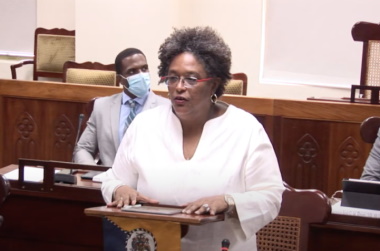
Mottley, tabling the Public Service (Appointments) Bill on Tuesday, said that the legislation will facilitate the permanent appointment of 1,170 temporary public officers who have served for more than three years, while 925 officers will be promoted to the positions in which they have been acting.
Government remains the island’s largest employer, with an estimated 20,000 people working in the public service and state-owned enterprises, and Mottley described the legislation as part of early Christmas cheer for civil servants.
“We [are doing] it again, but the numbers that we are dealing with are significantly less, and that is because the Services Commission and the Ministry of Public Service have tried to be able to move with dispatch on several issues, but the volume of issues without a functioning HR management information system will always be difficult.”
“We are well on our way to having that functioning HR MIS. . . . Obviously during the period of COVID, everything was put on pause, both for reasons of persons not being able to move, but also because of funding,” Mottley said, reiterating her administration’s commitment to improving the positions of public servants, police officers, teachers, and nurses.
“There is no doubt that the police service, the teachers and the nurses have been those who have been at the front line calling for repositioning, and I think the case has been well made . . . because without security we have nothing, we have potentially anarchy.
“Without health being able to be served and delivered to each person, we have nothing, and without the capacity to train up minds and to educate our children equally, we have a society that can be literally torn apart by division.
“So that the government is fully committed to the regrading process and I look forward in 2026 to being able to bring this to conclusion.,” she said, recalling that her government granted public officers their first salary increase in nine years; upgraded just under 300 long-serving police constables to the rank of Senior Constable; increased detectives’ allowances by between BDS$1 961 and BDS$2 269 (One BDS$=US$0.50 cents) per month.
Public sector unions have given a guarded response to Mottley’s statement, with the National Union of Public Workers (NUPW) and the Barbados Union of Teachers (BUT) noting that integrity would be critical to their success.
“The National Union of Public Workers always welcomes the news of public officers being appointed; we always welcome the news in this process,” said acting General Secretary Wayne Walrond.
He noted that confirmation in post had practical implications for workers’ financial security, particularly when seeking long-term loans.
“One of the things the banks are looking at is confirmation in a position, and any long-term lending like mortgages, if an officer is still temporary, that can impact their eligibility to get what we will call a substantive loan,” he said.
BUT President Rudy Lovell, the union has “repeatedly called for this process to become regularised, where teachers who are in temporary positions for three or more years without an adverse temporary teacher report are eligible for appointment to the teaching service”.
Lovell said extended periods of acting and temporary appointments had never been an administrative anomaly, but rather a “systemic failure that affected livelihoods, morale and professional dignity”.
“The confirmation and promotion of public officers, including teachers, acknowledges the legitimacy of long-standing grievances raised repeatedly by trade unions, including the Barbados Union of Teachers,” he added.








 and then