





































BRIDGETOWN, Barbados, CMC – The Central Bank of Barbados (CBB) said on Wednesday that the island’s overall economic outlook for 2026 and the medium term remains favourable, anchored by strong fundamentals and a clear transformational agenda.
“Continued momentum in tourism, construction, and business services, supported by sustained public and private investment, underpins this outlook. Meanwhile, continued disciplined fiscal management, low and stable inflation, and robust external buffers provide resilience against external shocks.”
But the CBB, in its review of the Barbados Economy from January to December last year, said that the challenge now is execution.
“Sustained public- and private-sector collaboration, continued productivity gains, and timely implementation of reforms under BERT 2026 (Barbados Economic Recovery and Transformation) programme. will be critical to converting stability into higher growth, stronger resilience, and lasting improvements in living standards.”
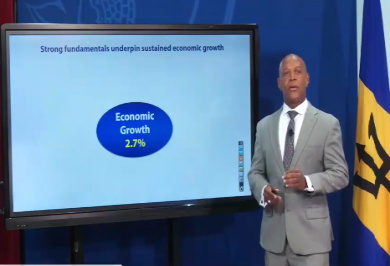
The Central Bank said stable economic growth and low inflation prevailed in 2025, even as global trade tensions intensified. Tourism, business and other services, construction, and agriculture supported real gross domestic product (GDP) growth of 2.7 per cent.
The unemployment rate ended the third quarter at 6.6 per cent, while jobless claims increased modestly during 2025. Lower international oil and freight costs eased inflation pressures despite higher global tariffs, and the 12-month moving average inflation rate slowed to 0.7 per cent by November 2025.
Higher housing and utility costs, together with stronger demand for dining services, lifted point-to-point inflation to 1.7 per cent in November,” the CBB noted.
CBB Governor, Dr. Kevin Greenidge, told reporters that economic growth is expected to remain solid in the near term and strengthen modestly over the medium term. He said real GDP growth is forecast to stay around 2.5 to 3 percent in 2026, reflecting continued momentum in tourism, construction, wholesale and retail trade, and business and other services.
“Over the medium term, growth is expected to trend toward about 3.5 per cent per year, supported by sustained public and private investment, productivity reforms, and economic diversification under the BERT programme 2026.”
Greenidge said that a broad investment pipeline underpins the medium-term growth outlook, referring to the ongoing and planned investments in airport and seaport infrastructure, road networks, water distribution, sewage treatment, renewable energy, and housing, which should sustain construction activity and ease capacity constraints.
Greenidge said public sector upgrades, together with private investment in tourism, real estate, and energy, are expected to attract additional investment and boost productive capacity across the economy.
He told reporters that tourism, construction, and business services should remain the major drivers of growth. ’Expanded airlift, improved connectivity, and scheduled events should support long-stay arrivals, while high vessel occupancy and an active cruise itinerary pipeline should sustain cruise tourism.
Planned expansion and upgrades at Grantley Adams International Airport will increase capacity, improve passenger flow, and support higher tourist arrivals over the medium term, reinforcing Barbados’ position as a regional hub. Spillovers from tourism and related infrastructure investment should continue to benefit accommodation, dining, transport, and cultural services.”
Greenidge said that the labour market conditions are expected to remain tight, while supporting household incomes and domestic demand. He said employment gains in tourism, construction, utilities, and services should underpin private consumption, as skills development and productivity initiatives under BERT 2026 aim to ease capacity constraints and support medium-term growth.
The CBB Governor said that global growth conditions have softened but remain broadly supportive of Barbados’ outlook.
According to the IMF’s January 2026 World Economic Outlook, global growth is expected to hold steady at around 3.3 per cent in 2026 and moderate to 3.2 per cent in 2027, with growth in Latin America and the Caribbean expected to be near 2.2 per cent in 2026 and 2.7 per cent in 2027.
Greenidge said that while trade policy uncertainty and elevated tariffs keep risks tilted to the downside, gradual global disinflation and resilient consumption in key source markets should continue to support tourism flows and external demand for Barbados’ services.
He said that inflation is expected to remain low and stable, though subject to external risks. Easing international oil prices and lower freight costs should keep imported inflation contained, while stronger domestic demand may place upward pressure on the prices of selected services.
Overall, inflation is expected to remain near the lower end of the forecast range, broadly between one and 2.5 percent over the near term.
Greenidge said that the external position should remain resilient, though regional geopolitical developments warrant close monitoring.
“Strong tourism receipts and capital inflows linked to investment projects are expected to sustain international reserves above prudential benchmarks. However, heightened geopolitical tensions involving Venezuela and the increased U.S. military activity in the southern Caribbean could introduce uncertainty around regional airspace, shipping routes, insurance costs, and travel logistics. Any sustained disruption could affect tourism flows and import costs, though Barbados’ strong external buffers protect against short-term shocks.”
Greenidge said that fiscal discipline is expected to remain intact, even as public investment accelerates.
He said the government’s intensified capital programme for the financial year 2025/26 “reflects a deliberate strategy to support growth through increased investment in infrastructure, while remaining on track to meet its primary surplus target of 4.1 per cent of GDP.
“Sustaining this balance between higher capital spending and fiscal discipline remains central to achieving medium-term debt objectives and supporting economic expansion. At the same time, policy actions under BERT 2026, including reforms to modernise the financial system and encourage private investment, are expected to reinforce fiscal sustainability and growth outcomes,” the Central Bank Governor said.










 and then
  said on Wednesday that the island’s overall economic outlook for 2026 and the medium term remains)