

















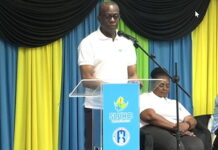




















NASSAU, Bahamas, CMC -Prime Minister Phillip Davis says transforming the country’s energy sector remains a priority for his administration. He says the need is to relieve Bahamian families and businesses from the burden of high prices and unreliable electricity supply.
“Relief is an important enough goal, especially during a global inflation crisis,” Prime Minister Davis told the audience attending “A New Energy Era for The Bahamas.”
He said the government is also “motivated by our profound conviction that our economy can be more competitive, prosperous, dynamic, and inclusive with more paths to security and success for more Bahamians.”
He said that while the country and the Bahamian people have very big ambitions, “you can’t build a 21st-century economy with 20th-century infrastructure.
“In every conversation I have with entrepreneurs, business owners, and investors from the very smallest to the very largest, the high cost of electricity and the costs and uncertainties associated with unreliable supply inevitably come up.
“For most Bahamians, their rent or mortgage payment is the only bill bigger. Major bills are a major burden, which means less disposable income and less spending and investment in our local economy.”
Prime Minister Davis said that high bills for businesses mean high operating costs, which affect competitiveness and the ability to diversify, create obstacles to growth and development and impact investments, business expansions, and job creation.
“Just imagine what we could accomplish if we had affordable, reliable, clean energy,” Davis told the ceremony, adding, “That’s where we’re finally headed”.
But he said before tackling the solutions, it is necessary to understand the scale of the challenge. He added that important parts of the country’s electricity infrastructure, including some transformers and substations, are more than 50 years old, dating back to before independence.
“It’s hard to describe the experience of listening to engineers emphasize that critical parts of our grid are on the verge of collapse with no chance of revival once they go down. And then there are the generation engines, “ Prime Minister Davis said, noting that 60 percent of the Bahamas Power and Light Company Ltd’s (BPL) plant in New Providence and 80 percent in the Family Islands need replacement within the next five years.
“So we have an aging, vulnerable, deteriorating, expensive system, dependent on heavy and diesel fuels, that cannot meet current needs, let alone the growing energy needs of a digital economy, or the increased demand we have to anticipate as temperatures rise in this new climate era,” he said, adding that it would cost an estimated half a billion US dollars “to rescue and modernize our grid.”
He said the BPL is carrying a legacy debt of the same amount, not to mention an unfunded pension liability of US$100 million.
Davis said that while he could go on about the grid’s vulnerability to storm damage, the inability of our current system to integrate renewable energy, and the tens of millions in rental costs annually that contribute to high prices, the quick short-term fixes that have been the historical pattern have not served the country well.
He said the government understood that there was a need for comprehensive, innovative reform and that for the first time, utility-scale solar power in New Providence – 70 MW of solar power and 35 MW of Battery Energy Storage Systems will be integrated into the grid;
He said solar power throughout the Family Islands, where new hybrid microgrids will incorporate solar energy and natural gas, will allow the authorities to eliminate expensive BPL rentals, replace aging generation units, and establish battery storage systems.
He said natural gas is being pursued as a partner fuel to solar to create important savings that can be passed on to the consumer. Energy efficiency upgrades, including energy audits and efficiency upgrades for government buildings, educational outreach to consumers, LED street lighting, and rooftop solar at schools, are also being pursued.
In addition, new electricity legislation (Electricity Act 2024), which allows for stronger consumer protections and allows adjustment to tariff rates to support consumers who most urgently need relief from high prices, is also being considered.
Prime Minister Davis said that when he asked Jobeth Coleby-Davis last September to become the country’s Minister of Energy, she jumped in and never looked back.
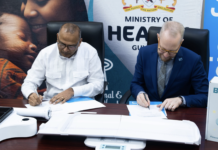
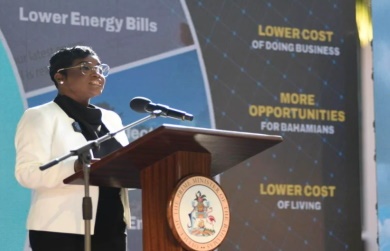
In her address, she said that the government will partner with Island Grid to modernize the country’s electricity grid, transmission, and distribution network and will also implement the use of liquefied natural gas (LNG) in New Providence, which will be purchased from Shell.
She said in addition to the partnership between BPL and Island Grid and the implementation of LNG in New Providence, the government’s plan includes:
- The building of utility-scale solar power in the Family Islands.
- The expansion of solar projects in New Providence.
- An equity rate adjustment.
“The partnership with Island Grid will extend the infrastructure capabilities beyond what BPL alone can do by bringing in a generation and T&D (transmission and distribution) expert to pursue much-needed upgrades,” she said.
“It is essential to share that Island Grid has over 60 years of experience delivering best-in-class energy infrastructure. The company’s projects included work on Walkers Cay, Grand Cayman, Grand Bahama, and Puerto Rico.
“The partnership with Island Grid will lower the fuel cost and improve operating efficiency. The benefit of this arrangement will be felt through affordable energy prices and fewer power interruptions. Energy costs will be lowered through several mechanisms.”
Coleby-Davis sought to assure BPL workers that there would be no job losses.
“To the workers of BPL, I wish to categorically state that there will be no layoffs because of the partnership. There is no intention to offer a voluntary separation program, and current industrial agreements will not be impacted,” she added.









 and then