




























NASSAU, Bahamas, CMC – Prime Minister Philip Davis has reaffirmed his administration’s commitment to defending The Bahamas’ borders, safeguarding national sovereignty, and dismantling transnational smuggling networks, providing fines for up to US$300,000.
He told Parliament that the Smuggling of Migrants Bill, 2025, directly targets criminal networks that profit from human suffering, modernising the country’s legal framework to make it easier to prosecute smugglers and impose harsher penalties.
“This Bill makes it easier to prosecute smugglers, and punishes them with tougher penalties than ever before. This is how we protect Bahamian communities. This is how we rule our waters. And this is how we reduce the number of migrants who enter our country illegally.” Still, the main opposition, the Free National Movement (FNM), says it will repeal the legislation if the party wins the next general election.
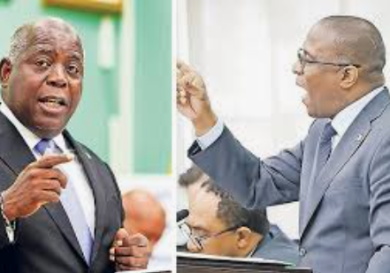
FNM and Opposition Leader, Michael Pintard, said the Bill, which was passed in the Parliament, will not affect a real crackdown on illegal migrants or the smugglers who exploit them for financial gain.
“The Smuggling of Migrants Bill will soon become the law of the land,” Pintard said in a statement.
“When the Free National Movement forms the next government, it will be repealed. The reason is simple: The Bill is a far cry from a real crackdown on illegal entrants, as well as the smugglers and financiers who exploit them for profit,” he added.
The government said that the Bill defines the smuggling of migrants as a distinct criminal offence and ensures that anyone involved in planning, financing, transporting, or harbouring migrants can be prosecuted – whether the smuggling operation begins, passes through, or ends in The Bahamas.
Under the new legislation, offenders face fines of up to US$300,000 and prison terms of up to 15 years, and Bahamian jurisdiction is extended to prosecute smuggling-related offences committed outside national waters or on foreign-flagged vessels.
It also provides for the confiscation of vehicles, vessels, and other assets used in connection with the crime.
Prime Minister Davis said the legislation builds on his government’s record of strengthening the Royal Bahamas Defence Force (RBDF) and Immigration Department through new patrol vessels, drones, radar systems, upgraded communications, and an expanded workforce.
Since 2022, more than 13,000 migrants have been repatriated – the highest number in Bahamian history – while detention centre populations have dropped significantly due to faster processing and repatriation.
Prime Minister Davis said that The Bahamas will continue to balance compassion with control, upholding the rule of law while refusing to yield to external pressure.
“Our first duty is to our citizens and to those who are here lawfully. We have refused to sign declarations that would commit us to accepting more migrants. We have refused calls to suspend deportations to Haiti. And we will continue to act in the best interests of The Bahamas.”
The Prime Minister said the Bill clarifies the legal distinction between human smuggling and immigration offences, ensuring that humanitarian treatment of migrants is upheld while preserving the nation’s right to enforce its laws.
“Being a victim of smuggling does not grant a right to remain in The Bahamas,” he said. “Our asylum laws remain unchanged, and anyone entering illegally will be repatriated.”
Prime Minister Davis warned that Bahamians who knowingly assist smugglers, including those who rent properties, provide transport, or lend vessels for illegal activity, will face serious consequences under the new law.
“If you are participating in or supporting human smuggling in any way, you will find yourself within the crosshairs of our justice system. This is a turning point. What might have felt like a side income will now carry consequences that can change your life.”
He praised the work of the Royal Bahamas Defence Force, the Department of Immigration, and the Ministries of National Security, Immigration, and National Insurance for their leadership and coordination.
“We will not allow criminal networks to use our islands as corridors. We will not allow lawlessness to challenge the safety and stability of our communities. We will not tolerate the exploitation of vulnerable people. And we will not compromise our sovereignty,” Prime Minister Davis said.
Addressing would be migrants directly, he said, “I say do not place your lives, or the lives of your children, in the hands of criminals.
“They will take your money, put you on an overloaded vessel, and send you into open water with little regard for whether you survive. If you come here in breach of our laws, you will be returned to your country of origin.”
During the debate, National Security Minister Wayne Munroe said Section 11, which provided immunity from prosecution to smuggled migrants, would be deleted, saying it would not have changed the way migrants who enter The Bahamas illegally are processed.
“We have heard the outcry, and this is a responsive government,” Munroe said, adding, “people had a problem with there being immunity and it’s being removed. When I examined it, I could not see its importance.
But Pintard said the government’s amendments to the Bill cannot fix what is wrong with the legislation.
“The Bill continues to treat smuggled migrants as victims in a general sense, even where those individuals willingly paid smugglers and chose to enter The Bahamas illegally. That is not consistent with international practice.”
He said that human trafficking involves coercion, and victims of this crime deserve protection.
Pintard said human smuggling “involves consent,” adding that migrants in this category “voluntarily join illegal networks to evade lawful entry.
“Our stance on this is clear: persons who voluntarily participate in smuggling should face penalties, not receive the protections reserved for genuine trafficking victims,” Pintard said, noting that the Bill places operational authority, including temporary residence decisions for smuggled migrants, under the minister of national security rather than the minister of immigration, which he said “makes no sense”.
Pintard was referring to a clause that states that the minister of national security “may grant a temporary residence permit to a smuggled migrant to facilitate the investigation or prosecution of an offence” under the new Bill, or to facilitate the migrant’s recovery or rehabilitation.
Pintard dismissed the government’s statement that the Smuggling of Migrants Bill is necessary to adhere to international treaties.
“That is simply not true. International protocols do not require The Bahamas to soften penalties for smuggling or blur the line between trafficking and smuggling. They do not override Parliament’s duty to protect the peace and security of our country,” the Opposition Leader said.










 and then