




















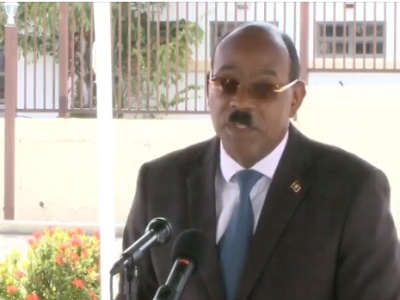
ST. JOHN’S, Antigua, CMC – Antigua and Barbuda Prime Minister Gaston Browne Tuesday sought to re-affirm the Caribbean Community’s (CARICOM) “invaluable role” in the regional integration process, even as he acknowledged that “it would be an untrue claim to say that our integration arrangements through CARICOM are perfect.
“Like many important relationships, we must always seize our opportunities for reflection and modernization,” Browne said at a Flag Raising ceremony here in recognition of the 50th Anniversary of CARICOM.
“I use this occasion to lament that a lack of fair and equitable benefits from our arrangements still challenges less endowed member states such as Antigua and Barbuda.
“We lament that in these 50 years, the Owen Arthur Study to further integrate the Less Developed Countries (LDC) into CARICOM is still languishing on the shelf, despite the reality that Heads decided to implement the Study’s recommendations fully,” Browne added.
He said while St. John’s applauds the operationalization of some Articles under Part II- Regime For Disadvantaged Countries, Regions and Sectors of the Revised Treaty, including Article 158 – the Development Fund, there is still much work to be done to allow the LDC’s to succeed within the fabric of CARICOM.
“We wish to see more extraordinary efforts made to operationalize Article 151 – Support for Sensitive Industries, where an industry may be considered as sensitive because of its vulnerable nature, the significance of its contribution to, among other things, gross domestic product, employment, foreign exchange earnings or its designation as vital within the national industrial policy.
“Accordingly, we reiterate the importance of the special regime for LDCs, particularly Article 164, where fledgling industries are given recognition and support required to build their competitiveness.”
Browne said that the LDCs should not merely be viewed as the market for goods of the more developed countries (MDC) of CARICOM, noting that while it is recognized that Trinidad has a significant balance of trade with the smaller nations in CARICOM, the imbalance needs to be addressed.
He said the International Trade Centre (ITC) reports that over the past four years, Antigua and Barbuda has been a significant importer of products originating from our CARICOM MDCs valued at over US$40 million.
“Notably, in 2022, Antigua and Barbuda imported products valued at US$24 million from Trinidad and Tobago; nine million US dollars from Jamaica; seven million US dollars from Barbados, and three million US dollars from Guyana.
“Conversely, Antigua and Barbuda exported to this CARICOM member state less than US$1.5 million combined for the same period. There is a significant imbalance of trade that exists. “
Browne said that a lack of mineral resources necessitates enhanced economic investment and technical support for the LDCs of CARICOM.
“Unfortunately, while this is widely recognized, we continue to see disproportionate values of financial and technical support going to the MDCs, perpetuating a situation of the ‘haves and have nots’ within the one CARICOM space,” he told the ceremony.
But Browne told the audience that he is of the “firm view” that CARICOM has significantly benefited all its member states.
“And we have seen this primarily through functional cooperation. And when you look at CARICOM in the context of the global challenges facing our respective nations, we can all conclude that we can do better collectively than individually.
“There is a saying if you want to go fast, go it alone; if you want to go far, go in a group,” he said, adding, “We have to go both fast and far, which means we have to do so collectively.
When considering the myriad global challenges, he said, “We either swim together or sink alone. So CARICOM is essential.”
Prime Minister Browne said that it was also crucial for him to acknowledge the efforts of Antiguans and Barbudans, who have helped advance the agenda of CARICOM over the last 50 years.
“I wish to recognize the national hero and late father of the nation, particularly Dr. Vere Cornwall Bird Snr and the late Sir Lester Bryant Bird, as well as the many others who provided great wisdom and shared ideas that have been recorded in the verbatim documents of CARICOM.
“No doubt, we stand on the backs of titans, whether statesmen, politicians, economists, academics, social scientists, historians or writers; many are no longer with us, but have left an indelible mark on the integration movement, its virtues, and challenges. Among the many voices are Eric Williams, George Lamming, George Beckford, Rex Nettleford, Tim Hector, Sir Alexander Bustamante, Sir Grantley Adams, and Robert Bradshaw,” he said.
“Antigua and Barbuda continues to support the ethos and aspirations of CARICOM. We look forward to our journey towards full integration and sharing, without fear, the ideas emanating from Antigua and Barbuda. At the same time, we seek to address various evolving issues that will hopefully position CARICOM in its meaningful place among the world’s nations,” Browne added.
In her address to the ceremony, CARICOM Secretary General, Dr. Carla Barnett, noted that CARICOM is acknowledged as the longest-lasting integration movement of its kind among developing countries and that “we also know that it is no mean feat that it has endured.
“Our longevity is the result of a deep commitment, immortalized in ink at Chaguaramas on 4 July 1973 and nurtured decade after decade by the steely determination of successive governments and the people of the region.”
She said this determination spurred the growth of the CARICOM Community from an initial membership of four member states to the current 15 full members and five Associate Members.
She spoke of the achievements over the five decades, adding, “As the theme selected for our 50th Anniversary celebrations declares, we are 50 years strong, with a solid foundation on which to continue to forge a Caribbean Community that is inclusive and resilient…unified, competitive force in the global arena”.
She said, looking forward, “We acknowledge that the global landscape has evolved significantly from the realities of 1973.
“If we are to fulfill the promise of our integration as laid out in the Treaty of Chaguaramas, we must continue to demonstrate the understanding, tenacity, and sense of shared purpose that has sustained us for the past 50 years. This is what will secure a safe and prosperous Community for future generations of our region,” Barnett said.








 and then