





































GEORGETOWN, Guyana– Guyana has launched a new “revolutionary” Low-Carbon Development Strategy (LCDS) 2030 that it says takes into consideration the country’s enormous contribution of its ecosystems to the world’s health and economy.
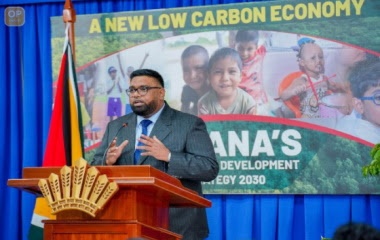
President Dr. Irfaan Ali launched the initiative on Thursday night that focuses on harnessing Guyana’s unique advantages to create a new low-carbon economy, built on the platform provided by the monitoring, reporting, and verification system (MRVS) and other areas of enhanced capacity in Guyana.
Ali stated that LCDS 2030, which is still in draft form, will create a new low-carbon economy by establishing incentives that value the world’s ecosystem services and promoting these as an essential component of a new global development model with sustainability at its core.
In Guyana’s case, harnessing the value of the country’s ecosystem services can build a long-term, low-carbon diversification opportunity.
“The scale of vision captured 12 years ago (in the first LCDS program) remains valid today,” he said, adding, “working together, we can transform our country without leaving any area of our country or segment of our people behind.
“We can become an even more attractive place for investors and our diaspora to choose to come home,” Ali said.
The draft LCDS addresses four main objectives: forest climate, and other ecosystem services, how to stimulate future growth through clean energy and sustainable economic activities, protecting humanity and biodiversity against climate change, and aligning Guyana with global climate goals.
“To address the theme, the discovery of oil and gas has rapidly integrated Guyana into a three to four trillion US dollar annual marketplace; revenue from our market can transform our country and create opportunities for our people, especially our youth that previous generations could only have dreamt of.”
President Ali recalled the level of awareness and interest shown in Guyana during his trip to Dubai, which he said was “unprecedented,” noting that the extent of attention was also experienced across the globe.
The draft LCDS is the basis for a national consultation to gather input and ideas from all Guyanese. The talk’s goal will be to receive and incorporate broad-based feedback on the measures contained within the strategy. Based on the outcomes of these consultations, the LCDS will be updated and tabled in the National Assembly.
There are seven chapters contained in the current draft that look at the building blocks for a new low-carbon economy; how forest climate services can be evolved; a new investment program to develop Guyana’s human, financial and physical capital; low-carbon energy transition; how to protect against climate change; sustainable management of the oil and gas sector; and oversight of the LCDS by a national consultation, the National Assembly and the Multi-Stakeholder Steering Committee.
“Because of the work of the last 12 years, we now know that Guyana has maintained the second-highest percentage of forest cover on earth – with more than 99.5 percent of our forest remaining – an area almost the size of England and Scotland combined. Deforestation rates are among the lowest in the world…
“All these ecosystem services and others provide enormous value to the global economy –Guyana’s forests alone are estimated to provide global value from US$40B to US$54B annually,” President Ali said.
He told the nation that this is Guyana’s moment, confident in the country’s ability to answer some of the biggest questions the world faces, like balancing energy and climate security and creating the basis for a future ecosystem services economy, while still helping its people become prosperous.
In 2009, Guyana launched the first LCDS, setting out a vision for inclusive, sustainable development while simultaneously maintaining the country’s forests, about 85 percent of the country’s territory, to help meet some of the most urgent challenges the world faces.
Guyana has the second-highest percentage of forest cover on earth. It is working with partners to sustain 99.5% of that forest while building the foundation for a new low-carbon ecosystem economy.
The expected opportunity to access a market mechanism for forest climate services and other ecosystem services will enable Guyana to store 19.5 billion tons of carbon dioxide equivalent- the measure used for greenhouse gas emissions- the world emits about 50 billion tons a year.









 and then