






























HOUSTON, CMC – Guyana has told an international energy conference that the global conversation must shift from “energy transition to energy balance,” and that the Caribbean Community (CARICOM) country is living proof that the model works.
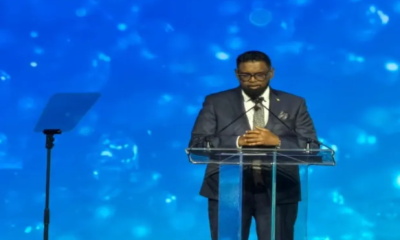
Addressing the opening of the 2026 edition of the Offshore Technology Conference (OTC), Guyana’s President Dr. Irfaan Ali, told the audience of global industry leaders, investors, and policymakers from more than 100 countries that the world is not simply switching from one energy system to another.
He said it is trying to close a growing gap between supply and demand that continues to rise, and that while global investment in clean energy reached a record US$3.3 trillion in 2025, it remains heavily concentrated in China, the United States, and the European Union, leaving the regions with the fastest-growing energy needs the least funded.
“This imbalance has profound implications. The regions with the fastest-growing energy demand are not the regions receiving the largest share of investment. The Global South, where demand is rising most rapidly, remains highly underfunded.”
Ali warned that the push toward critical minerals needed for renewable technology carries its own environmental price, including mass deforestation, toxic waste, and increased water consumption in already water-stressed communities.
“Are we addressing one environmental crisis while creating another?” Ali asked, noting that the tension is exactly why the framing needs to change.
“Instead of energy transition… how do we achieve energy balance to create a win-win scenario for investors, the planet, and humanity?”
He told the conference, which ends on Thursday, that Guyana has chosen the balanced path, extracting full value from its hydrocarbon resources while simultaneously building a modern, diversified energy system across all 10 administrative regions.
“Guyana demonstrates that energy production, climate leadership, and biodiversity protection are not mutually exclusive. They are mutually reinforcing. We are showing that a country can simultaneously produce oil, maintain a net carbon sink, expand renewable energy, and protect its natural environment. We take pride in that; it is the responsible thing to do. We urge others to join us in this endeavor for all humanity and for our own homeland and this planet Earth.”
The Gas-to-Energy (GTE) project in Wales, West Bank Demerara (WBD) in Guyana, is a cornerstone of that effort, aimed at lowering the carbon intensity of the national grid, improving reliability, and supporting industrial development. Solar farms have been deployed nationwide, with energy mixes tailored to each region based on geography and needs.
Hydropower development is advancing, and investment in wind energy is underway to diversify the renewable mix further. The government is also upgrading transmission and distribution networks, investing in smart grid technology, and scaling up energy storage to enable renewable energy to deliver on its potential.
President Ali said Guyana is also looking beyond its borders, actively developing projects in partnership with Suriname, Brazil, and French Guiana to build regional power infrastructure and interconnection systems that would deliver greater energy security and economic cooperation across the region.
Guyana’s role in the global energy and climate landscape is distinctive. We are one of the fastest-growing oil producers in the world. At the same time, we are one of the most significant net carbon sinks. Our forests cover approximately 85 percent of our landmass,” Ali said.
He said Guyana’s forests sequester more than 150 million tonnes of carbon annually, making it one of the world’s most significant net carbon sinks. Through the Low Carbon Development Strategy (LCDS) 2030, Guyana became one of the first countries to issue carbon credits under the ART-TREES standard, securing an agreement valued at approximately US$750 million. The funds have been channeled back into renewable energy, climate resilience, and national development.
“Guyana demonstrates that energy production, climate leadership, and biodiversity protection are not mutually exclusive. They are mutually reinforcing,” he said.
“We approach this moment with clarity and with discipline. We have rejected the false choice between economic development and environmental stewardship. We’ve also rejected the notion that the energy transition can be pursued through a single pathway. Instead, we have adopted a deliberate and integrated, dual-track approach,” he said, adding that these objectives are not mutually exclusive and, with careful management, reinforce each other.
“Guyana’s energy strategy is not a single project or a single sector. It is a system-wide transformation. Over the past five years, we have moved from policy to execution. Our gas-to-energy project is a cornerstone of this effort.”
Ali appealed to every government, financial institution, and private sector actor to invest in Guyana, noting that any energy investment is an investment in a sustainable future and a balanced framework that the world needs.
“The future of energy will not be defined by what we abandon. It will be defined by how wisely we manage what the world still requires, how responsibly we build what the future demands, and how fairly we ensure that no country and no community is left behind,” he told the conference.
“We’re using our hydrocarbon resources to finance the future. We are building isolated projects. We are building a diversified, resilient, and modern energy ecosystem. We are not delaying the transition. We are investing in the balance of the future,” he said, adding that the world requires reliable and affordable energy that is produced with the least impact on the environment and the greatest return on the dollar.
“And, I say most humbly that Guyana fits the bill in all of these criteria; any investment in energy in Guyana is an investment in a sustainable future and a balanced framework that the world needs.”






 and then
  country is living proof that the model works)