





















GEORGETOWN, Guyana, CMC – Guyana’s President Dr. Irfaan Ali, on Tuesday, expressed his “grave concern” over the public display of a brooch won by Venezuela’s Acting President, Delcy Rodriquez, showing her country’s map that includes Guyana’s Essequibo Region as she held talks with two Caribbean Community (CARICOM) leaders this month.
In a letter sent to Caribbean Community (CARICOM) chairman, Prime Minister Dr. Terrance Drew, the Guyanese leader said that “Guyana fully respects the sovereign right of CARICOM Member States to conduct bilateral relations with all partners, including the Bolivarian Republic of Venezuela.
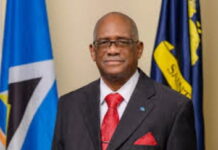
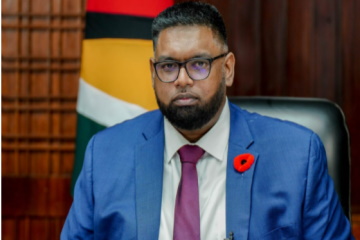
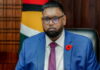
President Irfaan Ali (File Photo)
“However, it is deeply regrettable that such engagements have been accompanied by the prominent display of symbols asserting Venezuela’s claim to Guyana’s territory,” Ali wrote in his April 28, 2028, letter to Drew, who is also the Prime Minister of St. Kitts and Nevis.
Rodriquez held talks with Grenada’s Prime Minister Dickon Mitchell in St. George’s on April 9 and on Monday this week met with Barbados Prime Minister Mia Mottley. She said then that her visit was aimed at strengthening relations between the South American country and the region.
Earlier Guyana’s Education Minister, Priya Devi Manikchand, in a statement posted on her Facebook page, wrote “CARICOM leaders claiming to be our friends AND benefitting from that friendship even as they entertain their other friends who are completely disrespecting Guyana by openly claiming 2/3 of my country and sporting that on a visible piece of jewellery even as that matter is being adjudicated in the ICJ (International Court of Justice), has me questioning our friendships and the principles of these CARICOM leaders”.
She was critical of those CARICOM countries for violating the principle of Guyana’s sovereignty and territorial integrity, adding, “Principle is principle. It shouldn’t be cowardly. And it shouldn’t be convenient”.
In his letter, Ali said that the use of CARICOM engagements “to project or promote a territorial claim against a Member State risks being interpreted as acquiescence or tolerance.
“No action, whether deliberate or inadvertent, should create the impression that the Community’s platforms may be used to advance claims now before the International Court of Justice. CARICOM’s principled support for Guyana must be reflected not only in declarations, but also in the context and conduct of official engagements.
“This is not a matter of symbolism alone. It is a calculated and provocative assertion of a claim that Guyana has consistently and lawfully rejected, and which is before the International Court of Justice for final adjudication.”
The ICJ is set to begin oral hearings on May 4, with Guyana’s Attorney General and Minister of Legal Affairs, Mohabir Anil Nandlall, saying that hearings are scheduled for May 4-8, and may extend into the following week.
Guyana brought the case before the ICJ in 2018, seeking confirmation that the 1899 Arbitral Award, which established the boundary between the two countries, is legally valid. The award had been accepted for over 60 years before Venezuela declared it null in 1962 and revived its claim to the territory.
The matter is being addressed under the 1966 Geneva Agreement, which outlines mechanisms for a peaceful settlement. After bilateral efforts failed, the dispute was referred to the ICJ by the United Nations Secretary-General.
The Court has already ruled that it has jurisdiction to hear the case, paving the way for hearings on the merits, during which both sides will present full legal arguments.
Ali said that Venezuela cannot, while the case is before the Court, “seek to normalize by symbols, maps, legislation, appointments, or official display what it has failed to establish in law.
“Such conduct does not strengthen Venezuela’s case; it undermines confidence in its stated commitment to peaceful settlement, international law, and good neighborly relations,” he said.
Guyana recalls its consistent position that the boundary was settled by the 1899 Arbitral Award, which determined it as a full, perfect, and final settlement. Venezuela’s revival of the claim decades later, and its more recent measures purporting to annex the Essequibo and appoint officials for that territory, form part of a pattern of conduct inconsistent with international law and the process to which the matter has been submitted.”
Ali said that these “actions persist notwithstanding the Order of the Court of 1 December 2023, which required Venezuela not to take any action that would modify the situation that currently prevails in the territory in dispute, whereby Guyana administers and exercises control over that area, and required both Parties to refrain from any action that might aggravate or extend the dispute or make it more difficult to resolve”.
He said he is writing to the Drew in his capacity as the “current Chairman of CARICOM, conveying Guyana’s concern and urging continued vigilance in safeguarding the Community’s principled position.
“Guyana reminds all CARICOM Heads of Government of their repeated and unequivocal support for Guyana’s sovereignty and territorial integrity, and for the resolution of the controversy through the judicial process before the Court. That position was reaffirmed most recently at the Fiftieth Regular Meeting of the Conference of Heads of Government.
Guyana remains fully committed to the peaceful resolution of this matter in accordance with international law. We continue to repose our confidence in the Court and to respect its processes and eventual judgment.”
Ali said at the same time, Guyana expects all states, including Venezuela, “to act consistently with the principles of the United Nations Charter, refrain from provocation, and respect the ongoing judicial process”.







 and then