

























UNITED NATIONS, CMC – The United Nations says security efforts must be sustained, and international engagement must remain focused and coherent as Haiti enters a new critical juncture in its rebuilding of democratic institutions.
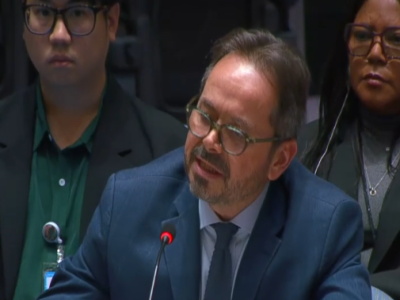
“There’s an overriding need for national stakeholders to strive to contain political fragmentation, to cast aside their differences, to sustain institutional continuity, and to focus on the organization of elections. Let us be clear, the country has no time to waste on prolonged internecine fighting,” Ruiz Massieu, the Special Representative of the UN Secretary-General, told the UN Security Council.
“The situation requires that the authorities, state institutions, political parties, civil society, the private sector, and religious and community leaders, for them all to prioritize the national interest and to act with responsibility and with restraint,” he added.
Massieu told the Security Council that there are high expectations for tangible progress on the political and security fronts in Haiti and that finding common ground around the mechanisms of efficient and effective government beyond the expired February 7 deadline of the Transitional Presidential Council (TPC) that has ruled the French-speaking Caribbean Community (CARICOM) country in the wake of the assassination of President Jovenel Moise in July 7, 2021.
Massieu said at this critical juncture, he has continued to exercise the good offices of the Secretary-General in support of Haitian-led efforts to ease political tensions.
“He said engagement with political stakeholders, civil society, women and youth groups, and institutional counterparts has focused on fostering inclusive exchanges around security, electoral priorities, governance challenges, and impunity concerns.
He said the United Nations Integrated Office in Haiti (BINUH) will continue to facilitate inter-Haitian consultations and encourage stakeholders to engage constructively on ways to create the necessary conditions to end the transition and restore democratic institutions.
“Steps taken in recent months to advance electoral preparations are particularly encouraging. The adoption of an electoral decree on 1 December and the publication of an electoral calendar on 23 December provide an operational framework for moving forward after years of delay.”
Massieu said that new legal provisions on voter registration, diaspora participation, women’s political inclusion, and the decentralization of vote tabulation, if effectively applied, could contribute to credible and inclusive elections.
“In particular, the introduction of new requirements on women’s representation on candidate lists, coupled with financial incentives, constitutes an important step towards addressing longstanding barriers to political inclusion.”
Massieu said Prime Minister Alix Didier Fils-Aime has declared 2026 an electoral year and that “achieving this goal will require sustained coordination among relevant institutions, predictable financing of the electoral process, and security conditions that allow all voters and candidates to participate without fear.
“In this regard, the United Nations remains engaged in supporting the Provisional Electoral Council to help ensure that preparations advance in a manner that is technically sound, inclusive, and credible,” Massieu said, adding that he stands ready to lead further and reinforce the UN engagement on this front and coordinate international assistance to national efforts to hold elections.
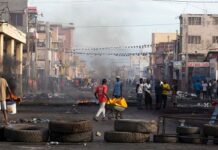
In his address to the Security Council, Massieu said that criminal gangs continue to demonstrate the capacity to mount coordinated attacks, exert control over key economic corridors and agricultural regions, force displacement, stretch humanitarian response capacity, and push police resources to their limits.
He said intentional homicides in 2025 increased by nearly 20 percent compared with more than 7,500 in 2024.
“At the same time, sustained pressure on gangs has yielded results. National security forces have intensified operations to reclaim territory and disrupt gang activities. In some parts of the Artebonite Department, police operations supported by the Gang Suppression Force (GSF) have led to the reopening of some road networks.”
Massieu said in the heart of the capital, Port-au-Prince, limited improvements are visible, and that state presence around the Champ-de-Mars, where the National Palace and several key ministries are located, is gradually being restored.
But Massieu said the challenge now lies in expanding and sustaining security gains as well as creating conditions for the delivery of basic services to communities.
“Without these security improvements, clearly risk reversal,” he said, adding that the transition of the Kenya-led multinational security support (MSS) mission to the GSF, alongside the establishment of the United Nations Support Office in Haiti (ONSO), as authorized by the Security Council, represents a critical step to enhance international support to assist Haiti.”
Massieu said he welcomes the progress made toward establishing ONSO, with the support of the Haitian and Dominican Republic authorities, as well as the appointment of Jack Christofides, a special representative for the member-state-led GSF.
“I look forward to working closely with him to ensure coordination and complementarity in our joint support to Haitian institutions. Recognizing the positive momentum created by the Fourth Generation Conference last December, I would like to take this opportunity to reiterate the urgent need for member-states to continue to provide the gang suppression force with the necessary resources to execute its mandate, including through voluntary contribution to the UN Managed Trust Fund.”
Massieu said at the same time that immediate security objectives must be balanced with longer-term efforts to strengthen the autonomy of national security institutions.
He said that the benchmarks annexed to the report of the Secretary-General provide a framework for progress, accountability, and sustainability in this regard.
Massieu said lasting stability will require renewed efforts to design and implement credible pathways for disengagement from violence and reintegration into society, particularly for youth and children.
“Gangs continue to recruit and exploit children by manipulating grievances and the daily suffering of ordinary citizens from marginalized neighborhoods. From this perspective, reinstating a national authority for disarmament, dismantlement, and reintegration remains a clear priority.
“A nationally-led approach to DDR is essential to complement enforcement measures laid by national security forces with the support of the gang suppression force. BINU, working alongside the United Nations Agency Funds and Programs, will continue to support national authorities in designing and implementing safe exit DDR and CBR initiatives, prioritizing children.”
Massieu said the humanitarian situation remains a grave concern and that an estimated 6.4 million people require humanitarian assistance in Haiti, placing the country among the largest humanitarian caseloads in the region.
“The humanitarian response remains underfunded. Last year, Haiti was one of the least-funded global humanitarian appeals. In 2026, US$880 million is required to help 4.2 million among the most vulnerable,” Massieu said, adding that the period ahead is certainly crucial for Haiti.
“Managing the political calendar, supporting still-fragile stabilization efforts, and addressing persistent humanitarian needs will directly determine the country’s ability to progress towards credible elections and a gradual return to a normal institutional functioning.
“ The developments we have observed demonstrate that progress is possible, but that it remains reversible. Such progress requires continued national commitment, unwavering international support, and close coordination among the security, political, humanitarian, and stabilization components.
“ Any disruption to this coherence would pose a real risk of setbacks. And in this particular juncture, unwavering and timely support from the Security Council will remain as important as ever,” Massieu told the UN Security Council.







 and then