







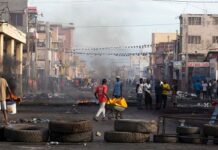

























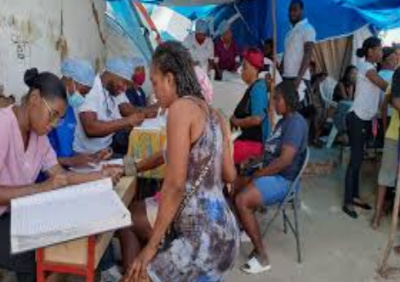
PORT AU PRINCE, Haiti, CMC – The United Nations Sexual and Reproductive Health Agency (UNFPA) says since January this year, gang violence has intensified in several areas of the Metropolitan Zone of Port-au-Prince as well as in Artibonite and Center departments.
“Armed groups continue to terrorize the population through killings, kidnappings, child trafficking, demands for payment at illegal checkpoints, extorting money from local businesses, and the destruction and looting of both public and private properties,” the UNFPA said in its 2006 “Situation Report on the Crisis in Haiti “ covering the period January-March.
It said that on March 25, armed attacks in the municipalities of Verrettes and Petite Rivière in the Artibonite department caused the displacement of 2,010 individuals from 470 households. “The vast majority (96 percent) found refuge with host families, while the remaining four percent relocated to a new displacement site that was established following the incidents. “
In the Center department, violence in Boucan-Carré displaced approximately 4,761 people from 1,035 households.
“Just over half (54 percent) settled across 12 newly established sites, while the remainder found refuge with host families. UNFPA and its implementing partners have mobilized to respond to the urgent SRH and GBV needs of the affected population.
“However, humanitarian access and logistical constraints continue to hinder rapid response efforts and the delivery of supplies beyond Port-au-Prince. Expanding gang control over key road and maritime routes has further delayed project implementation and response activities.
According to UNFPA, in the Artibonite, Center departments, as well as the Metropolitan zone of Port-au-Prince, houses have been burned, and there is an increase in kidnappings and robberies. It said that an estimated 1.4 million people have been forced to flee their homes, and thousands more have died.
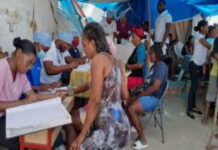
”Despite the security constraints, UNFPA and its implementing partners continue to provide sexual and reproductive health (SRH) and gender-based violence (GBV) services,” the UN organization said, noting that in the first quarter of 2026, UNFPA reached 7,470 people with SRH services and 5,580 people with GBV prevention and response activities.
It added that a total of 2,792 dignity kits were also distributed to displaced women and adolescent girls, as well as 100 inter-agency reproductive health (IARH) kits provided to health facilities and non-governmental organizations to meet the needs of 5,489 people.
UNFPA said it is appealing for US$32.8 million to strengthen and expand access to lifesaving SRH and GBV services in Haiti in 2026. It said that as of March, the total amount received was US$1.8 million, representing only 5.5 percent of the required funding.
“With needs escalating in Haiti, additional funding is urgently required to ensure critical health and protection services for women and girls.”
UNFPA said it has deployed midwives, nurses, and obstetricians to strengthen Comprehensive Emergency Obstetric and Newborn Care (CEmONC) services and the CMR services. This included five health facilities in the Center department, five in Artibonite department, and six facilities in the West department, including Petit-Goave Hospital, which was recently affected by Hurricane Melissa.
It said that since January, UNFPA has established WGSSs at the Toussaint Louverture, EFACAP, and Immaculée Conception displaced sites in Hinche, in the Center department.
“A total of 1,453 women and girls benefited from psychosocial support, and 62 of these were also referred to additional services, including medical assistance, 116 calls were made to the GBV hotline… supported by UNFPA and operated through implementing partners, continued to deliver psychosocial support, facilitate referrals to specialized GBV services, document cases, and provide GBV-related information to callers,” among other initiatives.
Following the recent gang attack in the Center department, UNFPA’s implementing partner, Organization des Citoyennes pour une Nouvelle Haïti (OCNH), conducted a rapid needs assessment at two new displacement sites in the Boucan-Carré commune to ensure that women and girls’ protection needs are central to the programming response. Immediate and spiraling needs remain health and protection, hygiene supplies, clothes, shelter, food, water, sanitation, and hygiene.






 and then
  says since January this year, gang violence has intensified in several areas of the Metropolitan Zone)