












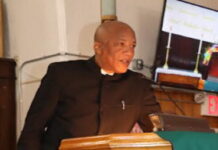




















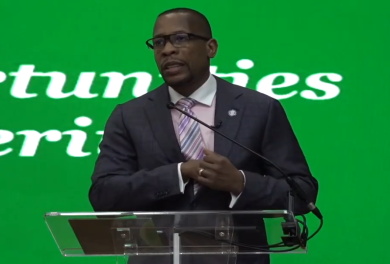
BASSETERRE, ST. Kitts, CMC – Governor of the Eastern Caribbean Central Bank (ECCB), Timothy Antoine, says that while the Eastern Caribbean Currency Union (ECCU) is politically integrated, it is, however, economically fragmented.
Antoine, addressing the ECCB’s 10th Annual Growth and Resilience Dialogue, which ends here on Friday, said as a result, the ECCU, comprising Anguilla, Antigua and Barbuda, Dominica, Grenada, Montserrat, St. Kitts and Nevis, St. Lucia, and St. Vincent and the Grenadines, faces a fundamental paradox and “that contradiction is costing us growth.”
The event here is being held under the theme “The Big Push: Resilient Leadership in a Dynamic World.”
The “Big Push” is a transformative 2026-2031 strategy initiated by the ECCB to accelerate, sustain, and double the gross domestic product (GDP) of the ECCU within a decade. It focuses on building resilience, accelerating renewable energy, digital transformation, and wealth creation to boost the region’s economy.
Antoine told the delegates to imagine an economy with steady growth. However, people still feel no progress, where costs are rising faster than opportunities, and where stability exists but transformation remains out of reach.
”That is not just a risk. It is a warning. And that is why we are here today,” he said, noting that while the ECCU is projected to grow at approximately 3.3 percent in 2026 and three percent in 2027, “that is not transformation.
“That is maintenance, and maintenance will not secure our future. And that is precisely why the Big Push is not optional, it is imperative,” he said, adding that the Big Push sets an ambition of seven per cent annual growth over the next decade.
He said that, while undertaking that initiative, the sub-region must also confront “another, quieter challenge” in which populations are not growing but are shrinking.
“This means fewer workers, lower output, and greater pressure on those who remain. Since we cannot grow by sheer numbers, we must grow by productivity. We must become a high-productivity, talent-driven economy.
“That requires managed talent mobility, attracting, integrating, and retaining skilled people from our diaspora and beyond, thereby moving from a brain drain to brain gain. We must grow differently. We must grow smarter. We must grow faster.”
He said one of the pieces of good news is that the Eastern Caribbean Dollar remains “strong, with a current backing ratio approaching 99 percent,” and that in July it will celebrate 50 years of stability under the peg. The EC dollar is pegged to the US dollar at 1 EC dollar = US$0.37.
“That stability is our foundation. But The Big Push will determine our future: stagnation or transformation,” Antoine said, noting that action is needed now since any delay is development denied.
He said in a world of constant shocks, hesitation and inaction carry real costs, and that delay compounds stagnation and, over time, leads to decline.
Antoine said that across every sector, food, energy, and tourism, the ECCU must move up the value chain, adding, “We must scale through collective action.
“No country, institution, or sector can do this alone. Transformation requires coordinated and sustained execution at scale,” he said, adding that the Big Push is the fire needed to transform the sub-region.
“It ignites action. It aligns effort. It delivers transformation, at scale,” he said, noting that the seven theatres of transformation are not a list of aspirations.
“It is a coordinated transformation agenda already underway,” he said, noting that the ECCU countries import nearly 90 percent of the food they consume, at a cost of more than two billion EC dollars annually.
“This is not just a food bill. It is a bill for vulnerability, paid every time the world is disrupted. Every external shock, whether supply chain disruptions or price spikes, hits our plates and our pockets. We must change that.
“Our goal is clear: reduce the food import bill by 25 percent through climate-smart agriculture and stronger regional distribution. Food must be produced regionally and moved regionally. And we must not ignore nutrition, because non-communicable diseases cause eight out of every ten deaths in our region.”
Antoine said food security is not just about availability; it is about affordability, resilience, and health. He also said that nearly 90 percent of the sub-region’s energy needs are met by imported fossil fuels.
“That means our economies remain exposed to global price volatility that we do not control. When oil prices rise, everything rises: electricity, business costs, and fiscal pressure. That is exposure we cannot afford.
“That is not sustainable, and it is not acceptable. Yet the opportunity before us is immense. Regional technical assessments suggest several gigawatts of geothermal potential and hundreds of megawatts of wind potential across the Eastern Caribbean,” Antoine said, noting that at the ECCB, the one megawatt solar plant already saves approximately two million E dollars million annually.
Antoine commended the government of St. Kitts and Nevis and the Nevis Island Administration on the signing of the agreement for the drilling of its production and reinjection wells.
He said that, through the Resilient Renewable Energy Infrastructure Investment Facility, in partnership with the World Bank, member countries, and others, the transition to clean, reliable energy will be accelerated.
“Energy security is not optional. It is economic security, and it is resilience,” Antoine said, adding that across the ECCU, it is often cheaper to import from outside the region than to trade within it.
“That is not just inefficient. It is unacceptable. Our biggest barrier is not distance. It is a disconnection. When people and goods move more easily and affordably, markets deepen, businesses expand, opportunities multiply, and growth accelerates.
“That is why we must invest in regional transport systems, modern ports, and digitized trade platforms. Without connectivity, there is no integration. Without integration, there is no scale.
The Big Push demands we fix this, decisively,” the ECCB Governor said, noting that nearly half of the ECCU population is not meaningfully participating in the digital economy.
“That is not just a digital gap. It is a growth gap. We must change that. Our digital agenda will focus on universal broadband, digital skills, AI-enabled services, and cybersecurity. Digital access must become a digital opportunity, and digital opportunity must result in economic empowerment. ”
Antoine also said that financial inclusion and wealth creation are lacking in the ECCU, with financial literacy at 12.2 out of 20.
”This means that, on average, our citizens correctly answer just over half of basic questions on saving, interest, debt, and investing. And the outcome is clear: Only 1 in 25 people, just 4 percent of our population, participates as investors in our securities market.
“That is not inclusion. That is exclusion. And that must change. We must move from savers to investors, thereby broadening ownership of wealth across our communities and countries.”
Antoine said the response is to expand the Partial Credit Guarantee Program with the ECCB, which has already supported more than 300 guarantees valued at EC$30 million.
He said the digital IDs are expanding, with Grenada as the pilot in 2025, and that retail bonds are being developed through the CARICOM Payment and Settlement System (CAPSS), enabling real-time, low-cost cross-border payments in local currencies.
Antoine said that these initiatives are necessary because financial inclusion must lead to financial empowerment, and financial empowerment must lead to wealth creation.
He told the conference that tourism growth will not come from more visitors alone, but from greater value per visitor.
“A modest increase in daily spending can generate millions in additional revenue without a single new arrival. We must make a decisive shift to high-value, sustainable tourism,” he said, adding, “we must stop chasing arrivals and start maximizing value”.








 and then
 , Timothy Antoine, says that while the Eastern Caribbean Currency Union (ECCU))