






































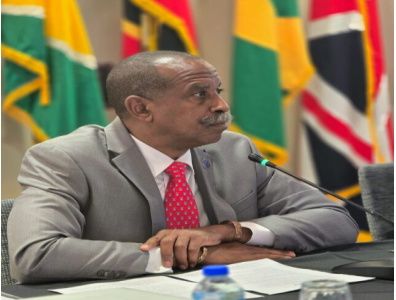
CASTRIES, ST. Lucia, CMC – The executive director of the Barbados-based Regional Security System (RSS), Rear Admiral Errington Shurland, says public-private partnerships and multilateral cooperation remain key to preserving stability, advancing development, and safeguarding the shared values of RSS member states.
Shurland told the RSS Council of Ministers meeting here that the shifting dynamics and geopolitical uncertainty of the current era require strong, enduring partnerships if states are to overcome emerging, increasingly complex challenges.
Shurland spoke of the regional organization’s achievements through collaboration with a range of international and regional partners, including the governments of Canada, the European Union, the United Kingdom, and the United States, as well as institutions such as the Eastern Caribbean Central Bank (ECCB), the Inter-American Development Bank (IDB), the Caribbean Development Bank (CDB), and and the Caribbean Community (CARICOM).
He said that these collaborations demonstrate that the cooperative frameworks already in place serve as “pillars of trust,” enabling states to address existing challenges collectively.
“In an international system that is characterized by shared security concerns and interconnectedness of criminal organizations across several jurisdictions, international cooperation remains an essential pillar in successfully managing crime and security,” Shurland stressed.
He said that the RSS, a treaty-based multilateral military alliance and hybrid organization in the Eastern Caribbean, established in 1982 to coordinate collective responses to regional security threats, is prepared to act as a catalyst for multilateralism.
He said the RSS, which brings together military and police personnel for maritime law enforcement, disaster management, and anti-narcotics efforts, will continue expanding partnerships to strengthen domain awareness, enhance competencies and cooperation, address corruption and governance issues, and improve information and intelligence sharing across jurisdictions.
“The RSS’s upcoming work with Global Affairs Canada, the Caribbean Development Bank, and the European Union through the Neighborhood Development International Cooperation Instrument and the EL PACCTO 2.0 program demonstrates renewed commitment to multilateral engagement rather than global fragmentation.
“RSS is also co-sponsoring other initiatives to enhance legislative and procedural frameworks required for effective law enforcement responses to cyber-enabled and cyber-dependent crimes, strengthening comprehensive statistical collection and data sharing systems across criminal justice agencies, and developing a new Strategic Plan and sustainability model. These will be done with the support of the European Union and CDB, respectively,” he said.
Shurland also pointed to the RSS’s partnership with the United Kingdom’s One Caribbean Fund and the Caribbean Basin Security Initiative, a collaborative effort with the United States, as further evidence of the value of strong partnerships in ensuring the region’s collective security.










 and then
 , Rear Admiral Errington Shurland, says public-private partnerships and multilateral cooperation remain key to preserving stability)