







































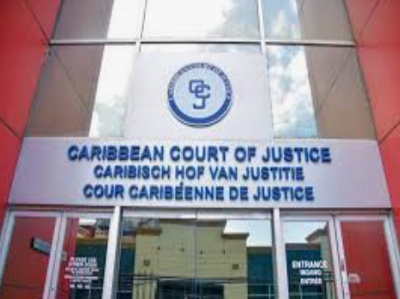
GEORGETOWN, Guyana, CMC – The Caribbean Court of Justice (CCJ) will on Wednesday conduct a case management conference involving Opposition Leader Azruddin Mohamed and his businessman father, Nazar “Shell” Mohamed, who are contesting their extradition to the United States on fraud-related charges.
The Mohameds moved to the Trinidad-based CCJ, the country’s highest and final court, appealing a decision by the Guyana Court of Appeal that the Home Affairs Minister, Oneidge Walrond, was merely performing an administrative function in issuing to a Magistrate Court, the Authority To Proceed (ATP) to begin their extradition process.
The ATP paved the way for the court to issue arrest warrants for the Mohameds and to proceed to subsequent committal proceedings, now before Principal Magistrate Judy Latchman. But the Mohameds are seeking a stay of the current extradition committal proceedings before the CCJ.
Their lawyers are arguing that Walrond’s decision was “infected” by political bias due to the utterances against the Opposition Leader, adding that they amounted to political persecution by his political opponents, namely President Irfaan Ali, Vice President Bharrat Jagdeo, and the Attorney General and Minister of Legal Affairs, Anil Nandlall.
“The Court of Appeal erred in law and in fact when it failed to give due weight to the sheer prejudicial nature of the accepted evidence of innumerable statements uttered by the Minister’s political leaders to whom she was answerable….(and) who for several consecutive months before the issuance of the Minister’s ATP constantly advanced their views and acted as a pressure group in labelling the Mohameds as ‘criminals’, ‘tax frauds’, ‘dishonest’, ‘robbers’, etc and ‘guilty’ of the very offences which formed the subject of the ATP,” lawyers noted in the appeal.
The lawyers are also asking the CCJ to rule that the Guyana Court of Appeal erred in law when it found that the Minister’s issuance of the ATP setting in motion the extradition committal proceedings was merely an “administrative act incapable of attracting any actual, perceived or notional bias”‘ impermissibly immunising the Minister’s ATP decision from being susceptible to judicial review for bias and so carved out in law a category of decisions which are immunity from bias.
In their appeal, the Mohameds are also contending that the Guyana Court of Appeal failed to consider that the Minister and her association, her government and its leaders, directly stood to benefit politically from the extradition of her and her association’s main political rival and his father, as such would justify the prejudicial statements made by her political leaders before the issuance of her ATP and suppress the Applicants’ political views adverse to her and her association, and otherwise.
The CCJ is also being asked to find that the Court of Appeal was wrong in law when it found that the Attorney General was not infected with bias, whether presumed or apparent, due to prejudicial statements made by him against Azruddin Mohamed in evidence that were unaddressed.
They said the Court of Appeal failed to consider that the Minister, if the Magistrate ordered the committal of the applicants, was obligated under the Fugitive Offenders Act to make the final decision as to whether or not to issue an order extraditing them and so the Minister’s impartiality was indispensable to the their right to receive a fair hearing from an unbiased tribunal/decisionmaker,
Also cited as grounds for appeal was that the Guyana Court of Appeal holding that the ATP decision of the Minister and any role of the Attorney General in facilitating and/or advising on the ATP could not be delegated to a person unaffected by presumed or apparent bias under section 27 of the Interpretation and General Clauses Act, Cap.2:01, and/or the Carltona principle.
The appellants also contend that the Court of Appeal erred in law in failing to give due consideration to the fact that the ATP decision substantially encroaches upon the fundamental rights of persons as it confers and empowers jurisdiction to the court of committal and triggers the local extradition process, without which no arrest, committal, or extradition may occur.
The Mohameds also said the Guyana Court of Appeal erred by relying on subsequent judicial safeguards, such as committal proceedings and habeas corpus, to find that bias could not have arisen at the initiation stage or in the ATP decision.
Further, the appellants say the Court of Appeal failed to consider the duty of fairness owed by the Minister to the Applicants/Intended Appellants, given the substantial adverse impacts it would cause to their lives.
The Mohameds are challenging their extradition to the United States, where they are wanted on several fraud-related charges. They were indicted in the United States in October 2025 on charges including wire/mail fraud, money laundering, and bribery linked to a US$50 million gold smuggling and tax evasion scheme. They were arrested in Guyana in October 2025 following a US extradition request.











 and then
  will on Wednesday conduct a case management conference involving Opposition Leader Azruddin Mohamed and his businessman father)