
































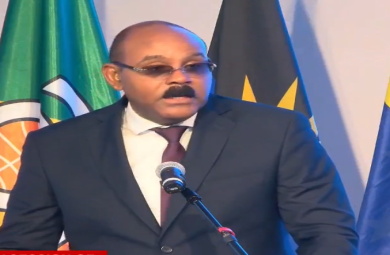
ST. JOHN’S, Antigua, CMC – Antigua and Barbuda Prime Minister Gaston Browne, Monday, defended the Citizenship by Investment (CBI) programme, which is being implemented by several countries in the Organisation of Eastern Caribbean States (OECS) to improve their socio-economic development.
Under the CBI programme, these countries, like Antigua and Barbuda, provide citizenship to foreign nationals in return for making a substantial investment in their socio-economic development.
“For several Caribbean small island states, these are lawful, transparent development tools, operating within clear legal frameworks and strong oversight. They have been strengthened in consultation and with the participation of the European Union, the United Kingdom, and the United States,” Prime Minister Gaston Browne told the inaugural European Union-Caribbean Parliamentary Assembly (CACP).
The three-day Assembly has been described by the EU as a “historic step in the partnership under the Samoa Agreement,” allowing for parliamentarians from Europe and the Caribbean to strengthen political dialogue and discuss key shared priorities, including climate resilience and energy transition, trade and investment, transnational organised crime, territorial integrity and multilateralism, and the situation in Haiti.
The Assembly comprises one Member of Parliament from each State Party in the Caribbean and an equal number of Members of the European Parliament. The Caribbean countries are Antigua and Barbuda, The Bahamas, Barbados, Belize, Dominica, the Dominican Republic, Grenada, Guyana, Haiti, Jamaica, St. Kitts and Nevis, St. Lucia, St. Vincent and the Grenadines, Suriname, and Trinidad and Tobago.
Prime Minister Browne told the delegates that the CBI programmes are very important and have “helped finance hurricane recovery, climate-resilient infrastructure, healthcare, education, and fiscal stability in these small economies with limited alternatives.
“We recognise that integrity is essential, and we have acted accordingly, tightening vetting, enhancing regulation, and expanding international cooperation,” he said, adding, “citizenship policy remains a sovereign responsibility.
“But sovereignty does not preclude dialogue. We have invited and continue to engage with the European Union on strengthening our CBI programmes. It is an engagement that is evidence-based, technically grounded, and as respectful of our development realities as we are respectful of your concerns. “
Prime Minister Browne said that the stringent due diligence, biometrics, residency, and other requirements make the “obtention of our citizenship far more difficult and less risky than other third country nationals obtaining non-immigrant EU visas.
“Therefore, the perceived risks associated with our citizens accessing the European Union are exacerbated,” he added.
Browne told the conference that in a world where pressure is increasingly mistaken for policy, “we choose to remind ourselves and each other that law, not leverage, is the only durable foundation of peace and prosperity.
“For the Caribbean, multilateralism is not a generalised abstract concept. It is a rules-based order on which small states in the Caribbean depend. It is how small states survive in a world of unequal power and inequitable distribution of economic and social benefits.”
He said that the rules are the shield for the Caribbean, with law as its insurance and predictability as the lifeline.
“When those weaken, our vulnerability grows. It is felt first by small, open economies such as ours in the Caribbean. But as Europe has come to learn, that vulnerability does not remain contained; it spreads outward and eventually reaches even middle powers.”
Browne said that only through multilateral cooperation and the practical, joint application of principles, rules, and law can small and medium-sized countries resist coercion.
He said that the European Union itself is proof that law-based, patient, negotiated, and principled cooperation can convert fragility into stability and difference into strength.
“We, in the Caribbean, have pursued the same approach, although not as yet, with the same level of success. But to the extent that both our regions recognise and practice integration and joint action, that shared experience must be the foundation of the partnership between Europe and the Caribbean.
“And at this moment in history, it must be reaffirmed, not quietly, not cautiously, but clearly. The EU and the Caribbean must stand together in defending multilateralism, not as rhetoric, but as practical diplomacy and institutional reform. “
Browne said that climate change remains the Caribbean’s defining challenge.
“We did not cause it. We cannot escape it. And, unlike others, we cannot deny it. We have to adapt to it and build resilience. We are adapting and building resilience, but the pace of impact now exceeds the pace of our capacity to respond.”
But he said the reality is that rising seas, coastal erosion, continuous droughts, and now the persistent burden of sargassum, an ecological crisis with real economic consequences for tourism, fisheries, public health, and coastal infrastructure.
“We therefore need partners not only to help us strengthen resilience within our region, but to act internationally to arrest climate change at its source. For there is no refuge in indifference: if the Caribbean perishes, climate change will not abate, it will only gather force and strike the next most vulnerable nations.”
Browne said that the Caribbean welcomes the European Union’s Global Gateway initiative and its stated ambition to mobilise investment at scale.
In 2021, the European Commission and the EU High Representative launched the Global Gateway, a new European strategy to boost smart, clean, and secure links across the digital, energy, and transport sectors, while also strengthening health, education, and research systems worldwide.
The EU said that since 2021, Europe has mobilised over €306 billion (One Euro = 1.29 cents) in investments to support sustainable, high-quality projects, addressing the needs of partner countries and ensuring lasting benefits for local communities.
In his address, Prime Minister Browne said that ambition must now translate into delivery.
“Resilient energy grids, renewable power generation, coastal protection, and climate-adaptive infrastructure cannot remain immobile simply as announcements and pilots,” he said, adding that finance must move faster.
“Access must be simpler. And vulnerability, not outdated income classifications, must guide eligibility. This is not a plea for charity. It is a call for partnership grounded in shared risk and shared responsibility.”
He said that the same principle applies to trade, noting that the EU–CARIFORUM Economic Partnership Agreement (EPA) provides a sound legal framework. Still, law alone does not generate prosperity; execution does.
“Small and medium-sized Caribbean enterprises still struggle to translate access on paper into access in practice. Rules of origin, regulatory complexity, and limited technical capacity, too often blunt the promise of the Agreement.
“If this partnership is to mature, it must become more usable, more navigable, and more responsive to the realities of small economies,” Prime Minister Browne said, adding that the ingredients for a reset in EU–Caribbean relations are present.
“What has been missing is the political will to implement them. The Caribbean does not need a proliferation of declarations.
“It needs a focused and coherent agenda to include: targeted market-access fixes, modernised rules of origin, credible investment pipelines under the Global Gateway initiative, climate finance that is fast and accessible, and security cooperation that recognises transnational crime as a shared threat.
“At a time when global trade routes are being reshaped, predictability is not a luxury; it is an economic stabiliser,” Browne said, adding that rules-based trade protects the strong, and while it has not always done so, it must also enable the small.
“We seek deeper European investment in renewable energy, science and technology, digital services, sustainable tourism, the blue economy, and the creative industries. The Caribbean offers political stability, strategic location, and a firm commitment to democratic governance and the rule of law.
“We offer certainty. We offer reliability. We offer a partnership. But a partnership also depends on people. Trade, investment, culture, and innovation require mobility. Entrepreneurs must meet investors. Artists must perform. Researchers must collaborate.
“A modern EU–Caribbean relationship must therefore support legitimate, secure, and predictable movement—fully consistent with security requirements but not constrained by unnecessary friction and exaggerated fears about our investment immigration programmes,” Prime Minister Browne added.








 and then
  programme, which is being)