





















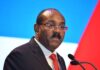
CASTRIES, St. Lucia, CMC – Prime Minister Phillip J. Pierre has confirmed that the United States has called on St. Lucia to stop sending its nationals to study medicine there.
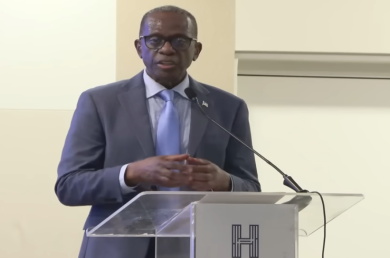
“I have a big problem. Many of our doctors got trained in Cuba, and now the great United States has said we can’t do that anymore,” Pierre told the weekend meeting of the second World Congress on Racial and Ethnic Health Disparities here.
“This is a major problem I have to face,” Pierre said, noting that most of the local doctors …have been trained in Cuba.
“We also have Cubans who come over to work. So the American government has said we can’t even train them in Cuba. So I have a major issue on my hands,” Pierre told the conference.
Pierre told the audience that many of St Lucia’s doctors received their training in Cuba and that the United States has now taken the position that this arrangement can no longer continue, adding pressure to an already strained health sector.
He cited the United States geopolitical pressures as the driving force behind this unprecedented shift, while urging the diaspora and innovative local initiatives to help the country navigate these new challenges.
Last month, the United States Embassy in Barbados said the Cuban regime’s “medical missions” programme, which has benefitted several Caribbean countries, relies on coercion and abuse.
“Cuban medical workers face withheld wages, confiscated passports, forced family separation and exile, restriction of movement through curfews and surveillance, intimidation and threats, and even pressure to falsify medical records and fabricate procedures. Many also endure excessive work hours and unsafe conditions,” the Embassy said.
Washington said it “is committed to exposing injustices and bringing an end to the Cuban regime’s coercive programme”.
Washington has also stepped up its attack on the Cuban health brigade programme, saying that the regime in Havana “is profiting off the forced labour of medical personnel and that “renting out Cuban medical professionals at exorbitant prices and keeping the profit for regime elites is not a humanitarian gift.
“It is forced labour. It treats the doctors as commodities rather than human beings and professionals. The United States calls for an end to the Cuban regime’s coercive and exploitative labor export scheme.”
The chair of the Congress, Sir Cato Laurencin, an orthopedic surgeon and senior academic based in the United States, said St Lucia is not without options.
“Those of us in the diaspora with St. Lucian roots need to work more closely with St. Lucia. There are physicians here who want to be part of the new hospital system and support the country’s healthcare development,” Laurencin said, noting the initiatives linked to the University of Connecticut’s institute as potential models.
He also highlighted programmes focused on fitness, healthy lifestyles, and local food cultivation, saying that such efforts are increasingly crucial as Washington has outlined concerns about Cuban medical missions through official diplomatic channels in the Eastern Caribbean.
Pierre also addressed the financial pressures facing the health sector, citing the long-delayed re-opening of the St Jude Hospital in Vieux Fort, south of here. He said commissioning the facility would cost about US$50 million, a figure the national budget cannot absorb.
He said his administration has explored using the Citizenship by Investment Programme (CBI), through which foreign investors are granted local citizenship in return for making a substantial investment in the island’s socio-economic development, as a means of helping to bridge the funding gap.
“These disparities, apart from social and economic, must filter down into our health care system. We have tried in St. Lucia to implement a school feeding programme to ensure that our kids get at least one nutritious meal a day.
‘But sometimes the funders determine that you have to buy certain foods. I have no choice,” he said, urging the people of the Caribbean region to change their lifestyles and thought processes to deal with the situation.
The hybrid Congress was intended to encourage professionals to come together to discuss racial and ethnic health disparities and how to overcome them.
It was organised by Springer Nature’s The Journal of Racial and Ethnic Health Disparities and the Connecticut National Medical Association (CTNMA) in conjunction with the National Medical Association (NMA), the St. Lucia Medical and Dental Association, W. Montague Cobb /NMA Health Institute, the Cato T. Laurencin Institute for Regenerative Engineering at UConn, and the St. Lucia government.



 and then