





































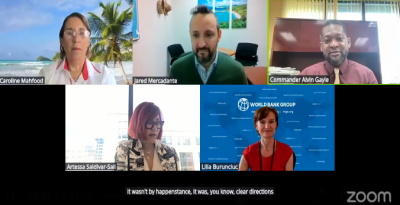
KINGSTON, Jamaica, CMC – The World Bank’s Country Director for the Caribbean, Lilia Burunciuc, said regional countries can develop the necessary resilience to face some of the world’s most severe environmental risks, such as hurricanes, floods, volcanic eruptions, and coastal pressures that can erase progress within hours.
“Definitely…developing resilience is possible, and we can see in Japan, for example, a country in the world that is also prone to many disasters and how resilient this country is,” Burunciuc told a virtual panel discussion, “Caribbean Resilience in Action, From Recovery to Readiness”.
The event organised by the World Bank brought together policymakers, technical agencies, regional bodies, civil society, private-sector partners, and development institutions to reflect on lessons learned and shape the next phase of resilience.
The organisers said that ultimately, the region’s resilience journey is about more than rebuilding, noting “it is about designing financial, institutional, infrastructural, and social systems that enable Caribbean countries to face future shocks with greater strength, unity, and readiness”.
Burunciuc told the panel that becoming resilient like Japan “would require a lot of capacity building with good planning, good prioritisation, and of course learning from mistakes and correcting them and responding better to each following disaster.
‘But in my view, it is possible, and I think the Caribbean region is moving in the right direction, and we see from disaster to disaster, countries are more resilient.
“Of course, there is still a long way to go, but we are here to travel this road with you,” she told the panel.
The executive director of the Jamaica-based GraceKennedy Foundation, Caroline Mahfood, said that the region has little or no choice but to develop the necessary resilience to disasters, adding, “we have to be resilient or unless we are going to leave our islands”.
She said even with the passage of Hurricane Melissa that struck Jamaica last October killing at least 45 people and leaving damage estimated at more than US$9.9 million “the truth is the way we are building back our schools is going to be very different from how we did it in the past, and I think that will also help to protect us for the future”.
She said that the buildings of the future will have different kinds of roofing and windows, “and as I said, we don’t have a choice, and that’s the way we are as Caribbean people, we are resilient”.
The Director General of the Office of Disaster Preparedness and Emergency Management in Jamaica, Commander Alvin Gayle, said it is “absolutely” possible for the region to develop the resilience needed to deal with future disasters.
But he acknowledged “what it requires is the realisation that it is possible and also making the necessary efforts to cause us to do the things which will make our structures and systems resilient”.
He said Japan’s move towards resilience in the face of disasters “wasn’t by happenstance, it was clear directions and policies that caused it to occur.”
He said that the Caribbean would have to re-examine how buildings are now constructed, as well as how the telecommunications sector is structured, and water treatment plants, adding, “all those things will have to be realised.
‘We also have to realise that resilience starts with an ability to bounce back. It doesn’t mean that we will never be damaged. Still, over time, once the policies and the culture change towards how we look at certain things, we will become significantly more resilient, maybe until we achieve the mark of what happens in Japan,” Gayle said.
The senior infrastructure specialist at the World Bank, Artessa Saldivar-Sali, said the road to resilience may be a long endeavour, citing the destruction caused by Hurricane Katrina, which struck the southeastern United States in late August 2005. The hurricane and its aftermath claimed nearly 1,400 lives, and it ranked as the costliest natural disaster in US history.
“Believe it or not, they are still rebuilding and recovering. And this is not meant as a criticism, but it’s the recognition that no matter how much resourcing you have, how much good intention…resilience is a long term endeavour.”
She said that while the World Bank is happy to be “walking this road, I think we also need to embrace realism and pragmatism, and discuss digital transformation. Every day, there is an opportunity to be smarter and to leapfrog some of the challenges.
She reminded the panel and the audience that resilience does not mean you will not get hurt again, “it means that every time you fall, you get up.
“I fully agree that resilience is growing, and we are delighted to be working together on this”.











 and then