






































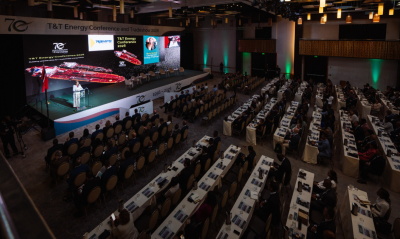
PORT OF SPAIN, Trinidad, CMC – The Energy Chamber of Trinidad and Tobago, Monday, opened a three-day energy conference promising to review the Safe To Work (STOW) programme after the government withdrew support for the event.
“We have committed to reflect, review, and make changes as needed,” Energy Chamber chairperson Mala Baliraj told the opening ceremony following recent criticisms from Prime Minister Kamla Persad-Bissessar, who had labelled the Energy Chamber as “self-serving” and had instructed state-owned entities, including Heritage Petroleum and the National Gas Company (NGC), not to participate in the event.
The conference is being held under the theme “Building collaboration for a sustainable energy future”.
Last week, Energy Minister Dr. Roodal Moonilal told the post-Cabinet media conference that “STOW through the Energy Chamber is holding businesses to ransom by having a monopoly on who can conduct business in the energy sector using health and safety as a strangling tool.”
The government has moved to terminate the STOW certification as a mandatory requirement for state projects.
“It is not practical for me to use this platform to address all of the issues raised in the last week, but I do want to acknowledge them and to assure you that we will address the specific concerns through the appropriate channels constructively and respectfully.
“Our intention is always to work towards a collaborative approach with all of our stakeholders; as such, we hope to be able to reposition and create a space for open and structured engagement with the government that supports the best outcomes for the sector,” Baliraj said.
“We have listened to the message in the spirit of constructive feedback. We acknowledge that some stakeholders believe the STOW programme has acted as a barrier to small contractors’ ability to do business. We are committed to a collaborative approach to reposition this space.”
The Energy Chamber chairperson said that there is a view that the private sector body is “dominated by multinationals and a handful of larger local members.
“We hear this perception, and it is understandable where that might come from, but I take the opportunity to clarify. The Energy Chamber’s membership is diverse and includes all ownership structures.
“Among the roughly 400 members, the range is from giant global corporations to micro-enterprises and everything in between. To guard against the dominance of one set of interests over another, there is a robust, transparent governance framework that ensures a diverse Board that reflects this breadth of membership.
“Given the current perception, we clearly have to do better. We need to ensure that the perception is not, in fact, driven by reality. So, to ensure that the perception does not persist, we will review our internal governance to re-commit to fair and balanced representation with broad-based engagement of our membership and critical external stakeholders.”
Baliraj said that she also wanted to reinforce the aim of the conference, “as it has come under question.
“The conference’s primary purpose has always been to create a space, one time, every year, when the Trinidad and Tobago energy industry players come together. It is meant to create an atmosphere where we can discuss the issues that impact us all, explore ways we can work together, and build new networks and opportunities for our businesses.
“I dare say, some have come to believe that you can get a quick sense of the health-check of the local energy sector by the ‘vibe’ of the conference,” Baliraj said.
In her address, the Energy Chamber chairperson noted the period of intense activity in the local energy landscape.
The Chamber referred to several significant milestones, including the licensing of an ultra-deepwater exploration block to the US pilot and energy giant, ExxonMobil, which it said has reignited global interest. The seismic vessel Amazon Warrior is reportedly preparing to begin a five-month 3D survey of the block this week.
“Given Exxon’s unprecedented success across the maritime boundary in Guyana, this has understandably raised significant renewed global interest in Trinidad & Tobago. We have also seen the entry of another global player, China National Offshore Oil Corporation (CNOOC), into Trinidad and Tobago’s deepwater with bids for blocks TTDAA 24, 25, and 30. We hope those bids will move forward, into an active exploration campaign soon.”
In addition, the Brechin Castle Solar Farm, the largest in the English-speaking Caribbean, has officially begun feeding green electrons into the national grid, and progress remains steady on Shell’s Manatee project and bpTT’s Cypre development, both of which are critical to maintaining the country’s natural gas supply.
“In 2025, we have also seen projects that we had listed as being in the FID category “working towards a final investment destination”, moving into the execution phase with FID having been taken, notably, Shell’s Aphrodite project.
These projects, joined with others, are already in execution and working towards the first production. These include the EOG/bpTT Coconut project, which is in execution, with the platform under construction in the TOFCO yard, and bpTT’s fourth subsea project, Ginger, also on schedule to deliver first gas in 2027.
“The biggest project in execution is the Shell Manatee, set to come onstream at the end of 2027. By all reports, execution of these major projects is all proceeding as planned: important news for the downstream gas industry,” Baliraj said, adding that while the government’s absence is felt, the industry’s daily operating reality requires high-quality safety practices that “protect lives and ensure workers return home to their families.”
She told the conference that securing investment decisions for these and other upstream projects remains the most crucial element to secure the future of Trinidad’s energy sector.
“In recent months, we have seen the Minister of Energy place a firm focus on accelerating approvals in the energy sector, culminating in the welcome news of the Cabinet’s decision to establish an oversight committee, the Energy Accelerator Hub. It is heartening to see a focus on this area, which aligns with our advocacy position over the years. The Energy Chamber remains fully committed to working with the government on that process.”
This year marks the 70th anniversary of the Energy Chamber of Trinidad and Tobago, with Baliraj acknowledging “those men and women of energy, on whose shoulders we stand”.











 and then