

































KINGSTOWN, St. Vincent, CMC – The St. Vincent and the Grenadines government says it will adopt the position of the sub-regional Organisation of Eastern Caribbean States (OECS) even as the main opposition Unity Labour Party (ULP) urged Kingstown to reject a request from the United States to facilitate third country refugees to mitigate scenarios where Washington cannot return these individuals to their state of birth or origin.
So far, Antigua and Barbuda, Dominica, St. Kitts and Nevis, and St. Lucia have said that they have signed a memorandum of understanding (MOU) with Washington regarding the removal of refugees and deportees.
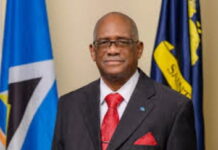
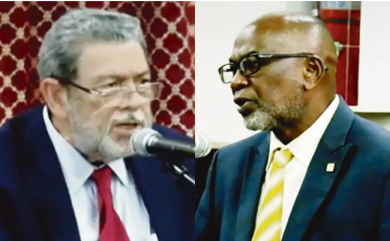
“The Prime Minister has indicated that his OECS colleagues, prime ministers, will be meeting as a collective and deciding, with the proper advice from the technocrats, how we will address the State Department on this issue for clarifications and for the appropriate protocols in dealing with the situation,” said Deputy Prime Minister St. Clair Leacock.
“Let’s take these things in concentric circles. We’re not alone. That’s the CARICOM situation with Venezuela. That’s the CARICOM (Caribbean Community) situation regarding immigration. You listen to the news; you see what’s around it. The whole world is in crisis. Bigger people than us are trying to come to grips with their relationships,” said Leacock, who is also Minister of National Security and Immigration.
But Opposition Leader, Dr. Ralph Gonsalves, says St. Vincent and the Grenadines and other Caribbean Community (CARICOM) countries should reject the United States’ proposal to accept refugees and deportees from third countries.
Gonsalves said that while Leacock said that Kingstown will stand by the OECS position, the government should also come to its own conclusion to reject Washington’s request.
Gonsalves, who was voted out of office on November 27 last year, after 25 years as head of government, said the United States had approached his administration on the matters not long before the elections.
“I told the US authorities that it was not within their interest and our interest to accept deportees and refugees from third countries emanating out of the United States of America,” said Gonsalves.
“The point that I made was that the numbers you’re going to ask us to take are not going to move the needle,” he said, adding that there are tens of thousands of refugees and persons to be deported from the United States.
He said Washington was suggesting that each OECS country accept between 10 and 20 of these people each year.
“Let us say 12 for each of the six OECS countries. That’s 72 people. That’s a drop in the bucket as far as the US would be concerned. So why do they want to put that pressure on us?” Gonsalves said.
He suggested that the United States wants to tick a box to leverage larger countries, telling them, “Hey, these nationalist governments in the Eastern Caribbean, small, they take in as many as they can take. What about you? Why don’t you take more?” Gonsalves said.
Leacock, using the example of Europe and the United States, where Washington is attempting to annex Greenland, which is part of Denmark, said even Europe is uniting to deal with the United States, and “they are big and mighty countries.
“What are they doing? Not Germany by itself, not France by itself, not England by itself.
“They’re saying, as a collective, let us have a conversation and have a stand. And if they are doing that, why do you feel small island states like St. Vincent want to be laws unto themselves?”
Leacock said that while St. Vincent and the Grenadines is a sovereign state, he maintains that the country will follow the “cooperative position of the OECS.
“… the cooperative position that the prime ministers sit down and disagree and agree, come out with after they’ve met with the US State Department. And that is not settled as yet.”
Asked if Kingstown has its own position, Leacock said:
“But what would be the position? The position is rational. Any person has a sense of self-belief, and a sovereign state would not want someone imposing on them what, on the surface, seems to be an unreasonable solution.
“And, therefore, you’re going to try and negotiate yourself out of that with your eyes wide open and a high degree of realism of who you’re coming up with and dealing with against. And that’s what it is. That’s what we’re dealing with.”
Leacock, who was speaking on a radio programme here, asked listeners whether they want, “with one stroke of the pen, having taken a stand today on the immigrant position, which, basically, is people want to live in America, find that tomorrow, those of you want the right to go to America can’t go to the United States of America?
“And then the same set of people will say, ‘You all have messed up.’ So I’m taking guidance and direction from my foreign minister and my prime minister on this,” Leacock said, adding that he is due to meet with the Commissioner of Police, Enville Williams, and the head of the regional security system.
“He will be making a presentation to us on the implications of Venezuela and other issues on regional security,” Leacock said, noting that in March, he takes up the chairmanship of the Council of Ministers for National Security.
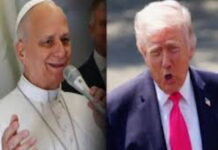
Gonsalves, who was also speaking on a radio programme here, said Washington’s actions are in pursuit of its America-first strategy and domination of the Western Hemisphere under the Monroe Doctrine, and its Monroe Doctrine iteration under President Donald Trump.
Gonsalves said that unless there is a united, concerted effort to go to the United States through CARICOM, states within the 15-member regional bloc will be “picked off one by one”.
He said CARICOM countries rolling over and playing dead, thereby becoming neo-colonies or resisting the United States on every single question, would be “an infantile approach, given all the practical circumstances”.
He, however, said there is a range of negotiables in between those two extremes that the region can use to advance its own requests on matters CARICOM would like to see done in its favour, even while not compromising on things that are existential to the bloc.
“… on specific issues like this, the refugees and deportees, … we should say no … and we should explain in the manner in which I’ve just said that is not in the interest of the United States of America for it to be done.”
Gonsalves rejected the suggestion that the refugees and deportees could include “persons of some quality” who might be skilled and the receiving country’s right of refusal, saying, “… all that sounds good on paper.
“The truth of the matter is, the Americans would like to keep the skilled people and the people who could build up their country; they don’t want to send them to us. What we’re going to get, by and large, are quote-unquote, the dregs, just like what they sent to El Salvador.”
The former minister of national security said that even when CARICOM nationals are deported after serving a sentence in the United States, they are only told about the offence for which the person was imprisoned.









 and then