




























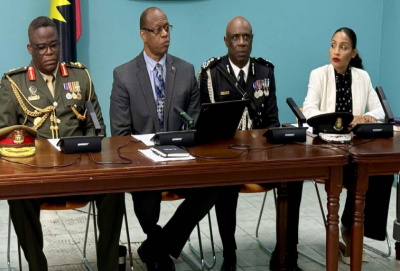
ST. JOHN’S, Antigua, CMC – The leadership of Antigua and Barbuda’s law-enforcement and national security agencies say they will continue to work against any attempt to make the island a transit corridor for narcotics trafficking.
“We will not provide shelter for those who profit from it. We remain vigilant at sea, resolute in investigation, firm in enforcement, and committed to cooperation with trusted partners—guided always by the law and the national interest,” they said in a joint statement.
The heads of the Royal Police Force of Antigua and Barbuda, the Antigua and Barbuda Defence Force, the Office of National Drug and Money Laundering Control Policy and Antigua and Barbuda Immigration Department, are also calling on the population to “remain alert and to report suspicious activities to law enforcement authorities”.
They said that Antigua and Barbuda continues to work closely with regional and international partners to address evolving threats and that the public is assured that law enforcement, border control agencies, and the Defence Force remain “fully engaged and vigilant to protect the nation, preserve the integrity of its financial and border systems, and contribute responsibly to regional and international security”.
In their joint statement, the leaders said that Antigua and Barbuda reaffirms its firm commitment to safeguarding national and regional security through sustained action against drug trafficking, money laundering, firearms trafficking, and organised crime, while remaining vigilant to emerging threats related to cybercrime and irregular migration.
They said that they recognise that recent counter-drug efforts by the United States government aimed at disrupting narcotics flows from producing countries to the south “have resulted in allegations reported in sections of the print and electronic media that narco-traffickers corrupted governments and leaders of governments within the Caribbean.
“It is suggested that Antigua and Barbuda was a primary part of the alleged Caribbean route and that its leader is involved.”
They noted that recent commentary in the public domain and on social media has suggested that Antigua and Barbuda or its politicians and officials are involved in alleged regional narcotics trafficking routes.
“We are not aware of any indictment, investigation, or official finding that identifies Antigua and Barbuda, its institutions, or its officials in this regard.
“As the professional heads of the agencies responsible for national security and law enforcement, we state unequivocally that Antigua and Barbuda has worked vigorously and consistently to counter narco-trafficking, and that this sustained effort is reflected in independent international assessments that classify the country as low risk for such activity.”
The leaders said that the most recent national threat analysis continues to classify Antigua and Barbuda as a “low-risk jurisdiction, reflecting a strong legal and regulatory framework, effective financial oversight, a comparatively low crime rate, and meaningful international cooperation.
They said robust anti-money laundering (AML) and counter-terrorist financing (CTF) measures, supported by a stable political environment, have significantly reduced opportunities for illicit finance and threats to national security.
But they acknowledge “notwithstanding this positive assessment, drug trafficking, fraud, and firearms-related crimes remain priority concerns.
“The country has undergone a detailed peer review under the Caribbean Financial Action Task Force (CFATF) process, which records high-level political commitment, structured national coordination, and the continuous strengthening of systems to combat money-laundering and related crimes.
“Antigua and Barbuda is not listed among jurisdictions identified by the Financial Action Task Force (FATF) as having strategic deficiencies requiring enhanced monitoring. Similarly, the Organization of American States, through the InterAmerican Drug Abuse Control Commission (CICAD), has expressly recognised Antigua and Barbuda’s operational performance.”
The security leaders said that in its evaluation, CICAD observed that “Antigua and Barbuda implements actions to identify organised criminal groups involved in drug trafficking and related crimes; maintains effective inter-institutional collaboration and cooperation mechanisms to coordinate activities aimed at dismantling those groups; and has participated in joint operations and investigations with other countries directed at dismantling organised criminal networks”.
They said they wanted to emphasise that there has never been “any credible intelligence, investigative finding, or evidentiary material indicating political involvement in narco-trafficking in Antigua and Barbuda.
“Where allegations arise, they are assessed. Where evidence meets the legal threshold, investigations are pursued, and arrests are made. The law guides our actions. “
The leaders of the various national security agencies here said that they are “able to state this with confidence because Antigua and Barbuda’s national security framework is structured, coordinated, and subject to oversight – both regional and international”.
They said that Prime Minister Gaston Browne, who chairs the National Security Council, “has given consistent, explicit, and documented direction that Antigua and Barbuda must never be used directly or indirectly as a corridor for narcotics trafficking or related financial crime.
Under that direction, law enforcement and security agencies are required to share intelligence fully, pursue investigations wherever they lead, cooperate closely with international partners, and take enforcement action without regard to status, affiliation, or position.
“As heads of the operational agencies, we affirm that our actions are guided by that policy direction and by the law alone. Beyond assessments, our work is continuous and operational,” they said in the joint statement.








 and then