





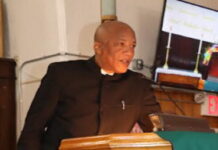









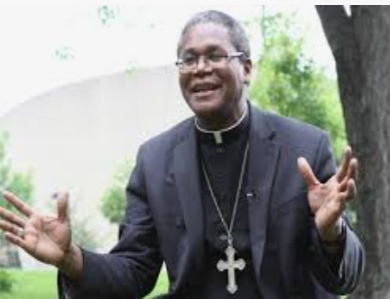
PORT AU PRINCE, Haiti, CMC – The Bishop of Anse-à-Veau and Miragoâne and Vice-President of the Haitian Episcopal Conference, Mgr. Pierre-André Dumas says he has withdrawn his offer to serve as a mediator to prevent possible chaos in Haiti as the mandate of the Presidential Transitional Council (CPT) comes to an end on February 7.
Earlier this week, former prime minister Jean Henry Céant, who served as prime minister for a seven-month duration before his government lost a vote of no confidence on March 18, 2019, said in a letter to Mgr Dumas that he learnt of his decision to serve as a mediator “with profound astonishment, mixed with sadness and dismay”.
“…by offering yourself as a mediator, you are entering a highly political arena,” Céant wrote in his January 11, 2026, letter.
But in a statement posted on social media, Bishop Dumas said that for several days now, his name has been circulating in the public sphere in connection with a possible national mediation, “at a particularly critical moment in the life of our country.
“For the sake of history and truth, and out of respect, peace, and responsibility, I wish to provide the necessary clarifications and announce my decision with complete transparency and serenity.”
The Bishop said he wanted to make it clear that he “never personally offered myself as a mediator,” noting that his name arose from external requests from political coalitions, civil society organizations, major institutions, and national and international figures.
“To all those who have placed their trust in me, I express my respectful gratitude. When I accepted these requests, I did so in a strictly pastoral spirit, in communion with the Church, without ever acting or claiming to act as an official representative of the Conference of Bishops of Haiti.
”I also reiterate, consistently, that I am not a member of any political organisation. My mission is that of a pastor. As a shepherd of God’s people, I have always considered it my duty to listen to everyone, to speak to everyone, and to encourage every sincere initiative oriented toward the common good, in accordance with the Gospel and the dignity of the human person.”
Bishop Dumas said that if he had “respectfully accepted certain requests, it is because I deeply believe in what the Church calls the culture of encounter: listening without excluding, engaging in dialogue without condemning, creating spaces where words can replace violence. “My intention has never been to develop a political solution, but rather, as a pastor, to help restore dialogue where it has broken down.”
He recalled the statements of Pope John Paul II, Pope Benedict XVI, and Pope Francis that commitment to the common good is one of the noblest expressions of social charity.
“Pastors do not govern, but they have a duty to enlighten consciences, to accompany those involved, and to encourage every authentic initiative oriented toward peace, justice, and dignity. The mediator can open the door, but it is the sons and daughters of Haiti themselves who must cross it together with courage and responsibility.”
But he acknowledged that in recent days, “inaccurate information, misinterpretations, and various forms of manipulation have circulated, creating confusion and misunderstandings in public opinion.
“After receiving wise counsel, discerning the situation in prayer, and considering the wisdom of the Church, I have decided to withdraw from all direct and operational involvement in this specific mediation process,” Bishop Dumas said, adding, “This withdrawal does not signify indifference, discouragement, or abandonment.
“Quite the contrary. I have a profound belief in Haiti. I have a profound belief in Haitians. I remain convinced that there are women and men of worth in this country, institutions, and organizations capable of transcending particular interests and courageously and competently undertaking a genuine national mediation process.”
Bishop Dumas said that a Haitian solution is possible and that history supports this.
”Yes, we can make history. Yes, we can forge a new path not of violence, but of reconciliation, ushering in a renewed era of liberty, equality, fraternity, and prosperity, faithful to the ideals of our Founding Fathers.”
Bishop Dumas said that he “ will always remain available to my country and my fellow citizens. I will continue to pray, to call upon consciences, and to support every sincere initiative for dialogue, peace, and national reconstruction. Let us honor our ancestors.
”Let’s support Haitian sovereignty. Let’s choose life, responsibility, and hope. God bless Haiti. God bless its people,” he wrote.
Last week, the Eminent Persons Group (EPG) of the Caribbean Community (CARICOM) called on all stakeholders in Haiti to demonstrate patriotism above all other sentiments if Haitians are to determine their own destiny.
“Given the sustained efforts of CARICOM and the international community in supporting a Haitian-led process, the EPG is deeply concerned by the tardiness of the stakeholders to find common ground and coalesce around a Haitian-led consensual agreement on an alternative transitional process despite the points of convergence in the multiple proposals made public,” the EPG said in a statement.




 and then