










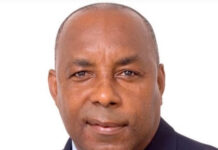







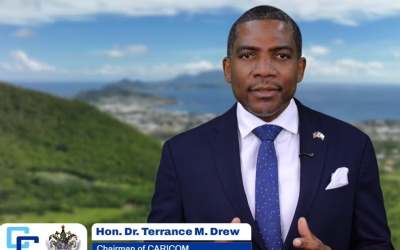
GEORGETOWN, Guyana, CMC – St. Kitts and Nevis Prime Minister Dr. Terrance Drew says recent international developments, including geopolitical tensions in the region and external policy decisions affecting Caribbean nationals, “remind us of a fundamental truth: None will come to save us. We must save ourselves.
”Recent public discussions among member states, reflecting differing national perspectives, have unfolded in a way that has attracted regional and international attention,” said Prime Minister Drew, who, from January 1, next year, replaces Jamaica’s Prime Minister Andrew Holness as the chairman of the 15-member Caribbean Community (CARICOM) for the next six months.
“While such differences are not unusual in a diverse Community such as ours, they remind us of the importance of managing our dialogue with care, mutual respect, and a resolute sense of regional responsibility,” said Drew, who said he is assuming the CARICOM chairmanship with “optimism and a deep dedication” to the ideals of the regional integration movement.
Prime Minister Drew was no doubt referring to the current tensions within CARICOM, sparked by recent comments from Trinidad and Tobago’s Prime Minister Kamla Persad-Bissessar, who said CARICOM “is not a reliable partner” and “has lost its way.”
But he reminded the region that “CARICOM was never conceived as a space free of disagreement.
“It was created as a forum where differences could be addressed constructively, internally, and with the shared understanding that our collective strength is greater than any single issue before us.
”This reality does not call for isolation, but for stronger coordination, more explicit purpose, and more profound solidarity. It requires us to speak louder, speak with conviction, speak with one voice; where our shared interests are concerned, and to act with strategic maturity on the global stage.”
Prime Minister Drew said that as Caribbean leaders and as citizens of this region, “we must recommit to the principles that underpin this Community. We must strengthen our institutions, enhance consultation, and ensure that our engagement reflects the seriousness of the responsibilities entrusted to us by our people.
”Differences and all, we are one Caribbean people, heirs to a civilization that transformed suffering into strength and adversity into achievement. We have contributed to the world in profound and undeniable ways that continue to shape global culture, sport, intellect, and conscience.
”Let us therefore move forward with shared purpose, with confidence in our combined capacity, and with faith in the Caribbean project.”
He said St. Kitts and Nevis has already begun preparations to host the CARICOM summit in Basseterre from February 24-27 and that he is “cordially” inviting “my colleague heads to join us in active engagement as we consider priority issues and advance the welfare of our people and of our region.
”CARICOM is and will continue to be a declaration of who we are and who we choose to be,” he added, saying, “together, we will strengthen it. Together, we will protect it. Together, we will secure the future of our Caribbean civilization.
In his message, Prime Minister Drew said he is taking up the CARICOM chairman position at “a moment that calls for reflection, calm leadership, and renewed commitment to the Caribbean ideal.
He said CARICOM, established in 1973 through the Treaty of Chaguaramas, was born out of “a clear-eyed recognition by our forebears that vulnerable states would face immense challenges in a rapidly changing global order.
“As such, CARICOM was founded to promote economic integration, coordinate foreign policy, encourage functional cooperation, and amplify the Caribbean’s voice internationally. This was an act of strategic foresight and regional self-belief, one built on the conviction that our collective strength is our greatest asset.”
Prime Minister Drew said that currently, CARICOM comprises sovereign states and associate members “bound not by geography alone, but by shared history, values, and destiny,” adding that “over time, CARICOM has delivered meaningful benefits to all of our people.
”Through regional trade and economic cooperation, we have expanded markets, supported local enterprise, and strengthened resilience. Through the movement of skills and labour, Caribbean people have contributed across borders, enriching societies and building shared capacity. Through functional cooperation, we have advanced health systems, disaster response, education, security, and climate advocacy.”
The incoming CARICOM chairman said, “In an increasingly uncertain world, regional integration is not optional.
“It is essential. As a unified body, we will continue to explore viable partnerships to encourage innovative approaches, capacity building, and access to affordable finance that are needed to foster sustainable development.”
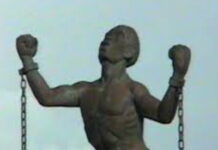
He reminded that the Caribbean civilization, forged in the crucible of slavery and indentured labour, “has produced achievements that far exceed our size” and that the region’s advocacy for reparatory justice will therefore continue through the work of the CARICOM Reparations Commission and the tenets of the CARICOM Ten Point Plan for Reparatory Justice.
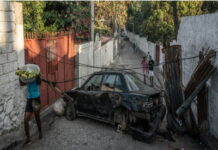
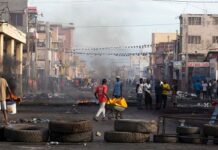
Drew said that the situation in Haiti continues to require sustained regional engagement “to help our fellow Caribbean brothers and sisters to stabilise and rebuild.
“We will continue our support, including through the Eminent Persons Group, as Haiti anticipates holding general elections in 2026, and as the UN Security Council Resolution 2793 on the Gang Suppression Force is implemented.”
In his message, Prime Minister Drew said that the region has made profound contributions to literature, economic thought, political philosophy, sports, music, and culture.
He said Caribbean creativity has given the world new musical genres, instruments, literary movements, and intellectual traditions that speak to freedom, dignity, resistance, and hope.
“We consistently rank among the world’s best, particularly in cricket and track and field, establishing a tradition of excellence that has inspired millions and reshaped global expectations of sporting achievement,” he said, adding that these achievements are not accidents of history; they are the result of resilience, discipline, imagination, and an unyielding belief in possibility.









 and then