


























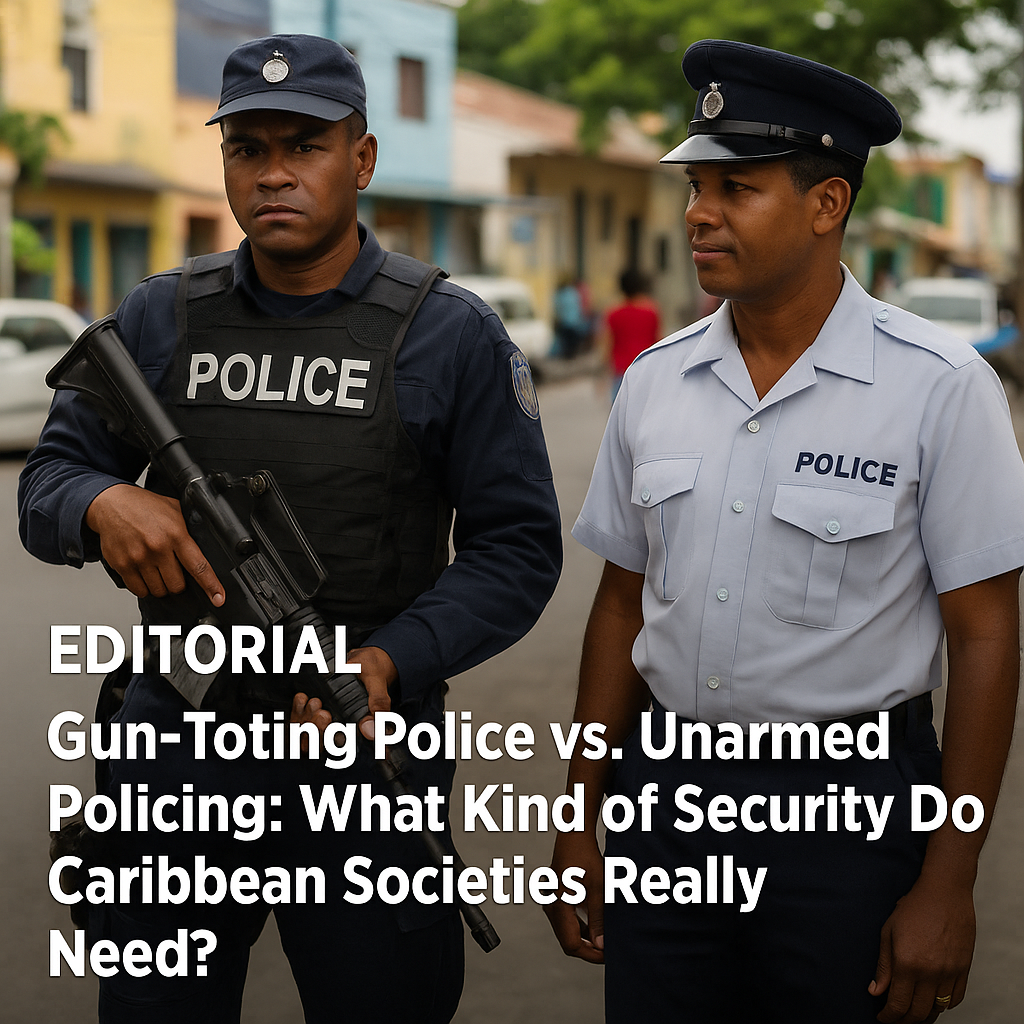
In the Caribbean, the debate over whether police officers should carry guns at all times has grown louder as violent crime pushes communities into states of anxiety and governments into defensive postures. Firearm seizures are up, gangs continue to reorganize, and civilian distrust sits like a fog over every police interaction. As our islands wrestle with these complex realities, the question is both urgent and uncomfortable: Does arming every officer make us safer — or does it simply escalate the danger?
The Case for Armed Policing: A Hard Reality
Caribbean societies — unlike the UK, Norway, or New Zealand — operate in environments where guns flow easily, criminals are often heavily armed, and police officers face life-threatening encounters far more regularly.
Supporters of gun-toting policing argue:
-
Firepower must match firepower; officers cannot confront AR-15s and Glock pistols with batons and negotiation alone.
-
Rapid response to violent emergencies requires armed readiness, not waiting for a tactical unit to arrive.
-
A visible armed presence may deter would-be offenders, especially in hotspots where gang loyalty is enforced at gunpoint.
It is difficult to ignore these points in nations where murder rates rank among the highest per capita globally. For officers in Jamaica, Trinidad and Tobago, Belize, St. Lucia, and parts of Guyana, the gun is not merely a tool — it is a survival mechanism.
The Case for Unarmed Policing: A Different Path to Public Trust
Yet, another truth exists: the constant presence of firearms on the hips of officers reshapes policing culture. It can shift an officer’s mindset from de-escalation to domination, from communication to commands. Caribbean history has also conditioned specific communities to view armed police not as protectors, but as enforcers of state power — sometimes harshly so.
Advocates for a less armed model argue:
-
Public trust improves when police are not perceived as soldiers in uniform.
-
Fatal encounters drop significantly in countries where officers are unarmed or armed only when necessary.
-
Communities communicate more openly when interactions feel less like confrontations and more like collaboration.
-
A policing culture built on conflict resolution rather than conflict anticipation strengthens long-term stability.
While full unarmed policing may not be immediately feasible in the Caribbean, the principles behind it—de-escalation, restraint, communication—remain relevant.
The Cultural Impact: What Message Does the Gun Send?
Guns change behaviour — not just for officers, but for civilians.
A gun can:
-
escalate tensions in routine stops,
-
make suspects panic,
-
increase the likelihood that misunderstandings will turn fatal.
Unarmed policing, by contrast, humanizes the badge. It signals approachability and lowers the emotional temperature in volatile communities — an invaluable asset in communities where mistrust is multi-generational.
The Caribbean Reality: A Hybrid Model May Be the Answer
Most Caribbean nations cannot immediately replicate the UK model of entirely unarmed policing. Our gun culture and crime realities are too different. But we can adopt a hybrid system already working elsewhere:
-
General officers remain unarmed or minimally armed, focusing on community policing.
-
Specialized armed units respond to high-risk situations.
-
Firearms become tools of circumstance, not standard accessories.
This approach preserves officer safety while reducing unnecessary armed confrontations. It also forces an institutional shift toward de-escalation, accountability, and measured force — all urgently needed in the region.
Conclusion: Safety Must Be Measured Not Only in Firepower, But in Trust
The debate is not about whether guns are “good” or “bad.” It is about what kind of society we want to build.
Armed policing may offer immediate tactical advantages, but unrestrained reliance on guns erodes public trust, fuels fear, and can turn the police–citizen relationship into an adversarial one. Unarmed or hybrid policing, meanwhile, offers a long-term path to legitimacy, though it requires investment in training, community partnerships, and political courage.
The Caribbean deserves security — not only from criminals, but from the cycle of distrust that has long weakened our justice systems. The right policing model must serve both needs, balancing strength with restraint, and readiness with humanity.










 and then