


















CASTRIES, St. Lucia, CMC – Prime Minister Phillip J Pierre says that together, St. Lucia and Africa can be a powerful voice for climate justice, reparative action, and a future where the populations of both regions can thrive.
In a nationwide radio and television address on Thursday night, Pierre said that after 191 years since the abolition of slavery, St. Lucians have made much progress as African descendants in overcoming the inhumane treatment and psychological trauma imposed on their ancestors.
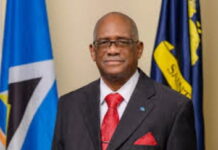
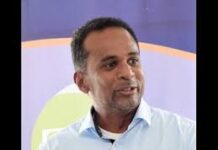
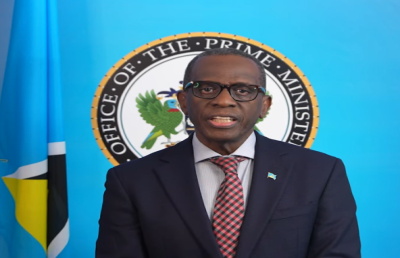
Prime Minister Phillip J Pierre addressing the nation on Thursday night (CMC Photo)
“This trauma has been carried across generations. And while its impact has been declining, its remnants continue to impede the progress of some of our people. The legacy of slavery is still able to divide us despite the common indignity suffered by our ancestors.
“And yes, there remain, sadly, a few among us who have yet to understand and appreciate the need to lift our people from self-doubt and the harmful effects of colonial values,” Pierre said, noting that the bonds of global cooperation, once a beacon of hope, have been strained by division, distrust, and conflict.
“Yet, it is precisely now that we must recommit ourselves to unity, dialogue, and shared purpose,” he said, noting that the “vilification and denigration” of the President of Nigeria, Bola Tinubu, by a politically motivated group, tacitly supported by the opposition party, was another demonstration of the harmful effects of the legacy of slavery.
Pierre said that “behaviour was nothing short of shameful and disgraceful,” adding that “had the visit been by a Head of State from another country, the reception from that group would have been at the very least respectful”.
Pierre said he wanted to inform the government and people of the Republic of Nigeria that St. Lucia had been honoured by the visit of their head of state and is looking forward to establishing and deepening economic, social, and cultural ties with Nigeria.
Pierre said he is pleased that during the visit, several memoranda of understanding (MOUs) were established for fostering economic, social, educational and cultural relations with St. Lucia and the wider Organisation of Eastern Caribbean States (OECS) and that his administration “will do its best to ensure that those MOUs bear fruit at the earliest opportunity”.
Pierre said that his administration is mindful of its role in transforming society into a place where its citizens are proud of their heritage and history.
“We will continue to address the inhibiting social and economic pressures on vulnerable groups. This is why we remain committed to assisting those most in need, to reduce the gap between the haves and have-nots, so that we can move forward together as a nation with a shared history and destiny.
“We must not allow any group that still does not value and respect their history and heritage to distract us from the immense strides that have been made in reassuring our people that they are as good as any. “
Pierre said In the area of education, steps have been taken to integrate African studies into the curriculum of secondary schools.
He said the absence of contributions from African civilisation and the thinking of African philosophers in the school system is a gap that needs to be filled.
“In filling these gaps, our students are expected to have greater historical knowledge and cultural awareness, to develop a greater sense of self-worth and identity, and to build their academic curiosity and creativity through the exploration of African literature, music, politics, and philosophy.
“If we are to achieve this, St. Lucia will proudly be a leader in culturally relevant and progressive education in the Caribbean. The Ministry of Education has already engaged a consultant to develop a framework for the development of a curriculum for African studies.”
Pierre said that this framework will include, among other things, teacher training and a phased implementation plan to introduce African studies in all secondary schools.
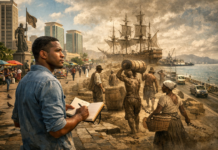
He said for centuries, the Atlantic or Middle Passage was a site of unimaginable suffering and forced separation, saying “now, it must become a bridge, a bridge for a reconnection, and a renaissance”.
He said the recent strides in multilateral cooperation, from the Africa-CARICOM Summit to the AfriCaribbean Trade & Investment Forum (ACTIF) for building partnerships in trade, technology, and cultural exchange, are not just diplomatic gestures.
Pierre said that he was among the more than 1000 participants from Africa and the Caribbean attending the Grenada meeting discussing a free-trade zone, the establishment of direct air and sea links, and the possibility of regional integration between the two regions.
“ The African continent, with its vast population, is expected to grow to 1.5 billion by 2050, offering exciting market opportunities for our nation. We must, therefore, position ourselves to make the most of it.
“From the rhythms of our drums to the resilience of our people, Africa lives in us, not just as heritage, but as destiny. The time has come to transform cultural kinship into concrete cooperation in trade, investment, education, technology, tourism, and the arts. Let us strengthen our ties not as distant relatives, but as equal partners in a shared journey of renewal.
“The transatlantic slave trade, the brutal and inhumane treatment of our African ancestors, must be addressed and understood if we are to fully appreciate its current impact on the social and economic inequalities in our society today.
“The legacy of slavery has left its scars, scars of self-hate and inferiority. Too many of our youth are looking for a sense of identity and affirmation, and are turning to gangs and violence. I say to young people, the violence and brutality of slavery have been abolished.”
Pierre said the abolition of slavery has provided a new freedom, which calls upon everyone to respect human life and be productive citizens.
“Let us not return to killings and brutality as a means of settling conflict. We must appreciate and respect human life and teach our children to do likewise. As a peace-loving people, human life must be valued and respected. The dignity and human rights of all must be respected regardless of colour, creed or gender,” Pierre told the nation.








 and then