


























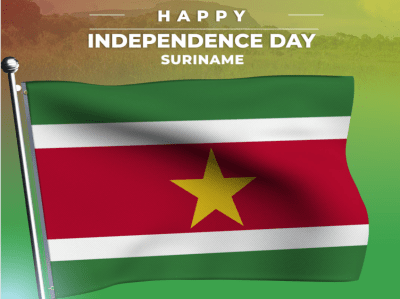
PARAMARIBO, Suriname, CMC—Suriname is observing its 49th anniversary of political independence from the Netherlands, and both the coalition government and the opposition have differing views on the socio-economic development of the Dutch-speaking Caribbean Community (CARICOM) country.
In a statement, the Progressive Reform Party (VHP) of President Chandrikapersad “Chan” Santokhi said the coalition government has significantly improved relations between Suriname and the Netherlands, which had become increasingly worse after the 1980 coup by former military strongman Desi Bouterse.
“Fortunately, after the inauguration of the Santokhi government in 2020, a turnaround has occurred in the relationship between Suriname and the Netherlands. The diaspora community has an extraordinary value for Suriname in terms of economic, social, cultural, and educational areas.
“Both countries have immense bonds with each other. Politically, the relationship between both countries is good. We are now two equal countries, and sovereignty symbolizes national independence.
“With oil & gas production in 2028, Suriname is taking big steps forward. We are at the crossroads to bring prosperity and well-being to the population so they no longer have to live in poverty. It is our responsibility to give our future generation a prosperous and balanced nation,” the VHP said.
The National Party of Suriname (NPS), which is also a member of the coalition, also commented on the 1980 coup, saying it is “a moment in the history of our country that was initially experienced as positive by society, but soon had increasingly far-reaching disastrous consequences for monetary stability, the economy of Suriname, the investment climate and the development of our country and people.”
It said Suriname is now on the eve of making an important choice that should positively influence the economy and the country’s development, referring to the May 25, 2025, general election.
“Do we go for stability, improvement of the economy, and progress of the country and its people, or do the people choose for further deterioration in living, working, and living conditions? “We are at a crossroads! From its position at the beginning of the current government, the NPS has tried to contribute positively to the country’s development based on a presented development vision.
“Insufficient cooperation and questionable actions within the government have forced the Green Party to leave the government. The observation was and still is that the current government policy does not serve the general interest.”
As the country enters its 50th year of independence, the NPS said, “a critical phase will be entered to learn from the mistakes of the past 49 years and in which corrective action must be taken.
“Where Surinamese people left for the Netherlands in 1975 because of political and economic uncertainty, we will more seriously than ever start the process of citizens wanting to return to their own country. The NPS will strongly advocate for this in the coming period. Let us work on what unites us and not what divides us,” it added.
The main opposition, the National Democratic Party (NDP), said that independence reminds the people of Suriname “of the complexity of the path we have walked since then.”
It said after centuries of colonial rule by the Netherlands, “our country still bears the heavy legacy of division, imposed by a divide and rule policy that hinders our development.
“The Netherlands, unlike other colonial powers, was known for deliberately sowing divisions between population groups in its colonies. This divide-and-rule strategy was intended to weaken resistance and strengthen the colonizer’s power. Unfortunately, we still feel the aftermath of this in the form of social tensions and structural inequality,” said the NDP, whose leader, Bouterse, has had public confrontations with the Dutch.
The party said that it is essential to recognize that the Netherlands used this tactic not only in Suriname but also elsewhere, such as in South Africa, where it “introduced the “Act 9 Reserve,” the policy of which was to set aside separate areas for the black population, systematically excluding them from economic opportunities and isolating them from the political process.
“This was a subtle but destructive form of divide and rule that left deep wounds. Our struggle for independence and the subsequent process of decolonization was a struggle against colonial rule but also against the divide-and-rule practices that have sought to divide our country.
“Today, 49 years after our independence, it is time to reiterate that working towards the creation of ‘One Nation with One Destiny’ is essential for our future. The recovery of our country depends on our collective efforts to advance racial, social, and economic equality,” the party said, adding that this independence day should be used “to reflect on our past, but above all to focus on a future of cooperation, peace, and progress.
“The lessons of our history, both in Suriname and abroad, should encourage us to continue building our beloved country stronger, wiser, and united.”
In a statement, the Speaker of the National Assembly, Marinus Bee, said he wanted to use the occasion to remind the Surinamese how valuable unity is in pursuing progress.
“Although we still have a long way to go, we must never lose sight of the fact that growth involves trial and error. The trick is not to give up,” he said, adding that a permanent task is building a harmonious society “in which our unique population’s diversity manifests Mama Sranan’s hidden power.
“Every Surinamese should realize that the construction of our country is a joint effort, which can only be victorious if we all show collective responsibility. If the spirit of solidarity guides every Surinamese, then our future can only become better by the grace of the Almighty<, ” Bee said.
Meanwhile, the 15-member Caribbean Community (CARICOM) grouping has extended congratulations to Suriname, commending its commitment to sustainable development, vibrant cultural tapestry, and role in CARICOM.
CARICCOM Secretary General Dr. Carla Barnett, in a message to President Santokhi, said that the country can proudly reflect on the steady progress and development it has achieved since 1975.
“Excellency, the Caribbean Community places great value on the role played by the Republic of Suriname to the regional integration movement, particularly in community development and cultural cooperation.
“Suriname’s motto and core values of justice, faith, and loyalty have shaped its unique national identity and spirit. You can proudly reflect on the steady progress and development achieved since 1975, a testament to Suriname’s commitment to sustainable development,” she added.








 and then