





































PORT OF SPAIN, Trinidad, CMC—Finance Minister Colm Imbert said Friday that the government will not allow taxpayers to fund salary increases to lecturers at the St. Augustine campus of the University of the West Indies (UWI) that would result in more than TT$700 million in backpay to the workers.
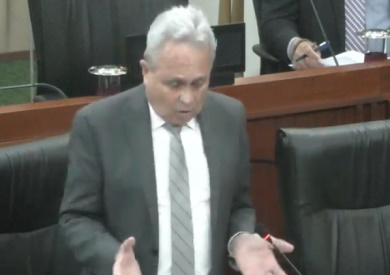
“I do not think it is prudent to impose a burden of backpay of TT$701 million on the taxpayers of Trinidad and Tobago. There are means to settling disputes and dispute resolution procedures, and I would urge all parties to utilize the available dispute resolution procedure,” Imbert told Parliament, noting that the workers were seeking a 24 percent increase.
Lecturers at the university have embarked on industrial action in support of their union’s demand for increased salaries.
The West Indies Group of University Teachers (WIGUT) said it understands and empathizes deeply with the staff’s frustration, which stems from the decade-long delay in resolving salary negotiations.
“The prolonged hardship and uncertainty are exacerbated by the rising cost of living in the post-COVID era, which has intensified financial pressures on all categories of staff,” the union said.
The lecturers, who say they are against a two percent wage hike, began their two-day industrial action on Thursday. WIGUT said management had been diligently following up on outstanding proposals and had been encouraged by positive assurances in the national budget and in meetings.
“However, as the teaching term concludes and examinations begin, the lack of concrete responses or gains has heightened concerns.
“The anguish is deepened because both Cave Hill, Barbados, and Mona, Jamaica, which began negotiations long after St Augustine, have concluded negotiations satisfactorily and received generous increases.”
But Imbert told legislators that he must state what is happening in Trinidad and Tobago because any revenue generated in Jamaica, Barbados, and any expenditure in these two countries “are totally and wholly irrelevant to or situation in Trinidad.
“If we accept the proposal from WIGUT, the backpay would be TT$701 million as of March 2024. The cost of the four percent offer we have offered to everybody else, which is being accepted by most trade unions, is estimated at a backpay of TT$79 million and TT$12 million in additional recurrent expenditure.”
Imbert said it is no secret that the state funds the university with “hundreds of millions of dollars in subvention.”
He said for the 2018-19 year, the university received a subvention of TT$517 million, followed by the next fiscal year of TT$520 million, and in 2020-21, a total of TT$528 million.
“Therefore, any settlement of wages at UWI will place the responsibility on the government and taxpayers to fund this increase,” Imbert said, brushing aside the opposition’s request that the government not intervene in the matter if the parties concerned have reached an agreement utilizing the dispute resolution procedure.
“It is ridiculous for the member opposite to ask taxpayers of this country to fund a settlement of a wage matter which the taxpayers fund. The government has to invest. Even this four percent offer will cost the government TT$79 million.
“It is absurd, and I know the former UNC (United National Congress) government did not do that. They did not allow statutory authorities and state enterprises to give away the shop…without any ministerial intervention,” Imbert said, adding that the current government is following the same guidelines as have existed.
“It is the same committee, it is chaired by corporation sole, and it has several ministers who look at the impact of wage settlements on the Treasury,” Imbert said,” adding it is a question of affordability.
“You can’t have a state enterprise or statutory authority just lumping TT$700 million in backpay on the taxpayers of this country.”
He told legislators that it was essential to put the wage issue into perspective, saying that from August 2011 to July 2014, the then-government approved a 10 percent adjustment in compensation for academic and senior staff at UWI.
He said it was a four-percent salary adjustment followed by an additional six percent distributed over the period.
“The government has since extended its four percent offer that has been made to the public service, the protective services for the period 2014-17 and the period 2017-2022,” Imbert said, adding that he has been advised that WIGUT has refused to accept the offer.
He said WIGUT wants an eight percent increase from July 2014 to 2015, another eight percent in 2015, and another eight percent in 2016.
UWI says it remains steadfast in its commitment to communicate with the government to resolve this impasse.
“No principal or employer can rest easy when protests occur. We worry about our students, who are most impacted by such actions. It disrupts their academic experience, creating anxiety during a critical time.
“We therefore urge all parties to move this process forward productively and swiftly, ensuring a resolution that benefits not only our staff but also the students who depend on the stability and excellence of The UWI experience. It added that our goal is to uphold The UWI’s mission as a transformative force for TT and the wider region.
UWI principal Prof Rose-Marie Belle Antoine said that while she empathized with the staff’s plight and acknowledged their protest action, little could be done.
“My management has diligently followed up on all outstanding proposals for over two years. We have been encouraged by positive assurances in the national budget and meetings; however, as the teaching term concludes and examinations begin, the lack of concrete responses or gains have heightened concerns,” she added.








 and then