

































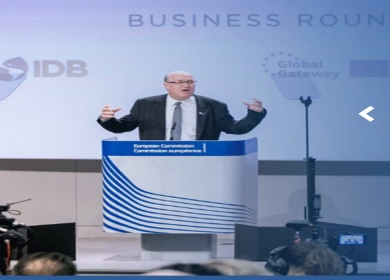
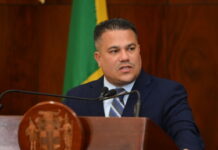
PUNTA CANA, Dominican Republic, CMC—President of the Inter-American Development Bank (IDB), Ilan Goldfajn, called on Latin America and the Caribbean (LAC) to implement policies that will allow them to take advantage of their ongoing economic growth.
Addressing a Business Forum that forms part of this year’s IDB and IDB Invest annual meetings of the Boards of Governors, Goldfajn said that the LAC grew faster than anticipated in the last couple of years.
He said inflation is declining due to responsible monetary and fiscal policy. According to the latest data, poverty dropped 10 percent and likely fell further last year.
Goldfajn said foreign direct investment (FDI) in Latin America and the Caribbean surged in 2022, setting a record that, according to initial data, it likely matched again in 2023.
“Labour markets have been robust. Unemployment rates have plummeted to some of the lowest levels in recent decades. So, the question is this: Will this recent better-than-expected performance last?
“It depends on Latin America and the Caribbean seizing the incredible opportunity that the global context provides the region. Latin America and the Caribbean could be at a potential inflection point if successful.”
The IDB president said the reason is that the region has great potential to help solve some of our most significant shared global challenges:
“For decades, Latin America and the Caribbean have been viewed through the lens of their needs—their need for financing and their need to reduce debt. But today, the world also needs Latin America and the Caribbean. That’s a cause of the region’s potential to be part of the solution to our shared challenges.”
He said that with the right reforms and investment, the region could be at the center of the effort to protect the world’s biodiversity, provide clean energy, and alleviate global food insecurity.
“And so, the question we ask at the IDB is how can we position the region to be part of the solution to these global challenges while also reducing poverty and inequality?
“The answer is to make the right short-term reforms and investments to leverage these opportunities while making the right long-term reforms and investments to increase productivity and economic growth over the long term.”
He said to seize the moment, “We must continue investing in our capacity to meet the world’s need to protect our most significant natural resources, like the Amazon.
“We must also keep investing in clean energy and food production. At the ID, we’re helping countries do this. For example, e, IDB Invest, our private-sector arm, is providing a US$50 million loan to Allkem, a world-class lithium producer, to boost lithium production in Argentina.”
He said this will promote low-carbon and climate-resilient private-sector development in Argentina.
However, he said certain measures need to be adopted to help the region grow faster.
“We need to strengthen the rule of law. Weak rule of law limits economic growth. For example, poor contract enforcement discourages investment. Who will invest if they don’t think laws will be complied with?
“In addition to legal security, the region needs basic physical security. It’s not just parents who want safer neighbors. Investors and business owners want them, too! Why? Because crime limits growth. The IDB estimated that crime costs the region 3.5 percent of gross domestic product (GDP) each year, double that of developed countries.”
Goldfajn said the LAC accounts for just eight percent of the world’s population but one-third of its murders, saying that diverts public resources away from investments that could increase productivity.
“For the region to grow faster over the long term, it must also make longer-term reforms and take a long-term approach to investing much more in physical and digital infrastructure.”
Goldfajn said between 2008 and 2017, Latin America and the Caribbean put just 2.8 percent of GDP into infrastructure, saying that’s half what East Asian and Pacific countries invested.
“Partly because of that, over the past two decades, emerging Asian economies have grown 12 times as much as our region. Today, our mobile broadband speeds can be ten times slower than in the OECD (Organisation for Economic Co-operation and Development Countries). That limits productivity.
Goldfajn said investing in digital infrastructure will improve connections, public services, and educational opportunities. If more schools are connected, human capital will be enhanced.
He said companies in the LAC also need workers with the right education and skills. Currently, over 50 percent of 15-year-olds don’t understand what they read.
“So, we must invest better in education. This will help us take better advantage of our greatest natural resource, our people. We need to invest in our human capital to increase, not just for one year, but for decades. When we do this, the results will be remarkable.”
He said companies also must take a long-term approach to investing in the region’s youth, giving them the skills they need to thrive in tomorrow’s digital economy.
“And, of course, business leaders like you know better than anyone about the region’s high taxes on companies, high taxes on labor, burdensome labor regulations, and lack of competition. All this hinders productivity and growth.
“That’s one reason half the region’s workers are employed informally. We must make it easier for companies to legally employ workers and invest. As I said, the private sector is key to the region’s future. We want to strengthen it further.”
Goldfajn said that’s why the IDB launched its new program titled “BID for the Americas,” which he said is not just a program but “a commitment to forging closer economic ties between Latin America, the Caribbean, and the rest of the IDB’s member countries, here in the Americas and throughout Europe and Asia.
“It symbolizes a collaborative effort to highlight and leverage IDB’s unique business and economic opportunities. Through this initiative, we’re reaching out to the private sector, demonstrating how engaging with Latin America and the Caribbean can lead to transformative impacts on development while yielding substantial business benefits.”
Goldfajn said that since the launch of Bid for the Americas last September and the Responsible Investment Forum in November, the IDB has held investor roadshows in Miami, Tokyo, and New York.
“We’ll hold additional roadshows in four other U.S. cities this year. And we’ll do international cities, including Madrid, starting in May. Our holistic approach addresses the needs for procurement, trade and investment, and financing, with a keen eye on sustainable and inclusive growth.”
He said to improve procurement processes and facilitate private-sector participation in projects, the IDB introduced new tools such as “The Bidder Center and the Build the Americas App.
“These tools will become an important resource for companies in all our member countries to bid on projects successfully. We believe that streamlining procurement can have a tangible impact on the quality of our projects, leaving a lasting impact on communities.
“Let’s talk specifics. Latin America and the Caribbean have historically faced challenges in fully integrating into the global trade and investment landscape,” he added.








 and then
 , Ilan Goldfajn, called on Latin America and the Caribbean)