


































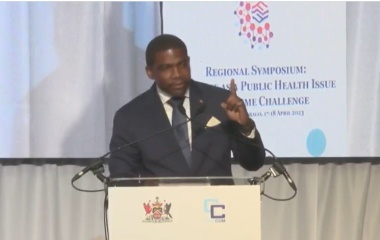
PORT OF SPAIN, Trinidad, CMC – St. Kitts-Nevis Prime Minister Dr. Terrence Drew says the violence challenge in the Caribbean appears to be well-characterized as a public health issue with ominous social and economic implications.
Addressing the two-day regional symposium on violence as a public health issue, Dr. Drew, a medical practitioner, said neither good health nor development is possible in a climate of violence.
” We need violence climate change. The pressing leadership task is to resource and apply best-practice interventions,” he said.
“I regard this regional symposium as a coalition of the willing. Notwithstanding the delays, there is a window of opportunity to move the needle to solutions. Our people must see and feel solutions now.”
He said he had come here convinced and wanted to leave seize, committed to training people with street credibility to function as violence interrupters.
” We can track and trace young people experiencing toxic exposure or at high risk for the same. We can find them and then offer a suite of targeted interventions. We can create a culturally appropriate public messaging campaign using known social influencers’ talents.”
Prime Minister Drew said that data produced in 1992 by the United States Government Accounting Office )GAO) showed that violence prevention programs save six to eight dollars for every dollar invested.
The US GAO conclusion that violence prevention funding is “Smart Money” is accepted and, to my mind, a political imperative. Therefore, gathering research evidence on violence is not the rate-limiting step of Caribbean action. Political will is.”
He said the Caribbean has a proud track record of solving or mitigating major public health issues through robust, evidence-guided intervention programs, adding, “St. Kitts and Nevis is ready and willing to move forward from research and experience to robust and sustained action.”
Prime Minister Drew said that much work has been done to document the risk factors; the characteristics of victims and perpetrators; and the impacts on the individual, family, country, and region, adding, “So, there is reason to be optimistic.
In 2002, the World Health Organization (WHO), in a report on violence, noted that “gangs and a local supply of guns and drugs are a potent mixture, increasing the likelihood of youth violence.”
He said St. Kitts and Nevis accept this formula that gangs, guns, and drugs are the key drivers “of our gang violence issue,” recalling that by the early 1990s, “we witnessed young adults than high school students organized in the transnational traffic of drugs.
“The groups of brothers and sisters became deadly territorial as they protected their turfs with imported guns. Such is the influence that by 2018, primary school children were gang members rather than being constructively engaged in organized arts, culture, and sports.”
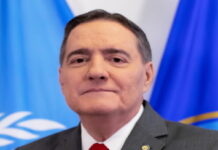
Meanwhile, the Programme Director of the Caribbean Office of the World Health Organization/Pan American Health Organization (WHO/)PAHO), Dean Chambliss, said the Caribbean is suffering such a wave of violence that this high-level symposium is necessary. He said the Americas region has the highest homicide rate in the world, both for adults and, even more tragically, children, while the homicide rates are more than three times the global average.
According to the WHO data, 10 of the top 20 countries and territories in the intentional homicide rate are in the Caribbean.
Chambliss said homicide is just the tip of the iceberg, and despite the sheer magnitude of deaths, the human cost of violence goes far beyond this number. Only a tiny proportion of all acts of violence are lethal and thus are reflected in mortality rates.
“Many forms of violence prevail in the region and result in enormous costs for health,
development, education, tourism, and the economy. PAHO applauds the clear-eyed commitment of Caribbean leaders gathered here today to tackle violence in our societies with fresh ideas and evidence-based approaches. “
He said PAHO/WHO had had a long working experience with Caribbean countries on violence prevention as a public health priority.
“We have had a particular emphasis on violence against women, children, and youth, focusing on how health systems can help to prevent and respond to violence as part of a multisectoral response. One thing that has long been clear, and has been reemphasized at various points today, is that fighting crime and violence is a whole-of-society struggle: from parents to teachers to health workers to church leaders to police officers, we must all work together as we deal with this most pressing and challenging of problems. “
He said a public health approach to violence prevention recognizes that different forms of violence intersect. PAHO/WHO recommends a range of cost-effective and practical interventions that can lead to real change.
Chambliss said that PAHO stands ready to work with Caribbean countries, the Caribbean Public Health Agency (CARPHA), and other partners at regional and national levels to tackle the root causes and public health effects of violence.
“We look forward to supporting further research to improve our evidence base and innovative interventions to prevent violence at all stages of life, especially among our youth.
Every individual has the right to live a healthy life free from violence. Our efforts during this symposium will further drive our commitment to creating a safer and more prosperous Caribbean for all,” he added.








 and then