




































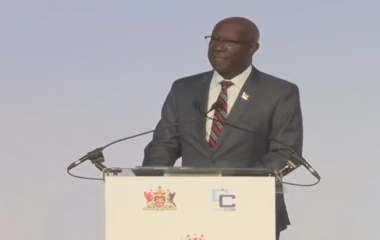
PORT OF SPAIN, Trinidad, CMC – Trinidad and Tobago Prime Minister Dr. Keith Rowley Monday urged all stakeholders in the Caribbean to get on board in dealing with the crime situation in the region, warning, “This is a war we cannot afford to lose.”
Rowley, who has lead responsibility for Energy and Security within the quasi Cabinet of the Caribbean Community (CARICOM), told the two-day regional symposium on crime that “this is a historic moment” and that deliberation is “not the usual command gathering to deal with trade, education, finance, tourism, health or diplomacy.
“We have assembled here in this unity of purpose to confront a problem — one that is common and threatening to every aspect of every individual’s life in the Caribbean,” Rowley told his fellow CARICOM leaders, academics, diplomats, and representatives of various regional and international institutions and countries.
The leaders of Antigua and Barbuda, Guyana, Belize, and Haiti are not attending the symposium, which is being held under the theme “Violence as a Public Health Issue-The Crime Challenge.”
Rowley told the audience that the record of the 21st century would show that for the new era, countries have continued to be haunted by violence from the domestic quarters at home, school yards, streets, and borders.
“In short, ladies and gentlemen, boys and girls, violence threatens to destroy our paradise in the Caribbean Sea. This is not to say we have not struggled to cope with this truth. On the contrary, we have been, but stubbornness and metastasizing malignancy could overwhelm us if we are not careful.
“Violence in the Caribbean is a public health emergency which threatens our lives, our economies, our national security, and by extension every aspect of our well-being,” Rowley said.
He told the opening ceremony that in Trinidad and Tobago, from 2011 to 2022, 5,439 lives had been lost to violent murder, mainly through the use of imported firearms and ammunition.
“In 2011, we lost 352 lives, and by 2022 the annual count was over 600, a new record, already being challenged by the murder rate for 2023. Except for COVID, in a pandemic, none of the listed dangerous diseases have taken lives like this in our population.”
Rowley said that apart from the deaths, the costs associated with crime and violence are astronomical, with all of these frequent daily incurred costs being borne by the taxpayers at every level from scarce revenues diverted from other more deserving productive priorities.
“Our current laws acknowledge a suite of afflictions, Yellow fever, smallpox, plague, cholera, Ebola, novel coronavirus as notifiable, warranting emergency responses if even only a few cases are known to appear.
“Violent behavior, violent crime, violent crime involving the use of firearms, the associated individual and group mental health trauma accompanying violent behavior, so ever-present amongst us now, pose a far greater destructive threat than these diseases and on that basis alone qualifies violence as a public health emergency.”
He said during the last 15 years, using the Trinidad and Tobago example, in the growing quest for safety and security, the country has witnessed a significant increase in the allocation of the national budget for National Security.
“In 2008, policing alone represented 32 percent of the four billion (ONe TT dollar=US$0.16 cents) National Security budget. By 2017 this rose to 38 percent. Even in the tighter budgetary environment of 2023, policing still accounted for 43% of the National Security allocation.”
He said in the political arena. Some believe that it is all about having the right national security minister. In contrast, others share their epiphany of separating the Ministry of National Security into fragments of Homeland Security and Defence.
“Trinidad and Tobago’s own experience put those theories to the test. In recent years we have had ten ministers of National Security sourced from career politicians, the military, and the private sector.”
But he said despite “all these musical chairs…the violence has not diminished. It has, in many instances, increased and become even more cynical. The problem does not exist and grow because of a shortage of Ministers or even Ministerial output”.
Rowley said that the two-day-forum has been long in coming and that regional leaders recently began looking at rising crime and violence in the Caribbean as a public health issue, with commitments to mount a symposium as this one in 2019.
But all efforts were understandably displaced and delayed by the COVID-19 pandemic. It is against this background that when Trinidad and Tobago announced its intention to have its national discourse and our Caribbean neighbors gladly agreed to join, we had no hesitation in making room for widest participation.”
He said time is of the essence, adding, “So let us all, very conscientiously, make the most of it in small doses as we speak, listen, and absorb in preparation to fight this demon.”
Rowley said across the region, territories are under siege from the acts of crime and violence from elements of its society, adding, “This is a battle in which we must all be engaged. This is a war that we cannot afford to lose.
“In this engagement, Governments are open to uncomplimentary charges of, some say, indifference, others say impotence, unimaginative planning, discrimination, an abdication of duties, poor leadership, and with repeated calls for resignations.
“Ole talk is cheap, we know that, but let us try and extract some light from the expressions of the next two days, in the fervent hope and expectation that the beast of violence which has stalked us for virtually all our existence in this blue Caribbean Sea, will be starved of its sustenance, condemned to wither and die so that we all may live in peace, safety, and harmony from the home to the school to the streets to the borders.”
He acknowledged that the presence here for the next two days of delegates is an “admission that crime and violence are now a significant part of the Caribbean’s overall plethora of problems, ranging from petty theft to school violence, home invasions, domestic violence, sexual abuse, human trafficking, drive-by shootings, drug-gang warfare, mindless daily revenge murders, etc.
“When such a situation arrives at the door, it is said that society failed to spot an oncoming crisis. Then there may be the failure to perceive the extent of that arrived situation as a societal problem. Further, there may be problems in finding solutions and whether the answers selected may even succeed.
“Today, if there is one aspect that we…we all may be guilty of, is that the problem of criminality and violence was not dealt with sufficiently, in a much earlier time frame, in the homes, in the schools, in the prisons, in the courts and the Parliaments. “
Rowley said that there was what can be described as “a creeping normalcy”; where countries allowed slow, moderate, deviant behavioral trends to increase, allowed slips in the aged-old standards, in ethical and moral norms in our family homes, in our schools, in public institutions, on the roads, and in public places.
“All of which, hindsight reminds us that we should have checked very early. Instead, we have been saying that these times are different; this is the modern age of American gun culture, as we adopt the internet revolution with its tremendous promises and warts. In a period of selfish individualism, we have flourished at the expense of society itself.
“So, morals and values are now considered flexible, their lines are blurred, and they occupy spheres of their own, determined and shaped by one’s whims, the present, fashionable social trends, and, worst, the political and bureaucratic shortcomings of something malleable called “the system,” Rowley added.
But he said hopefully, there would be elements of operational consensus after the planned examination and exchanges, which will form a plan of action that will give the Caribbean people their much-needed assurance that something, beyond talk, will be done, using the same planned, programmed and strategic methods that were adopted to confront the challenges of COVID-19.








 and then