


































PORT OF SPAIN, Trinidad, CMC – A two-day regional symposium on violence as a public health issue began here on Monday, acknowledging the impact violence and crime have on the socio-economic development of the Caribbean Community (CARICOM) region.
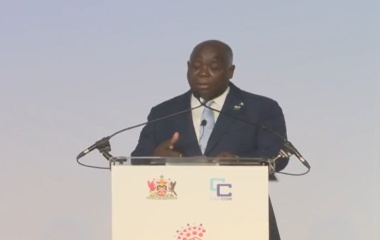
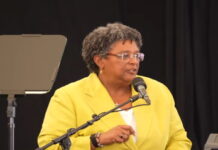
Bahamas Prime Minister and CARICOM chairman Phillip Davis said, “We need all hands on deck,” insisting CARICOM is committed to fighting crime in all forms.”
Davis said that the symposium, attended by regional police commissioners, academics, and other stakeholders, allows the region to hold an in-depth discussion about “what we can do as a region to develop a holistic approach to violence reduction.
“An epidemic of violence grips our region, claiming lives and generating fear and anger. In 2022, Jamaica had a staggering homicide rate of 52.9 per 100,000 inhabitants, Trinidad and Tobago had a rate of 39.4 per 100,000, and The Bahamas, St. Lucia, and St. Vincent and the Grenadines all recorded homicide rates above 30 per 100,000. This is over five times the global average.”
Prime Minister Davis said that people throughout the region live in crime hotspots, never knowing if they will be a victim on any given day.
He said in the Bahamas, he has had to comfort mothers and their families who have lost their sons and daughters, “ and I know many of you have done the same for your people.
“Violence spreads like a virus, gaining momentum as one violent crime begets another. There is a substantial history of analyzing patterns of violent crime using many of the same references used in epidemiology.
“Violence is contagious, and those who map the commission of violent crimes find that their data mirrors the spread of infectious diseases within a community. Violence can strike in waves and can grow exponentially. Those who come in close contact with violence are most likely to spread it and most likely to fall victim to it.”
Davis said that CARICOM had embraced the view of violence as a public health crisis, requiring comprehensive interventions to battle an epidemic that has claimed far too many lives.
“As with any public health crisis, we must define and monitor the problems, identify the risks and protective factors, and develop mitigation and prevention strategies to halt the epidemic.”
He said the discussions throughout the symposium would deepen the region’s understanding and provide policymakers with a foundation from which holistic strategies can be developed. “We must continue learning from one another and eight collaboratively develop data-based violence reduction models. I know I don’t have to persuade any of you about the urgency of this work.
“On a typical day, some estimates suggest that an average of 13 young adults between the ages of 16 to 30 lose their lives to violent crime in our region. Each day that passes is another day in which lives are ended, families are broken by grief and loss, and our communities are threatened.”
Prime Minister Davis said there is a need to mobilize resources with the same determination “we would bring to fighting any other life-threatening epidemic,” acknowledging that the battle is complex.
“There is a tangle of social, economic, and environmental factors at the heart of this crisis. During these two days of deliberation, we must find the resolve to untangle these layered issues. It is not merely a policing or legislative problem. Nor is it solely the domain of the courts.
“While better laws and expanded police capacity are important elements of a successful strategy, we need all hands on deck: parents, social workers, educators, rehabilitation specialists, social scientists, community workers and activists, mental health professionals, religious leaders, and many others must come together to address this pervasive issue.”
He said interagency and regional cooperation are necessary to address the problem of violence, which exists at the intersection of many other issues in the region.
“CARICOM is committed to fighting violent crime in all forms. There must be zero tolerance for violence against women and children. And there must be more outreach to – and support for – our at-risk young men.
“There is considerable research suggesting that a young man who makes it to adulthood without committing a crime is far less likely to become a criminal. Given this trend, we 13 must support our boys transitioning to manhood to keep them on a productive and peaceful path.”
The CARICOM chairman urged his regional counterparts to dedicate resources to collecting data and better understanding crime at the community level to develop more responsive interventions, adding, “We must allocate resources to address the social and economic causes of violence.
“Violence may occur in our communities, but the guns used in approximately 70% of violent crimes do not originate in our countries. We do not manufacture guns in the Caribbean. 15 Every gun used to commit a crime in the Caribbean is smuggled into our countries.”
He said 98.6 percent of all recovered illegal firearms in his country could be traced directly to the United States.
In Haiti, 87.7 percent of all recovered firearms can be traced likewise. In Jamaica, it amounts to 67 percent of all recovered firearms, and here in Trinidad and Tobago, it amounts to 52 percent.
“We have asked the US government and US-based gun manufacturers to cooperate with CARICOM member states when it comes to identifying weapons purchased in the US, as a part of a broader effort to hold weapons dealers 16 and traffickers accountable for the many lives lost to gun violence each year.
“We must call on our neighbors to the north to better police the trafficking of guns from the US to the Caribbean,” he said, noting that last month, the Bahamas, along with Antigua and Barbuda, St. Vincent and the Grenadines, Trinidad and Tobago, and Mexico, working along with the Latin American and Caribbean Network for Human Security, jointly filed a brief in the United States Court of Appeal in support of a US$10 billion lawsuit to hold US gun manufacturers liable for the destruction American-made guns have caused in the 17 countries.
“It was an action initiated by the Mexican government. We intend to challenge the laws that previously protected gun manufacturers from lawsuits. We are sending a clear message to the world that we are very serious about fighting gun violence in all forms and on all fronts, not just the home front.
“CARICOM’s commitment to regional security is clear. I know that we are here today because we share a determination to work together in unprecedented ways for the good of the region,” he said
He said the impact of violence goes beyond personal loss, as terrible as that is. High levels of sustained violence undermine investor confidence in the region, scare visitors away from tourism-dependent economies, and strain healthcare, educational, and social support systems.
“If we do not act decisively, this ongoing wave of violence will further erode our economic prospects. As we come together to take on our individual challenges, let us not forget the continuing humanitarian crisis in Haiti and the need to 21 work together with the Haitian people to stabilize their situation.
“What happens in Haiti has implications for the entire region, and CARICOM must provide support in whatever ways we can. I am hopeful that the discussions we initiate today will serve as a launching pad for developing impactful interventions and solutions,” Davis said, adding, “There are no quick fixes yet. We must act quickly to save our people from this epidemic”.










 and then