


































GEORGETOWN, Guyana, CMC –Trinidad and Tobago Tuesday said it is prepared to assist Caribbean Community (CARICOM) countries in further developing their oil and gas industries and has taken a deliberate policy to engage its regional neighbors in the development of economic cooperation in the energy sector.
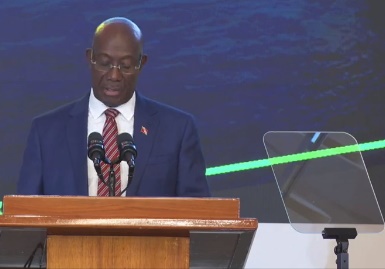
Prime Minister Dr. Keith Rowley, addressing the opening of Guyana’s International Energy Conference and Expo, told more than 1,200 delegates that crude oil, which was once seen as being at the margins of the region, has become a focal point with significant discoveries in Guyana, Suriname, French Guyana, Belize, and Trinidad and Tobago.
He said beyond this. There is considerable interest by significant oil and gas companies prospecting off the coasts of Barbados, Grenada, Bahamas, Cuba, Jamaica, and the Dominican Republic.
Rowley said exploration success by new Caribbean entrants in the petroleum industry could be a game changer for the Caribbean region.
He told the conference that is being held under the theme “Harnessing Energy for Development” and aims to facilitate the exchange of ideas, propositions, and plans for fundamental advances in the energy sector that .fossil fuels, namely oil, and gas, will remain the dominant energy source in the near to medium term.
“Regional availability and infrastructure will determine how countries expand their domestic energy supplies. Industry innovation for fossil fuels and renewable sources will continue to increase energy supply and energy efficiency, thereby improving energy security and reducing greenhouse gas emissions. “
Rowley said global trends such as climate change are forcing a rethinking of investment, especially in the light of a reshuffling of global economic activity and significant demand growth in the developing world.
“However, fossil fuels are still the main energy source for the world’s economic engine and are cost-effective. It is resilient and affordable energy that creates economic growth. Therefore, climate change should not prevent developing countries from using fossil fuels as energy sources in pursuit of economic growth.”
The Trinidad and Tobago prime Minister said it is interesting to note that during the rethink, in so far as circumstances demand, some developed countries have fired up their old coal-burning plants and have declared hitherto despised nuclear power as “clean energy.”
“The Caribbean response is to designate natural gas as the clean energy, reserve our right and willingness to continue to explore for and market oil resources, and invest in green energy and technologies as far as we can.
“We will continue to make the case to the major global polluters to encourage investment in green initiatives identified within the region. We in the Caribbean are not alone in defending our energy interests,” Rowley said, noting the statement by the Pulitzer prize winner Daniel Yergin who had pointed out that in the 1990s, before shale, gas never accounted for more than 17 percent of electricity generation by 2019 gas had risen to 38 percent and continues to rise.
Rowley said that the regional energy landscape needs to equip every country to meet the energy security requirements of the region. He said a cooperative approach allows for shared risks and diversified perspectives and will facilitate the development and execution of innovative solutions to the challenges associated with the energy demand for the region.
“It is with this recognition that Trinidad and Tobago has taken a deliberate policy to engage our regional neighbors in developing economic cooperation in the energy sector. To this end, we have executed unitization agreements with the Government of the Bolivarian Republic of Venezuela, the Government of Barbados, and the Government of Grenada, which will allow for the exploration of hydrocarbon resources in the maritime boundaries shared with our neighbors.”
Rowley said Port of Spain had executed a Memorandum of Understanding with Guyana and the Haitian Government on cooperation in the energy field.
He said Trinidad and Tobago had also executed a head of agreement with Venezuela for the development of the Dragon Field located in the eastern end of the Mariscal Sucre area of Venezuela to facilitate the sale of natural gas for supply, by pipeline, to the domestic market and the LNG facility located in Trinidad and Tobago.
Rowley said the progress in the development of the Dragon field was disrupted and delayed by United States sanctions against Venezuela, and following the request by Port of Spain, the US Treasury Department recently granted the Government an initial two-year (OFAC) license to develop the Dragon field to enhance Caribbean Energy security.
“In today’s economic environment, however, investments in enabling infrastructure and technology can be costly, even prohibitive. Trinidad and Tobago has the energy infrastructure to monetize hydrocarbon resources produced by its Caribbean neighbors.”
Rowley said Trinidad and Tobago possesses ten ammonia plants, seven methanol plants, four LNG plants, an iron and steel complex which, at peak performance, utilized as feedstock four bcf of natural gas per day, and an oil refinery that processed up to 140,000 barrels of oil per day.
He said Trinidad and Tobago’s current natural gas production averages 2.8 bcf per day, and the country is still exploring the market for a user for the oil refinery.
“Trinidad and Tobago, therefore, provides a viable option for those countries that wish to optimize the monetization of their hydrocarbon resources without incurring the substantial capital expenditure. The proposed Dragon Gas Project with the Bolivarian Government of Venezuela is an example of Government to Government cooperation in monetizing natural gas resources.
“We are open to discussion with our other Caribbean neighbors on the monetization of their hydrocarbon resources in Trinidad and Tobago. We would also wish to assist you in developing programs to meet the necessary training needs of your energy personnel.”
Rowley told the conference that Trinidad and Tobago possesses several non-governmental and Government agencies that have been meeting the human resource development needs of the energy and industrial sectors of Trinidad and Tobago and emerging oil and gas economies.
“As an emerging central oil and gas producing region, we have a window of opportunity to take a proactive approach to leverage our collective knowledge and expertise to optimize new opportunities in the future.
“Linking the energy and industrial transformations to a collaborative economic strategy would ensure that the region makes the most out of its abundant oil and gas resources. We must use our energy resources to benefit our people, build resilience and scale in our economies, and create energy security for the region.
“I am confident that the spirit of community, which has been key to our success as the oldest surviving integration movement in the developing world, will foster and augment the level of cooperation that can make the Caribbean an economic force in the region,” Rowley added.









 and then
  countries in further developing their oil and gas)