






































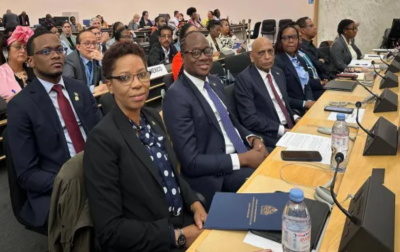
GENEVA, CMC -Caribbean Community (CARICOM) countries Tuesday reiterated their call for reparatory justice for the trans Atlantic slave trade, saying their position is grounded in responsibility and equity.
Guyana’s Minister within the Ministry of Culture, Youth and Sports, Steven Jacobs, speaking on behalf of the 15-member regional integration grouping, expressed “strong support” for the Fifth Session of the Permanent Forum of People of African Descent, which discussed “Reparations, Sustainable Development and Economic Justice”.
“We meet at a moment when the pages behind us are well known, but the next chapter remains unwritten,” Jacobs said, adding that the story of people of African descent has often been shaped by injustice, chapters of dispossession, chapters of exclusion, chapters whose consequences continue to dictate present realities.
Jacobs said the recent recognition by the United Nations General Assembly of slavery and the transatlantic trade in enslaved Africans as the gravest crimes against humanity places an essential truth on record.
“But acknowledgment alone does not resolve injustice. If left unaddressed, its effects will continue to shape opportunity, access, and development,” Jacobs said, noting that for the CARICOM states, this is a lived reality.
“Our call for reparatory justice is therefore grounded in responsibility and equity. Through the 10-Point Plan for Reparatory Justice, we continue to advance an evolving framework rooted in accountability, development, and partnership.
“We also welcome the growing momentum at the international level, including the Accra Proclamation, and the strengthening of collaboration between Africa and the Caribbean. These efforts reflect a recognition that this is a shared history, and that the next chapter must be shaped through shared action.”
Jacobs said that the legacies of enslavement and colonialism remain embedded in global systems, reflected in persistent economic imbalances and constrained development pathways. He said that for Small Island Developing States (SIDS), these challenges are further intensified by climate change.
”Addressing these interconnected realities requires coherence across reparatory justice, reform of the international financial architecture, and urgent, equitable climate action,” Jacobs said, adding, “the Second International Decade must therefore be a decade of delivery, where commitments translate into measurable progress in the lives of people of African descent.
”CARICOM remains committed to working constructively with this Forum and the wider international community to ensure that the next chapter is not written for people of African descent. Still, by them and with them and in justice to their past, present, and future,” Jacobs told the Forum.










 and then
  countries Tuesday reiterated their call for reparatory justice for the trans Atlantic slave trade, saying their position is grounded in responsibility and equity)