

















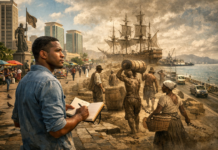

















CASTRIES, St. Lucia, CMC – One of the great dangers of the present age is not simply that history is forgotten. It is that history persists even after memory has failed. We may no longer remember the sequence of events, the names of treaties, the origins of institutions, or the older struggles between temporal power and moral authority.
But the patterns remain. The instincts remain. The theatre of power remains. And because memory has weakened while appetite has not, history returns not as wisdom but as repetition.
That, I believe, is one of the most useful lenses through which to read our present geopolitical condition.
We are living through a period of turbulence in which governments around the world are increasingly advancing fictions to justify actions that would previously have required greater restraint, greater shame, or greater argumentative rigor. The fiction may be national security. It may be civilizational destiny.
It may be the will of the majority. It may be theological righteousness. It may be cultural survival. But the structure is familiar: power first creates a narrative of necessity, and then asks institutions, citizens, and even conscience itself to ratify it.
This is why history remains so important even when public memory becomes thin. History reminds us that power has always sought moral language to dignify its appetites. It does not like to appear naked. It clothes itself in duty, providence, protection, destiny, and order.
In that sense, the current geopolitical moment is less unprecedented than many suppose. The surface technologies are new; the underlying political grammar is ancient.
We see this in the retreat from multilateralism and the growing strain on the international order. The United Nations itself has warned that multilateral peace and security efforts are under “unprecedented and significant strain,” while governments across Europe and elsewhere are openly speaking of “crumbling” alliances and a deteriorating world order. What is often presented as realism in this context is, in fact, a rehabilitation of older doctrines of raw advantage: spheres of influence, coercive trade leverage, selective legality, and the re-sacralization of state interest.
This is where the phrase “the persistence of history despite the loss of memory” becomes especially useful. Many contemporary societies imagine themselves as modern precisely because they have forgotten how old their political behaviors are. They think they are improvising when in fact they are reenacting.
The contest between authoritarian political ideology and religious prescription is a case in point. There is a temptation to see each confrontation between church and state as unique to its own time. Yet the deeper pattern is recurring.
Temporal power periodically reaches a point at which it can no longer tolerate an independent moral tribunal standing outside itself. It may accept religion as ornament, as ceremony, as civilizational branding. But it grows impatient when religion insists on judgment.
That is why Henry VIII remains such a useful historical reference. His break with Rome was not, in the first instance, a revolt against religion as such. It was a refusal of external moral constraint upon sovereign will. The English church, once separated from Rome, became, in effect, subject to the crown, with the royal supremacy enacted by law and enforced by treason statutes. Britannica’s account is blunt: the church effectively became a spiritual department of state under the king’s authority.
That episode matters because it reveals something enduring: rulers do not always seek to abolish religion. Often, they seek to nationalize it, discipline it, or reduce it to a legitimating arm of political power. The issue is not belief alone. It is a jurisdiction. Who has the right to define the moral limits of state action? Who speaks for conscience when the sovereign speaks in the language of necessity?
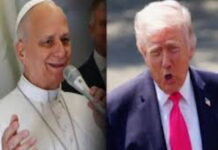
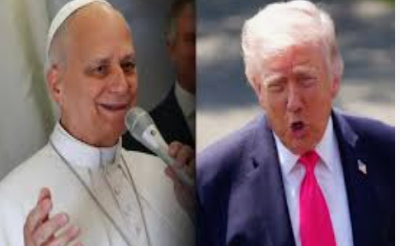
This is why the contemporary tension between sections of nationalist politics in the United States and the Vatican deserves attention. It should not be caricatured, and it should certainly not be treated as a simple replay of Tudor England. History does not repeat mechanically. But it does echo.
In 2025, Pope Francis publicly supported U.S. bishops in defending the rights and dignity of migrants, warning against deportation regimes that disregard the humanity of those affected. The Vatican’s letter of February 10, 2025, explicitly called for a society more fraternal, inclusive, and respectful of the dignity of all, especially migrants and families living in fear.
In April 2025, during Vice President J.D. Vance’s visit to the Vatican, the Holy See acknowledged cordial relations but also an “exchange of opinions” over migrants, prisoners, and international conflicts, while Reuters reported that Francis had described the administration’s immigration crackdown as a “disgrace.”
The tension did not end there. In April 2026, Pope Leo reiterated his opposition to war. He warned that democracy, without a moral foundation, can degenerate into “majoritarian tyranny” or become a mask for the dominance of economic and technological elites. Reuters and Vatican News both reported this in the context of public criticism from President Trump after papal interventions on war and international morality.
That language is important. It goes to the heart of the matter. The Vatican is not merely disputing particular policies. It is contesting an anthropology. It is asking whether political power still recognizes a moral order beyond electoral victory, beyond border enforcement, beyond military assertion, beyond the passions of the crowd. In other words, it is reviving an old claim: that not everything legal is therefore just, and not everything majoritarian is therefore moral.
This is where the parallel with Henry VIII becomes illuminating, though not identical. Henry’s quarrel with Rome emerged from dynastic and sovereign concerns, yet it widened into a constitutional revolution in which the state sought supremacy over spiritual authority. Some of today’s nationalist movements exhibit a similar impatience with any transnational or universal moral claim, whether it comes from international law, multilateral institutions, or religious bodies. The objection is not simply that these institutions disagree. It is that they presume to judge.
That is the real affront.
The modern authoritarian impulse does not always march under overtly anti-religious banners. Quite often, it seeks religious endorsement. It prefers a compliant church, a patriotic church, a civilizational church, a church that blesses the nation rather than interrogates it. Once again, the issue is not whether religion exists, but whether it remains capable of contradiction.
The same logic extends beyond church-state relations into geopolitics more broadly. States increasingly construct narratives that transform ambition into necessity and coercion into order.
Trade pressure becomes patriotic renewal. War becomes preemption. Mass exclusion becomes sovereignty. Institutional weakening becomes efficiency. Historical grievance becomes perpetual license. In each case, a fiction is advanced—not necessarily because leaders believe it fully, but because power requires a vocabulary through which self-interest can appear morally serious.
History throws sharp light on this. We have seen empires justify conquest as civilization, colonial extraction as uplift, racial hierarchy as science, and geopolitical dominance as peace. The vocabulary changes; the conceit remains. When memory is weak, people experience these maneuvers as new. History tells us they are not new at all. They are ancient methods wearing contemporary clothing.
This matters enormously for small states, especially in the Caribbean. We are often told that the strong are merely being realistic and that the weak must adapt to a harsher world. But small states cannot afford historical amnesia. We know too well what happens when power is wrapped in fiction. We know what it means when legal order is selectively invoked, when universal principles are applied asymmetrically, when larger actors convert pressure into doctrine and then demand acquiescence in the name of stability.
For us, memory is not a luxury. It is strategic equipment.
And yet we must go further. It is not enough to remember the injury. We must remember the pattern. The lesson of history is not simply that powerful states behave badly. That is too crude and too easy. The deeper lesson is that every political order is tempted to confuse power with providence. Every order is tempted to make success its own moral proof. Every order is tempted to subordinate truth to mobilization.
That is why the persistence of history despite the loss of memory is both a warning and an opportunity.
It is a warning: societies that forget their political inheritance become susceptible to old manipulations in new forms. But it is also an opportunity because history, properly read, restores discernment. It helps us recognize the moment when sovereignty becomes idolatry, when religion becomes an instrument, when democracy becomes mere arithmetic, and when national purpose detaches itself from human dignity.
The present global turbulence is therefore not only a contest of armies, markets, or tariffs. It is also a contest over whether there remains any authority—moral, legal, spiritual, historical—that can say to power: thus far and no further.
That question is not abstract. It is unfolding in arguments over migrants, over war, over sovereignty, over the meaning of democracy, and over the right of institutions such as the Vatican, the United Nations, and regional bodies to speak in a register beyond strategic interest alone. The Holy See’s recent insistence on the dignity of migrants, its warnings against majoritarian tyranny, and its critique of war are all part of that larger struggle.
So what, then, is required of us?
First, historical literacy is not an ornament, but a civic defense. People unable to identify the old habits of power will repeatedly submit to them.
Second, moral courage in public institutions. The moment institutions cease to contradict power, they become extensions of it.
Third, humility in statecraft. Governments must govern, yes. Borders must be managed. Security must be preserved. But whenever necessity is invoked, one must ask: necessary for whom, at what cost, and under what moral limit?
And finally, for small states such as ours, a disciplined commitment to principle. In a world sliding back toward coercive hierarchies, our survival depends not on sentiment but on clarity: clarity about history, clarity about power, and clarity about the difference between realism and surrender.
History persists whether we remember it or not. The question is whether we will meet its return with wisdom or with amnesia. If we forget, we shall still relive. But if we remember rightly, then history need not be a prison. It can become instruction.
And perhaps that is the task of our time: to recover memory before repetition hardens into fate.
*Dr. Didacus Jules, the Director General of the Organization of Eastern Caribbean States (OECS), has dedicated this article to his A-level history teacher, Robert Harvey.











 and then