
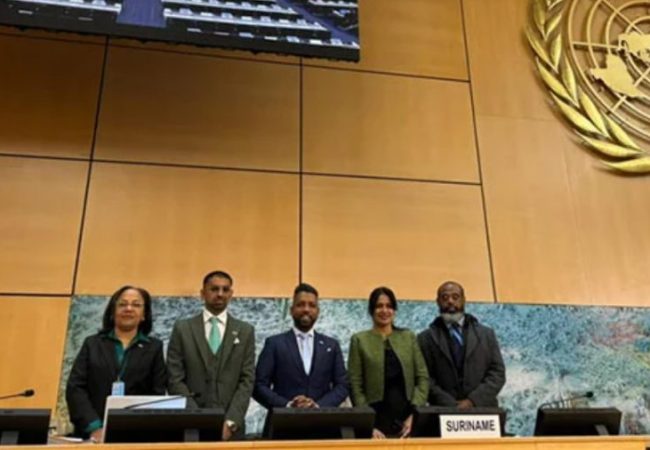
Suriname acknowledges a backlog in implementing its human rights obligations.
GENEVA, CMC – Suriname on Monday acknowledged that it still has important human rights obligations that have not been fully met, including the legal recognition of the collective fundamental rights of indigenous and tribal peoples and the establishment of an independent human rights institute.
The human rights record of the Dutch-speaking Caribbean Community (CARICOM) country was examined by the United Nations Human Rights Council’s Universal Periodic Review (UPR) Working Group for the fourth time, and Justice and Security Minister Harish Monorath said the government intends to have the national human rights institute operational by 2027.
Monorath is leading the delegation making the presentation, and he acknowledged that while Paramaribo has made progress with legislation and institutional reforms, it is still behind on implementing some.
He said that adopting laws is insufficient on its own and that institutions, financial resources, and accessible procedures must also be in place to protect rights in practice.
The Jennifer Geerlings-Simons administration acknowledged that one of the most significant backlogs concerns the collective rights of indigenous and tribal peoples. It said that the international rulings in the Moiwana, Saramaka, and Kaliña and Lokono cases have not yet been fully implemented.
The National Assembly is still considering the legislative proposal on the collective rights of indigenous and tribal peoples. In May 2026, the Land Rights Project 2026–2030 was launched with the support of the UN Development Program (UNDP). This is intended to contribute to consultation with communities and the development of a legal framework.
Monorath spoke of the importance of meaningful community involvement in decisions regarding their territories, with attention to the principle of free, prior, and informed consent. The government acknowledges that it still needs to implement important recommendations in this area.
The establishment of an independent National Human Rights Institute has also not yet been finalized. According to Monorath, a legal basis for this has existed since 1986, but work is underway to modernize the legal framework.
The National Assembly’s Human Rights Committee is preparing legislation. A major bottleneck is funding. The government is investigating a model in which the Ministry of Justice and Security financially supports the start-up, after which the institute must function independently.
Monorath said independence must be legally established and evident in funding, appointment procedures, and administrative autonomy. The government aims to have the institute fully operational by 2027.
Another outstanding issue is establishing a Children’s Ombudsman. Although the law in question entered into force in January 2025, the institution is not yet functioning. The government has since established a working group to make the organizational and administrative preparations.
Monorath said that independent leadership, sufficient resources, and accessible complaint procedures, among other things, must be arranged.
The approach to domestic violence also continues to require attention, and while the National Council for Domestic Violence was established in November 2025 and has drafted a concept policy framework for 2026–2028, the proposed amendments to the law against domestic violence, including stronger protection against psychological violence, have been submitted to the Council of State.
But Monorath told the UN body that Suriname has made progress in several areas, including expanding the judiciary. He said that on October 23, 15 new judges were installed, bringing the total number to 45.
In addition, eleven judicial officers in training are expected to complete their program in 2027.
The government is also reporting progress on freedom of expression, freedom of the press, and access to government information. It said the legislative proposal regarding the public disclosure of administrative information is still under consideration.
 and then