
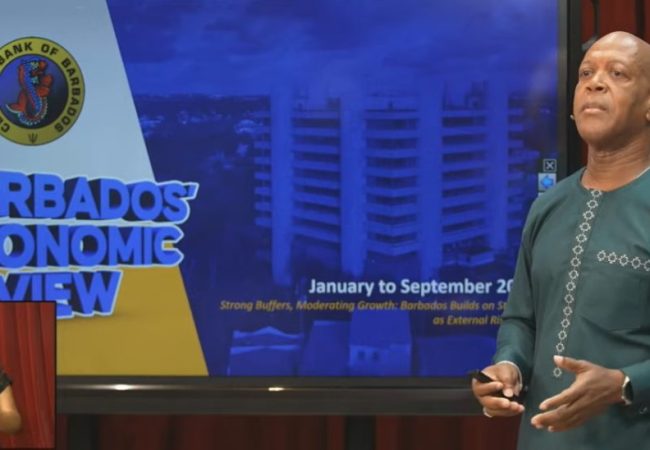
Central Bank says outlook for Barbados economy remains positive.
BRIDGETOWN, Barbados, CMC – The Central Bank of Barbados (CBB) Wednesday said the outlook for the local economy remains positive, but sustaining growth will require stronger traded-sector performance and more effective investment execution.
Central Bank Governor, Dr. Kevin Greenidge, reviewing the performance of the Barbados economy for the first nine months of this year, said encouraging forward tourism bookings and increased planned airlift provide opportunities for stronger activity during the final quarter of 2026.
“However, shorter visitor stays, uncertainty in major tourism markets, higher international costs and delays in investment projects remain important risks. Barbados’ fiscal, external and financial buffers provide a strong foundation for continued economic stability.
“Translating that stability into faster and more balanced growth will require sustained investment, higher productivity, improved export competitiveness and stronger foreign -exchange earnings,” he told reporters.
According to CBB data, Barbados sustained economic growth during the first nine months of 2026, as growth in the non–traded sector offset weaker performance in the traded sectors. The figures show that the non-traded sector sustained economic growth during the first nine months of 2026, but weaker traded-sector activity narrowed the expansion. Real gross domestic product (GDP) grew by an estimated 1.4 percent, compared with 2.3 percent in the corresponding period of 2025. Although the overall growth rate remained unchanged from the first half of 2026, its composition shifted further toward non-traded activity.
The non-traded sector expanded by 1.8 percent, compared with 1.6 percent at midyear, as business and other services contributed about one percentage point to overall growth and wholesale and retail trade a further 0.4 percentage point. Together, these gains more than offset a marginal decline in construction.
In contrast, the traded sector contracted by 0.6 percent, following modest growth of 0.4 percent at midyear, as agricultural output fell sharply in the third quarter and tourism activity weakened. Non-traded activity therefore continued to support economic activity, but stronger traded-sector performance will be essential to broadening the sources of growth.
Domestic activity therefore remained the principal source of growth, although the expansion became less broadly based in a challenging international environment.
Greenidge said that tourist arrivals demonstrated resilience, but shorter visitor stays constrained the sector’s contribution to economic growth. He said long-stay arrivals increased marginally by 0.2 percent, while in-transit cruise arrivals rose by 17.3 percent.
“However, shorter average stays reduced visitor nights, contributing to a 1.2 percent decline in tourism value added. Higher hotel room rates supported accommodation revenues, although occupancy levels fell. These developments highlight the importance of strengthening visitor spending and tourism earnings, alongside growth in arrival numbers.”
The CBB said that September recorded the strongest growth of the year, as the Caribbean Premier League tournament drew visitors mainly from Trinidad and Tobago, Guyana and the United States.
“Long -stay arrivals rose by 13.1 percent and visitor nights by 11.6 percent in the month, although this boost could not offset weaker arrivals and shorter stays earlier in the year. A shift in the mix of markets contributed to shorter average stays: the United Kingdom, a market of longer -staying visitors, accounted for 26.9 percent of arrivals, compared with 29.4 percent a year earlier.”
The CBB said that reduced winter airlift contributed significantly to the decline from the United Kingdom.
It said arrivals from the United Kingdom fell by 12,484, or 8.2 percent. Seat capacity from the United Kingdom and Ireland fell by 11 percent, reflecting a 15 percent reduction by Virgin Atlantic and a 5 percent decline by British Airways.
“Capacity stabilized over the summer, and arrivals from the United Kingdom in the third quarter edged above their level a year earlier. Arrivals from the United States declined by 3,075, or 1.7 percent, as sharply higher airfares and a nine per cent reduction in seat capacity weighed on demand during the first half, before recovering slightly in the third quarter.”
Greenidge said labor market conditions showed mixed results, while inflation remained moderate despite some upward pressure. T
CBB data showed the unemployment rate rose to 6.6 percent in the second quarter of 2026, from 6.1 percent a year earlier, as labor force growth outpaced employment gains.
However, Greenidge said unemployment claims fell by six per cent from January to September, providing a more encouraging recent indicator.
He said the 12-month moving-average inflation rate reached 1.5 percent in July, up from 0.5 percent a year earlier, reflecting higher prices for food, utilities and several household services.
Greenidge said Mia Mottley’s government measures to contain domestic fuel and electricity costs continued to cushion the impact of rising international energy prices.
The CBB said that the current account deficit narrowed, largely because higher corporate tax receipts lifted current transfer credits. During the first nine months of 2026, the deficit declined by BDS$181.5 million (One BDS$ = US$ 0.50) to BDS$532. 6 million. A BDS$244.9 million increase in net current transfers, linked to higher foreign-currency corporate tax receipts, drove that result.
Greenidge said that those inflows, together with a marginally narrower merchandise trade deficit, more than offset weaker services and income balances.
“While favorable, the improvement did not reflect a broad strengthening of export earnings, reinforcing the importance of expanding sustainable foreign -exchange inflows,” he added.
Barbados maintained substantial international reserves, notwithstanding a decline in external financing inflows.
Gross international reserves (GIR) stood at BDS$2.8 billion at end-September 2026, equivalent to 22.8 weeks of import cover and comfortably above the 12-week international benchmark.
The CBB said that after rising in the first half, reserves declined by BDS$309.6 million in the third quarter, leaving them BDS$217.8 million below their end-December 2025 level, as lower foreign investment and other financial inflows did not fully offset the economy’s external financing needs.
Greenidge said that the reserve position continues to provide an important safeguard against external shocks, while highlighting the need to strengthen tourism earnings, investment inflows and external competitiveness.
The CBB said that the government maintained substantial fiscal and primary surpluses, although expenditure growth exceeded revenue gains during the first half of the financial year 2026/27.
It said the primary surplus reached BDS$507.5 million, exceeding the end-September program floor by BDS$137.5 million, while the overall fiscal surplus totaled BDS$150.1 million.
Greenidge said that both surpluses narrowed relative to the corresponding period of financial year 2025/26, as higher spending on goods and services, transfers and capital projects more than offset increased revenue collections.
“Part of the increase in transfers reflected government measures to limit the impact of higher international fuel prices on households and businesses. Corporate income tax receipts, including collections under the Qualified Domestic Minimum Top-up Tax, continued to support fiscal performance.
“Sustained surpluses provide an important foundation for debt reduction and priority investment, although the timing and persistence of exceptional tax receipts warrant careful consideration.”
Greenidge said that economic growth and sustained fiscal discipline kept the public debt ratio on its downward trajectory.
According to the official figures, gross public sector debt stood at approximately BDS$15.3 billion at end-September 2026, remaining BDS$148.2 million below the program ceiling.
The debt -to-GDP ratio declined to an estimated 93.6 percent, from 94.8 percent at the end of financial year 2025/26.
“Although the nominal debt stock increased modestly, growth in nominal GDP reduced the debt burden relative to the size of the economy, sustaining progress towards the medium -term debt objective,” Greenidge added.


 and then